Lipids
Lipids are mostly nonpolar, so they are hydrophobic.
Part 1 · Hook
Why this matters
Butter is solid on the counter; olive oil pours. Both are fats made of the same three kinds of atoms, in the same basic shape. The difference is a few bends in their carbon chains. The same bends decide whether the thin oily film around every one of your cells stays flexible in the cold, which is why fish in icy water build their cell boundaries from the bent chains found in oils rather than the straight chains of butter.
Part 2 · Before you start
What this builds on
Part 3 · Prerequisite check
Quick check before you start
1. Why do nonpolar molecules not dissolve in water?
- Water molecules hydrogen-bond to each other and push nonpolar molecules together
- Nonpolar molecules carry a full negative charge that repels water
- Nonpolar molecules are always larger than water molecules
Show the answer
Nonpolar molecules have no partial charges for water to grab, so water molecules bond to each other instead and squeeze the nonpolar molecules into droplets: they are hydrophobic.
- Correct: Water molecules hydrogen-bond to each other and push nonpolar molecules together:
- Nonpolar molecules carry a full negative charge that repels water:
- Nonpolar molecules are always larger than water molecules:
2. Which functional group makes a molecule act as an acid?
- Hydroxyl, –OH
- Carboxyl, –COOH
- Methyl, –CH3
Show the answer
A carboxyl group releases H+ and becomes –COO−. Hydroxyl is polar but not acidic; methyl is nonpolar.
- Hydroxyl, –OH:
- Correct: Carboxyl, –COOH:
- Methyl, –CH3:
3. How many water molecules are released when three molecules are each joined to a fourth by dehydration synthesis?
- One
- Two
- Three
Show the answer
Each new covalent bond made by dehydration synthesis releases one water, so three bonds release three waters.
- One:
- Two:
- Correct: Three:
Part 4 · See it
See it first
Part 5 · Step by step
How it works, step by step
- Lipids are built mostly of C–H and C–C bonds, which are nonpolar.Lipids are hydrophobic: they do not dissolve in water, and water pushes them together.
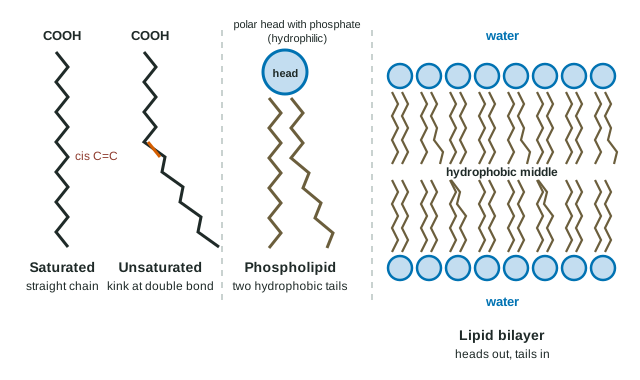
- A fatty acid is a long hydrocarbon chain with a carboxyl group at one end; a saturated chain has only single C–C bonds and is straight.Straight chains pack tightly side by side, attract each other strongly, and need more heat to melt: saturated fats such as butter are solid at room temperature.
- A cis double bond in an unsaturated chain puts a fixed bend (kink) in it.Kinked chains cannot pack tightly, attract each other less and melt at lower temperatures: unsaturated fats such as olive oil are liquid.
- A phospholipid has a polar, phosphate-containing head and two nonpolar fatty acid tails.In water, phospholipids arrange themselves into a bilayer, heads facing the water on both sides and tails hidden in the middle: the basic structure of every cell membrane.
- Triglycerides are made of three fatty acids joined to glycerol, rich in C–H bonds and low in oxygen.They store about twice as much energy per gram as carbohydrates, which makes fat the body's long-term energy store.
Part 6 · Key ideas
Key ideas
- A triglyceride (fat or oil) is glycerol + three fatty acids, joined by dehydration synthesis (three waters released). Lipids are not polymers: there is no repeating chain of monomers.
- Saturated: no C=C double bonds, chains "saturated" with hydrogen, straight, solid at room temperature (animal fats). Unsaturated: one or more C=C double bonds, kinked, liquid (plant and fish oils).
- Phospholipids are amphipathic: a hydrophilic head and hydrophobic tails. That is why they form bilayers, and cell membranes are phospholipid bilayers.
- Steroids are lipids built from four fused carbon rings. Cholesterol sits in animal cell membranes; steroid hormones such as testosterone and estrogen act as signals.
Part 7 · Misconception
A common mistake
The wrong idea: Unsaturated fats are liquid because they have fewer hydrogen atoms, which makes them lighter.
What actually happens: The missing hydrogens matter only because of the shape they leave behind. Each cis double bond bends the chain, so neighboring chains cannot pack closely; fewer, weaker attractions between them mean they melt at a lower temperature. A trans double bond leaves the chain nearly straight, so a trans fat packs almost like a saturated one and is solid, even though it has the same number of hydrogens as its cis twin.
Part 8 · Check yourself
Check yourself
Exam-style questions. Anything you miss goes into your review queue.
1. Phospholipids are shaken into a beaker of water. Which arrangement are they most likely to form?
- A double layer with tails facing each other in the middle and heads facing the water on both sides
- A double layer with heads facing each other in the middle and tails facing the water on both sides
- A single layer lying flat on the bottom of the beaker, with heads and tails pointing in random directions
- Separate molecules spread evenly through the water, like dissolved salt
Show the answer
Amphipathic molecules arrange themselves so that hydrophilic parts touch water and hydrophobic parts touch each other. For a two-tailed phospholipid that is a bilayer, the basis of every cell membrane.
- Correct: A double layer with tails facing each other in the middle and heads facing the water on both sides: Correct. This bilayer keeps the hydrophobic tails away from water and the hydrophilic heads in contact with it.
- A double layer with heads facing each other in the middle and tails facing the water on both sides: This would put the hydrophobic tails in contact with water, the arrangement water pushes them out of.
- A single layer lying flat on the bottom of the beaker, with heads and tails pointing in random directions: Random orientation would expose tails to water; the molecules arrange themselves to hide them.
- Separate molecules spread evenly through the water, like dissolved salt: The long nonpolar tails keep phospholipids from dissolving as single molecules.
2. Why do phospholipids form bilayers in water while triglycerides form oily droplets instead?
- Triglycerides are heavier than phospholipids, so they sink to the bottom and pool together in droplets.
- Phospholipids have a polar head to face the water; triglycerides have none, so they cluster away from water.
- Triglycerides have three tails, which are too many to fit in the middle of a bilayer.
- Phospholipids are saturated and triglycerides are unsaturated, so phospholipids alone pack into flat sheets.
Show the answer
A bilayer needs an amphipathic molecule: a hydrophilic end to face water and a hydrophobic end to hide. Phospholipids have both; triglycerides are almost entirely hydrophobic, so they gather into droplets.
- Triglycerides are heavier than phospholipids, so they sink to the bottom and pool together in droplets.: Triglycerides are less dense than water (oil floats), and weight does not decide the arrangement.
- Correct: Phospholipids have a polar head to face the water; triglycerides have none, so they cluster away from water.: Correct. With nothing hydrophilic to face outward, triglycerides minimize contact with water by pooling into droplets.
- Triglycerides have three tails, which are too many to fit in the middle of a bilayer.: The number of tails is not the problem: with no hydrophilic part, a triglyceride has nothing to place against the water.
- Phospholipids are saturated and triglycerides are unsaturated, so phospholipids alone pack into flat sheets.: Both can be either saturated or unsaturated; how saturated the tails are affects how tightly they pack, not whether a bilayer forms.
Data table
Melting points of eight fatty acids
The table lists published melting points for eight fatty acids found in foods. "Cis" and "trans" describe the shape around a double bond: a cis double bond bends the chain; a trans double bond leaves it nearly straight.
| Fatty acid | Carbons in chain | C=C double bonds | Melting point (°C) |
|---|---|---|---|
| Lauric | 12 | 0 | 44 |
| Myristic | 14 | 0 | 54 |
| Palmitic | 16 | 0 | 63 |
| Stearic | 18 | 0 | 70 |
| Oleic | 18 | 1 (cis) | 13 |
| Elaidic | 18 | 1 (trans) | 45 |
| Linoleic | 18 | 2 (cis) | −5 |
| α-Linolenic | 18 | 3 (cis) | −11 |
3. What do the four saturated fatty acids show about chain length and melting point?
- Melting point rises as the chain gets longer.
- Melting point falls as the chain gets longer.
- Chain length has no clear effect, since the four are solid at room temperature.
- Melting point rises with chain length, but the 18-carbon acid alone is solid at room temperature.
Show the answer
Hold double bonds constant (zero) and compare lengths: each extra two carbons raises the melting point by roughly 7 to 10 °C. Longer straight chains have more length over which to attract their neighbors.
- Correct: Melting point rises as the chain gets longer.: Correct. 12, 14, 16 and 18 carbons melt at 44, 54, 63 and 70 °C.
- Melting point falls as the chain gets longer.: The values go up, not down, from lauric (12 carbons, 44 °C) to stearic (18 carbons, 70 °C).
- Chain length has no clear effect, since the four are solid at room temperature.: All four are solid at room temperature, but their melting points still rise steadily with length.
- Melting point rises with chain length, but the 18-carbon acid alone is solid at room temperature.: All four melt above about 22 °C, so all four are solid at room temperature.
4. Stearic and oleic acids both have 18 carbons, but oleic acid melts 57 °C lower. Which explanation is best?
- Oleic acid has two fewer hydrogen atoms, which makes each molecule lighter and easier to melt.
- A cis double bond bends oleic acid's chain, so the chains cannot pack closely and attract each other less.
- The double bond in oleic acid makes the chain polar, so it forms hydrogen bonds with water molecules instead.
- Oleic acid's double bond is weaker than a single bond, so it breaks when the fatty acid melts.
Show the answer
Melting pulls molecules apart, overcoming the attractions between them. A cis kink keeps chains from packing, so there are fewer attractions to overcome.
- Oleic acid has two fewer hydrogen atoms, which makes each molecule lighter and easier to melt.: Two hydrogens change the mass by about 1%, far too little to explain 57 °C; elaidic acid has the same formula as oleic acid yet melts at 45 °C.
- Correct: A cis double bond bends oleic acid's chain, so the chains cannot pack closely and attract each other less.: Correct. Fewer, weaker contacts between bent chains mean less heat is needed to pull them apart.
- The double bond in oleic acid makes the chain polar, so it forms hydrogen bonds with water molecules instead.: A C=C double bond is nonpolar; melting point is measured on the pure fatty acid, with no water involved.
- Oleic acid's double bond is weaker than a single bond, so it breaks when the fatty acid melts.: Melting separates whole molecules from each other; no covalent bonds inside the chain break.
5. A student claims that chain shape, not the number of hydrogen atoms, is what lowers the melting point of unsaturated fatty acids. Which comparison in the table gives the strongest evidence for this claim?
- Stearic acid (70 °C) compared with lauric acid (44 °C)
- Oleic acid (13 °C) compared with α-linolenic acid (−11 °C)
- Oleic acid (13 °C) compared with elaidic acid (45 °C)
- Stearic acid (70 °C) compared with oleic acid (13 °C)
Show the answer
To isolate one factor, compare two molecules that differ only in that factor. Oleic and elaidic acids have identical formulas; only the cis or trans shape differs, and that alone shifts the melting point by 32 °C.
- Stearic acid (70 °C) compared with lauric acid (44 °C): Both are saturated; this comparison changes chain length, not shape.
- Oleic acid (13 °C) compared with α-linolenic acid (−11 °C): These differ in both the number of hydrogens and the number of kinks, so the two cannot be separated.
- Correct: Oleic acid (13 °C) compared with elaidic acid (45 °C): Correct. Same length and same number of hydrogens (one double bond each); only the shape differs, cis bent versus trans straight, and the melting points differ by 32 °C.
- Stearic acid (70 °C) compared with oleic acid (13 °C): This changes both the hydrogens and the shape at once, so it cannot show which one matters.
6. Which of these fatty acids would be liquid at a room temperature of 22 °C? Select all that apply.
- Lauric acid
- Palmitic acid
- Oleic acid
- Elaidic acid
- Stearic acid
Show the answer
A substance is liquid when the room is warmer than its melting point. Of these, only oleic acid (13 °C) qualifies; the others, including trans elaidic acid, melt above 22 °C.
- Lauric acid: Solid: it melts at 44 °C, above room temperature.
- Palmitic acid: Solid: it melts at 63 °C.
- Correct: Oleic acid: Liquid: it melts at 13 °C, below room temperature.
- Elaidic acid: Solid: as a straight trans chain it melts at 45 °C, despite its double bond.
- Stearic acid: Solid: it melts at 70 °C.
7. Across the saturated fatty acids from lauric (12 carbons) to stearic (18 carbons), by how many °C does the melting point rise, on average, for each 2 carbons added to the chain? Give your answer to one decimal place.
Type a number in °C.
Show the answer
Total rise: 70 − 44 = 26 °C. From 12 to 18 carbons is three steps of 2 carbons. 26 ÷ 3 = 8.67, which rounds to 8.7 °C per 2 carbons.
- Answer: 8.7 °C
Part 9 · Summary
Summary
Lipids are mostly nonpolar, so they are hydrophobic. Triglycerides (glycerol plus three fatty acids) store energy densely. Saturated fatty acids are straight and pack tightly, so they are solid at room temperature; cis double bonds in unsaturated fatty acids kink the chains, so they are liquid. Phospholipids have a hydrophilic head and two hydrophobic tails and form the bilayers of cell membranes. Steroids such as cholesterol and steroid hormones are built on four fused rings.
Part 10 · Up next
What comes next
Part 11 · Connections