Controls and what they rule out
A negative control (should be "no") rules out false positives from the method, materials or contamination.
Part 1 · Hook
Why this matters
A home test for fat says "yes" for every food you try, even plain water. Is everything fatty, or is the test broken? Without the right controls you cannot tell, and graders award a point only when you say exactly what your control rules out.
Part 2 · Before you start
What this builds on
Part 3 · Prerequisite check
Quick check before you start
1. Why does oil leave a lasting see-through spot on paper while water does not?
- Oil is a nonpolar lipid that does not evaporate at room temperature; water evaporates.
- Oil is more polar than water, so it bonds to the paper more strongly.
- Water is hydrophobic, so it is pushed out of the paper fibers.
Show the answer
Lipids such as triglycerides are nonpolar and do not evaporate at room temperature, so their spot stays. Water is polar and evaporates.
- Correct: Oil is a nonpolar lipid that does not evaporate at room temperature; water evaporates.:
- Oil is more polar than water, so it bonds to the paper more strongly.:
- Water is hydrophobic, so it is pushed out of the paper fibers.:
2. What is a control group?
- The group given the baseline condition, used for comparison
- Any factor kept the same in every group
- The group in which the independent variable is largest
Show the answer
A control group is a whole group at the baseline. A factor kept the same in every group is a controlled variable.
- Correct: The group given the baseline condition, used for comparison:
- Any factor kept the same in every group:
- The group in which the independent variable is largest:
Part 4 · See it
See it first
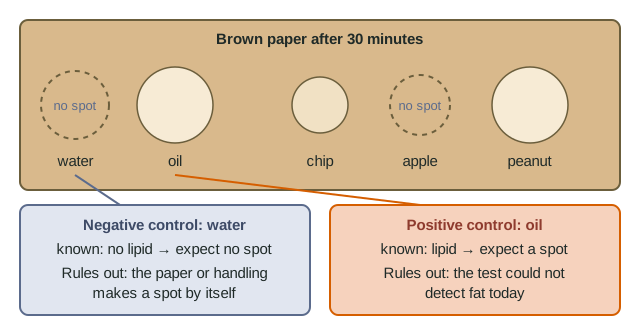
Part 5 · Step by step
How it works, step by step
- A test can go wrong in two directions: a "yes" when the substance is absent, or a "no" when it is present.You need one control for each kind of error.
- You run a sample known to lack the substance (water) through exactly the same steps.This negative control should give "no"; if it does, a "yes" from a food is not caused by the paper, handling or contamination.
- You run a sample known to contain the substance (vegetable oil) through the same steps.This positive control should give "yes"; if it does, a "no" from a food is believable, because the test is working.
- A control gives the wrong result (water turns positive).Every result from that run is suspect, so you find the cause (such as a contaminated wash tub) and repeat.
- Some other factor differs between your groups (sample mass, reading time).That confounding factor could explain the difference, so it must be held constant before the result can be credited to the independent variable.
Part 6 · Key ideas
Key ideas
- Worked example. Grease-spot test. Negative control: water, treated the same way. Justification: "Water has no lipid, so if it leaves no spot after 30 minutes, a lasting spot from a food is not caused by moisture or handling." Positive control: vegetable oil. Justification: "Oil is a known lipid, so a spot shows the test can detect fat today."
- To earn the point, a justification names what the control rules out. "Water is the control because it is the control" scores nothing.
- A confounding variable differs between groups and could change the dependent variable. Different pans, different sample masses or different reading times are classic examples.
- The control must go through every step the test samples go through. An untouched sheet of paper is not a negative control for a test that involves rubbing and wetting.
Part 7 · Misconception
A common mistake
The wrong idea: The control is the group where nothing happens, so any control will do.
What actually happens: A negative control is chosen to show the method does not make a positive by itself; a positive control is chosen to show the method can make a positive. Each rules out a specific error, and an answer must say which.
Part 8 · Check yourself
Check yourself
Exam-style questions. Anything you miss goes into your review queue.
Experimental setup
The grease-spot test
Fats and oils (lipids) are hydrophobic: they soak into paper and do not evaporate, leaving a see-through (translucent) spot. Water also makes paper see-through, but only until it evaporates. A class rubbed each sample onto brown paper, waited 30 minutes, then held the paper up to a light.
| Sample | Translucent spot after 30 min? |
|---|---|
| Distilled water | No |
| Vegetable oil | Yes, large |
| Crushed potato chip | Yes |
| Apple slice | No |
| Crushed peanut | Yes, large |
| Unknown white powder | Faint |
1. Which sample is the negative control, and what possibility does it rule out?
- Distilled water; it rules out that the paper or the procedure makes a lasting spot without any fat.
- Vegetable oil; it rules out that the test fails to detect fat on this paper on this day.
- Apple slice; it rules out that foods from plants contain fat, since apples come from plants.
- Distilled water; it rules out that the foods were contaminated with extra water before the test began on the paper.
Show the answer
A negative control should give no response. Water is treated exactly like the foods. Because it leaves no spot after 30 minutes, any lasting spot from a food cannot be blamed on wetness, the paper or the handling.
- Correct: Distilled water; it rules out that the paper or the procedure makes a lasting spot without any fat.: Correct: expected negative, treated identically, rules out a false positive from the method.
- Vegetable oil; it rules out that the test fails to detect fat on this paper on this day.: Oil is the positive control; it rules out a false negative.
- Apple slice; it rules out that foods from plants contain fat, since apples come from plants.: The apple is a test sample, not a control, and its result says nothing about other plant foods.
- Distilled water; it rules out that the foods were contaminated with extra water before the test began on the paper.: Water is the right sample, but it rules out a spot made by the method, not water in the foods.
2. Suppose the vegetable oil had left no spot. What could the class conclude about the apple's "No" result?
- Nothing reliable: the test failed to detect a known fat, so the apple could contain fat that was missed.
- The apple contains no fat, because its result matches the result for the vegetable oil.
- The apple contains more fat than the oil, because neither of them left a spot on the paper.
- The apple contains no fat, because the water also left no spot, which shows that the negative control worked properly.
Show the answer
The positive control checks that the test can give a "yes". If a known fat gives "no", the test is not working today (wrong paper, too little sample, wiped off), so other "no" results cannot be trusted.
- Correct: Nothing reliable: the test failed to detect a known fat, so the apple could contain fat that was missed.: Correct: a failed positive control makes negatives untrustworthy.
- The apple contains no fat, because its result matches the result for the vegetable oil.: Matching a failed positive control shows the test is broken, not that the apple lacks fat.
- The apple contains more fat than the oil, because neither of them left a spot on the paper.: Two blank results give no basis for ranking fat content.
- The apple contains no fat, because the water also left no spot, which shows that the negative control worked properly.: A working negative control rules out false positives; it does nothing to rule out false negatives.
3. A student checks the paper after 2 minutes instead of 30 and records "Yes" for the apple slice. What most likely explains this result?
- The apple's juice, which is mostly water, had not yet evaporated, so wetness made a spot that would have faded.
- The apple contains a large amount of fat, which slowly evaporates from the paper over the 30 minutes.
- Water is hydrophobic, so the apple's water soaked into the paper and stayed there like an oil would.
- Checking early made the test more sensitive, so the "Yes" at 2 minutes is the correct reading for the apple.
Show the answer
Water also makes paper translucent until it evaporates. Wetness is a factor that differs between juicy and dry foods, so reading early lets it produce a false positive. The 30-minute wait, checked by the water control, removes it.
- Correct: The apple's juice, which is mostly water, had not yet evaporated, so wetness made a spot that would have faded.: Correct: a temporary water spot, a false positive.
- The apple contains a large amount of fat, which slowly evaporates from the paper over the 30 minutes.: Fats do not evaporate at room temperature; that is why their spot lasts.
- Water is hydrophobic, so the apple's water soaked into the paper and stayed there like an oil would.: Water is polar and evaporates; lipids are the hydrophobic ones that stay.
- Checking early made the test more sensitive, so the "Yes" at 2 minutes is the correct reading for the apple.: Reading early adds false positives from water; the water control shows spots must last 30 minutes to count.
Data table
A starch test that went wrong
Iodine solution turns blue-black when it meets starch and stays orange-brown otherwise. A student added three drops of iodine to each test tube below. All tubes were rinsed in the same tub of wash water before use.
| Tube | Contents | Color after iodine |
|---|---|---|
| 1 | Starch solution | Blue-black |
| 2 | Distilled water | Blue-black |
| 3 | Potato extract | Blue-black |
| 4 | Table sugar dissolved in water | Blue-black |
| 5 | Vegetable oil | Pale blue-black film |
4. Which result shows that the experiment has a problem?
- Tube 2, because distilled water should stay orange-brown with iodine.
- Tube 1, because starch solution should stay orange-brown with iodine.
- Tube 3, because potato extract is expected to be free of starch.
- Tube 5, because vegetable oil should turn fully blue-black.
Show the answer
Distilled water is the negative control. It has no starch, so it should stay orange-brown. A blue-black result means starch got in from somewhere.
- Correct: Tube 2, because distilled water should stay orange-brown with iodine.: Correct: the negative control failed.
- Tube 1, because starch solution should stay orange-brown with iodine.: Starch solution is the positive control; blue-black is the expected result.
- Tube 3, because potato extract is expected to be free of starch.: Potatoes store a lot of starch; blue-black is expected.
- Tube 5, because vegetable oil should turn fully blue-black.: Oil is a lipid, not starch; it is not expected to turn blue-black.
5. What is the most likely cause of the blue-black color in the tubes of distilled water and sugar water?
- Starch carried over in the shared wash water coated every tube, contaminating them before the samples went in.
- Table sugar is a polysaccharide made of glucose, so it reacts with iodine just as starch does.
- Iodine turns blue-black on its own after several minutes in a tube, whether or not starch is present in the solution.
- Distilled water breaks down into starch when iodine is added, by dehydration synthesis of water molecules.
Show the answer
Every tube was rinsed in the same tub. Starch from the starch-solution tube or potato extract in that water would coat each tube, so even water and sugar test positive. The failed negative control reveals the contamination.
- Correct: Starch carried over in the shared wash water coated every tube, contaminating them before the samples went in.: Correct: a shared source of starch explains positives in tubes that should be negative.
- Table sugar is a polysaccharide made of glucose, so it reacts with iodine just as starch does.: Table sugar is sucrose, a disaccharide (glucose + fructose), not a polysaccharide; it does not give the starch color.
- Iodine turns blue-black on its own after several minutes in a tube, whether or not starch is present in the solution.: If iodine alone turned blue-black, it would be useless as a starch test; the positive and negative colors differ.
- Distilled water breaks down into starch when iodine is added, by dehydration synthesis of water molecules.: Water does not turn into starch; dehydration synthesis joins monomers such as glucose and needs them to be present.
6. A student tests whether saturated fats melt at higher temperatures than unsaturated fats. She buys butter from one store and olive oil from another, and heats each in a different pan on a different stove. Which factor is most likely to be confounding?
- The pans and stoves heat at different speeds, which could change the measured melting point.
- The type of fat, because saturated and unsaturated fats differ in their structure.
- The temperature at which each fat melts, which the student reads off a thermometer.
- The stores where the fats were bought, because one of them sells more expensive brands.
Show the answer
A confounding factor differs between groups and could affect the dependent variable. Different pans and stoves change how heat reaches each fat and how the temperature is read, so a difference could come from them rather than from the type of fat.
- Correct: The pans and stoves heat at different speeds, which could change the measured melting point.: Correct: it differs between groups and plausibly affects the result.
- The type of fat, because saturated and unsaturated fats differ in their structure.: Type of fat is the independent variable, the factor being tested.
- The temperature at which each fat melts, which the student reads off a thermometer.: Melting temperature is the dependent variable, the measured result.
- The stores where the fats were bought, because one of them sells more expensive brands.: Price differs, but price has no plausible effect on melting point; a confounding factor must also be able to change the result.
7. An exam answer says: "The control is the tube of water, because it is the control." Which addition would best earn the point for justifying the control?
- "…because water contains no starch, so if it stays orange-brown, color changes in the food tubes are not caused by the tubes or the iodine."
- "…because water is the standard control in most biology experiments, so the teacher will expect to see a water tube listed in the data table."
- "…because water is a clear liquid, so it is easy to see whether the color of the iodine changes."
- "…because the control has to be kept the same as the other tubes, so it should contain nothing of its own."
Show the answer
Justifying a control means saying what it rules out: water lacks starch, so a negative result there shows the materials and method do not create a positive by themselves.
- Correct: "…because water contains no starch, so if it stays orange-brown, color changes in the food tubes are not caused by the tubes or the iodine.": Correct: names what the control rules out.
- "…because water is the standard control in most biology experiments, so the teacher will expect to see a water tube listed in the data table.": Habit is not a reason, and water is not the right control for every test.
- "…because water is a clear liquid, so it is easy to see whether the color of the iodine changes.": Easy visibility is convenient, but it says nothing about what the control rules out.
- "…because the control has to be kept the same as the other tubes, so it should contain nothing of its own.": The control differs from the test tubes in exactly one respect (no sample), and this answer does not say what that shows.
Part 9 · Summary
Summary
A negative control (should be "no") rules out false positives from the method, materials or contamination. A positive control (should be "yes") rules out false negatives from a test that is not working. If either control fails, the run's results are not trusted. A confounding variable is a second difference between groups that could explain the result; hold it constant. When asked to justify a control, say what it rules out.
Part 10 · Up next
What comes next
Part 11 · Connections