Elements of Life
Organisms build their molecules from atoms they take in; atoms are recycled, never made new.
Part 1 · Hook
Why this matters
A 25-meter oak tree weighs many tonnes, yet the soil around it barely sinks as it grows. In the 1600s Jan van Helmont grew a willow in a weighed tub of soil for five years: the tree gained about 74 kg while the soil lost only about 60 grams. Most of the tree's mass came from something invisible: carbon dioxide from the air, plus water. Every atom in a living thing was taken in from outside, and every one will eventually be passed on.
Part 2 · Before you start
What this builds on
Part 3 · Prerequisite check
Quick check before you start
1. What holds the atoms of a single molecule together?
- Hydrogen bonds between partly charged atoms
- Covalent bonds, in which atoms share electrons
- Ionic attractions between neighboring molecules
Show the answer
Atoms within a molecule share electrons in covalent bonds. Hydrogen bonds and ionic attractions act between molecules or ions.
- Hydrogen bonds between partly charged atoms:
- Correct: Covalent bonds, in which atoms share electrons:
- Ionic attractions between neighboring molecules:
2. Why does oil not dissolve in water?
- Oil is nonpolar, so water molecules hydrogen-bond with each other instead of with it
- Oil molecules are too large to fit between water molecules
- Oil is more polar than water, so it repels water
Show the answer
Oil's C–H bonds are nonpolar. Water molecules attract each other and push the oil aside, so oil is hydrophobic.
- Correct: Oil is nonpolar, so water molecules hydrogen-bond with each other instead of with it:
- Oil molecules are too large to fit between water molecules:
- Oil is more polar than water, so it repels water:
3. A solution's pH falls from 7 to 5. What happened to its hydrogen ion concentration?
- It doubled
- It rose 100-fold
- It fell 100-fold
Show the answer
Each pH unit is a tenfold change, and a lower pH means more H+. Two units down is 10 × 10 = 100 times more H+.
- It doubled:
- Correct: It rose 100-fold:
- It fell 100-fold:
Part 4 · See it
See it first
Part 5 · Step by step
How it works, step by step
- Living things grow, repair themselves and reproduce by building new molecules.They must take in atoms from their surroundings, because atoms are not created or destroyed in living things; they are only rearranged.
- A carbon atom can form four covalent bonds, to other carbons and to H, O, N, P or S.Carbon atoms link into chains, branches and rings: the carbon skeletons of every large biological molecule.
- Proteins and nucleic acids contain nitrogen, and nucleic acids and ATP contain phosphorus.Organisms must take in nitrogen and phosphorus (plants from the soil, animals from food) or they cannot build these molecules or grow.
- Some amino acids contain sulfur.Sulfur is needed to build many proteins; together the core elements of life are C, H, O, N, P and S.
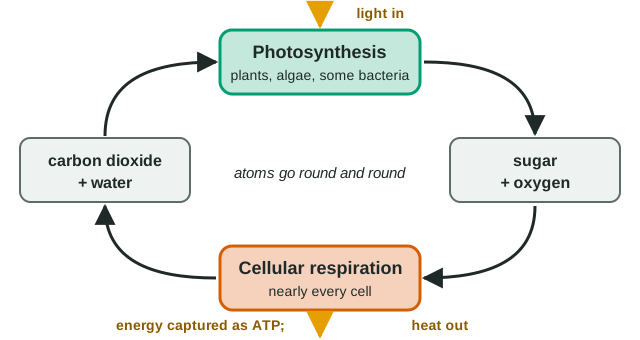
- Photosynthesis builds sugar from carbon dioxide and water, and cellular respiration breaks sugar back down to carbon dioxide and water.The same atoms cycle between air, water and organisms again and again: matter is recycled, while energy flows through.
Part 6 · Key ideas
Key ideas
- An element is a substance made of one kind of atom. Six of them, carbon, hydrogen, oxygen, nitrogen, phosphorus and sulfur (CHONPS), make up about 98% of the mass of a living thing.
- Isotopes are atoms of one element with different numbers of neutrons. They behave the same in chemistry, so a radioactive or heavy isotope can be fed to cells and traced into the molecules that use that element.
- Organic molecules are built on carbon skeletons. Small attached groups of atoms, the functional groups, give each molecule its chemistry: –OH is polar, –COOH acts as an acid, –NH2 as a base.
- Which element is in which molecule: N in proteins and nucleic acids; P in nucleic acids, ATP and some lipids; S in some amino acids, so in many proteins. Sugars and fats are mostly C, H and O.
Part 7 · Misconception
A common mistake
The wrong idea: A growing plant gets most of its mass from the soil, and the food you eat is turned into energy and used up.
What actually happens: Most of a plant's dry mass is carbon, taken from carbon dioxide in the air; the soil supplies small amounts of N, P, S and other minerals. Food is not turned into energy: its atoms are rearranged into new molecules or released (mostly as carbon dioxide and water), while the energy in its bonds is captured as ATP or lost as heat.
Part 8 · Check yourself
Check yourself
Exam-style questions. Anything you miss goes into your review queue.
1. Which element is part of both proteins and nucleic acids but is absent from typical sugars and fats?
- Oxygen
- Carbon
- Nitrogen
- Sulfur
Show the answer
Proteins (through their amino groups) and nucleic acids contain nitrogen. Sugars and fats are built from C, H and O.
- Oxygen: Sugars and fats contain oxygen too.
- Carbon: Carbon is the skeleton of all four families of molecules, sugars and fats included.
- Correct: Nitrogen: Correct. Every amino acid has an amino group, and nucleic acids contain nitrogen too; typical sugars and fats are made of C, H and O.
- Sulfur: Sulfur is in some amino acids but not in nucleic acids.
2. A carbon atom is part of a sugar molecule in one of your muscle cells. Trace it back through what you ate. Where was it most likely before it entered any living thing?
- It did not exist yet; your body made it from the energy in the food you ate.
- It was in carbon dioxide in the air, before a plant took it up by photosynthesis.
- It was a nitrogen atom in the soil that a plant converted into carbon.
- It has been in your body since birth, since atoms in the body are kept and reused for life.
Show the answer
Matter cycles. Carbon enters living things when photosynthesis builds sugar from carbon dioxide, moves to you as food, and returns to the air as carbon dioxide from cellular respiration.
- It did not exist yet; your body made it from the energy in the food you ate.: Living things cannot make atoms. Energy in food is used to rearrange atoms, not to create them.
- Correct: It was in carbon dioxide in the air, before a plant took it up by photosynthesis.: Correct. Plants pull carbon out of carbon dioxide to build sugar; you got the atom by eating the plant or an animal that ate it.
- It was a nitrogen atom in the soil that a plant converted into carbon.: Organisms rearrange atoms into new molecules but do not change one element into another.
- It has been in your body since birth, since atoms in the body are kept and reused for life.: Your cells break down and rebuild molecules constantly, releasing carbon as carbon dioxide; most atoms in a muscle are replaced within months.
Model
Five molecules from cells
The table gives the formula and a condensed structure for five small molecules found in cells. In the structures, a dash is a covalent bond; groups in parentheses are attached to the carbon just before them.
| Molecule | Formula | Condensed structure |
|---|---|---|
| A | C3H7NO2S | HS–CH2–CH(NH2)–COOH |
| B | C6H12O6 | A six-carbon chain carrying five –OH groups and one C=O group at the end of the chain |
| C | C16H32O2 | CH3–(CH2)14–COOH |
| D | C10H16N5O13P3 | A ring-shaped nitrogen-containing part, a sugar with five carbon atoms, and a chain of three phosphate groups |
| E | C2H5NO2 | H2N–CH2–COOH |
3. Which molecule carries a sulfhydryl group?
- Molecule A
- Molecule C
- Molecule D
- Molecule E
Show the answer
A sulfhydryl group is –SH. Only Molecule A contains sulfur, and its structure starts HS–.
- Correct: Molecule A: Correct. HS– at the start of its structure is a sulfhydryl group, which is why its formula contains S.
- Molecule C: Molecule C carries a carboxyl group (–COOH) on a long hydrocarbon chain; it has no sulfur.
- Molecule D: Molecule D carries phosphate groups; its formula has P but no S.
- Molecule E: Molecule E carries amino and carboxyl groups but no sulfur.
4. Molecule C does not dissolve in water. Which feature of its structure best explains this?
- Its carboxyl group releases hydrogen ions, which makes it repel water molecules.
- Most of the molecule is a chain of carbons carrying hydrogens, and C–H bonds are nonpolar.
- It contains oxygen, which is highly electronegative and pulls electrons away from water.
- It is much larger than a water molecule, and large molecules are too big to dissolve in water.
Show the answer
Solubility depends on polarity. Molecule C is almost all CH2 groups, a hydrocarbon chain, which is nonpolar and hydrophobic. That is the mark of a lipid.
- Its carboxyl group releases hydrogen ions, which makes it repel water molecules.: A charged –COO− group would attract water, not repel it; the group is hydrophilic, not the cause.
- Correct: Most of the molecule is a chain of carbons carrying hydrogens, and C–H bonds are nonpolar.: Correct. Fifteen carbons carrying hydrogens form a long hydrophobic chain; one polar group at the end cannot make the whole molecule dissolve.
- It contains oxygen, which is highly electronegative and pulls electrons away from water.: Its two oxygens are in the polar –COOH group; electronegative atoms make a molecule more water-friendly, not less.
- It is much larger than a water molecule, and large molecules are too big to dissolve in water.: Many large molecules dissolve if they are polar; size alone does not decide whether something dissolves.
5. Which of the molecules are amino acids? Select all that apply.
- Molecule A
- Molecule B
- Molecule C
- Molecule D
- Molecule E
Show the answer
An amino acid has both an amino group (–NH2) and a carboxyl group (–COOH). Molecule A has both, and so does Molecule E; containing nitrogen, as ATP does, or a carboxyl group alone, as the long chain does, is not enough.
- Correct: Molecule A: Amino acid. It has an amino group (–NH2) and a carboxyl group (–COOH) on the same carbon; it is cysteine.
- Molecule B: Not an amino acid. It has hydroxyl and carbonyl groups and no nitrogen: it is a sugar.
- Molecule C: Not an amino acid. It has a carboxyl group but no amino group or nitrogen.
- Molecule D: Not an amino acid. It contains nitrogen, but in a ring, with a sugar and phosphate groups: it is ATP.
- Correct: Molecule E: Amino acid. H2N–CH2–COOH has an amino group and a carboxyl group; it is glycine.
6. Molecule F also has the formula C6H12O6, but its C=O group is in the middle of the carbon chain instead of at the end. How are Molecules B and F related?
- They are isotopes, because they contain the same elements in the same amounts.
- They are the same molecule, because a formula fully describes a molecule.
- They are isomers: the same formula with different structures, so they can have different properties.
- They differ on paper alone; moving a group along the chain does not change a molecule's behavior.
Show the answer
Isomers share a formula but differ in how their atoms are bonded. Because structure decides function in biology, isomers can taste, react and fit other molecules differently.
- They are isotopes, because they contain the same elements in the same amounts.: Isotopes are atoms of one element with different numbers of neutrons. B and F are molecules, and their atoms are ordinary.
- They are the same molecule, because a formula fully describes a molecule.: A formula gives only the count of each atom. Moving the C=O changes the structure, so B and F are different molecules.
- Correct: They are isomers: the same formula with different structures, so they can have different properties.: Correct. Same atoms, different arrangement. Different shapes can behave differently in cells.
- They differ on paper alone; moving a group along the chain does not change a molecule's behavior.: The position of a functional group changes the molecule's shape, and shape affects how it interacts with other molecules.
Graph
Carbon dioxide in sealed chambers
Two identical sealed glass chambers were kept at 25 °C. Chamber 1 held a potted plant; Chamber 2 held 20 crickets with no plant. A probe recorded the carbon dioxide concentration of the air in each, in parts per million (ppm). A bright lamp shone on both chambers for the first 60 minutes and was then switched off.
Chamber 1: plantChamber 2: crickets
Data table
| Time (lamp off at 60 min) (min) | Chamber 1: plant | Chamber 2: crickets |
|---|---|---|
| 0 | 420 | 420 |
| 10 | 398 | 432 |
| 20 | 375 | 444 |
| 30 | 352 | 456 |
| 40 | 330 | 468 |
| 50 | 307 | 480 |
| 60 | 285 | 492 |
| 70 | 291 | 504 |
| 80 | 297 | 516 |
| 90 | 303 | 528 |
| 100 | 309 | 540 |
| 110 | 315 | 552 |
| 120 | 321 | 564 |
7. Which statement correctly describes the data for Chamber 1 (the plant)?
- Carbon dioxide fell while the lamp was on and rose more slowly after it was switched off.
- Carbon dioxide fell at a steady rate for the whole 120 minutes.
- Carbon dioxide rose while the lamp was on and fell after it was switched off.
- Carbon dioxide rose after the lamp went off, at about the same speed it had fallen.
Show the answer
In the light the plant's curve drops from 420 to 285 ppm; in the dark it climbs from 285 to 321 ppm, a much shallower rise.
- Correct: Carbon dioxide fell while the lamp was on and rose more slowly after it was switched off.: Correct. It fell by 135 ppm in the first 60 minutes and rose by 36 ppm in the next 60.
- Carbon dioxide fell at a steady rate for the whole 120 minutes.: It fell only while the lamp was on; after 60 minutes it rose.
- Carbon dioxide rose while the lamp was on and fell after it was switched off.: This is the reverse of the data: 420 ppm fell to 285 ppm in the light.
- Carbon dioxide rose after the lamp went off, at about the same speed it had fallen.: The rise (about 0.6 ppm per minute) was much slower than the fall (about 2.25 ppm per minute).
8. Which explanation best accounts for the rise in carbon dioxide in Chamber 1 after the lamp was switched off?
- Plants switch from photosynthesis to cellular respiration at night, so the plant began releasing carbon dioxide.
- Respiration continued in the plant's cells, and without light, photosynthesis stopped taking carbon dioxide up.
- Carbon dioxide stored in the soil leaked into the chamber once the lamp stopped warming the soil.
- Without light, the plant broke down the oxygen it had made earlier into carbon dioxide.
Show the answer
Two processes run in the plant in the light: photosynthesis (removes CO2) and respiration (adds CO2). The curve shows the difference. In the dark, photosynthesis stops and only respiration is left, so CO2 rises.
- Plants switch from photosynthesis to cellular respiration at night, so the plant began releasing carbon dioxide.: Plants respire all the time, in light and dark. Respiration did not start at 60 minutes; it was hidden by faster photosynthesis.
- Correct: Respiration continued in the plant's cells, and without light, photosynthesis stopped taking carbon dioxide up.: Correct. Respiration releases carbon dioxide continuously. In the light, photosynthesis removed it faster than respiration added it; in the dark only respiration remained.
- Carbon dioxide stored in the soil leaked into the chamber once the lamp stopped warming the soil.: The temperature was held at 25 °C, and soil storage would not explain the steady, sustained rise; respiration does.
- Without light, the plant broke down the oxygen it had made earlier into carbon dioxide.: Oxygen alone has no carbon, so it cannot be turned into carbon dioxide; the carbon comes from sugar broken down in respiration.
Part 9 · Summary
Summary
Organisms build their molecules from atoms they take in; atoms are recycled, never made new. Carbon's four bonds make chains, branches and rings, and functional groups such as hydroxyl, carboxyl, amino, phosphate and sulfhydryl give each molecule its chemistry. Nitrogen goes into proteins and nucleic acids; phosphorus into nucleic acids, ATP and some lipids; sulfur into some amino acids. Photosynthesis and cellular respiration cycle carbon, hydrogen and oxygen between the air, water and living things.
Part 10 · Up next
What comes next
Part 11 · Connections