Carbohydrates
Carbohydrates are built from monosaccharides such as glucose, fructose and galactose.
Part 1 · Hook
Why this matters
A cow can live on grass and a termite on wood, yet you would starve on either, even though grass and wood are packed with the same sugar, glucose, that powers your cells. A potato is also glucose, linked into chains, and you digest it easily. The difference between a potato and a plank comes down to which way one oxygen bridge points between neighboring glucose units.
Part 2 · Before you start
What this builds on
Part 3 · Prerequisite check
Quick check before you start
1. What happens in dehydration synthesis?
- Two monomers are joined and a water molecule is released
- A polymer is broken apart by adding water
- A molecule loses all its hydrogen atoms
Show the answer
Dehydration synthesis joins monomers with a covalent bond, removing an –OH and an –H as water. Breaking with water is hydrolysis.
- Correct: Two monomers are joined and a water molecule is released:
- A polymer is broken apart by adding water:
- A molecule loses all its hydrogen atoms:
2. Two molecules have the same formula, C6H12O6, but different structures. They are:
- Isotopes
- Isomers
- Polymers
Show the answer
Isomers share a formula but differ in how their atoms are arranged. Isotopes are forms of one element; polymers are chains of monomers.
- Isotopes:
- Correct: Isomers:
- Polymers:
3. Which elements make up carbohydrates?
- C, H and O
- C, H, O and N
- C, H, O, N and P
Show the answer
Carbohydrates are built from carbon, hydrogen and oxygen. Proteins add N; nucleic acids add N and P.
- Correct: C, H and O:
- C, H, O and N:
- C, H, O, N and P:
Part 4 · See it
See it first
Part 5 · Step by step
How it works, step by step
- A simple sugar such as glucose (C6H12O6) has many polar –OH groups.It dissolves easily in water and is the monomer from which larger carbohydrates are built.
- Dehydration synthesis between an –OH on carbon 1 of one sugar and an –OH on another sugar forms a glycosidic bond.Two sugars make a disaccharide (such as sucrose); hundreds or thousands make a polysaccharide.
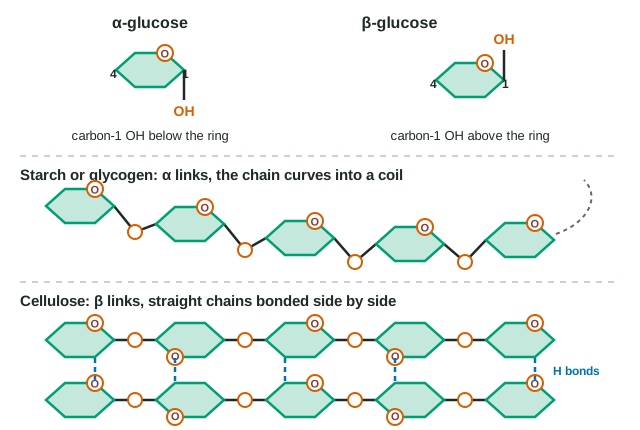
- Glucose comes in two ring forms: α, with the carbon-1 –OH below the ring, and β, with it above.Bonds between α-glucose units give a chain that coils (starch, glycogen); bonds between β-glucose units give a straight chain with every other unit flipped (cellulose).
- Coiled, branched α chains are compact, and many chain ends are exposed.Starch in plants and glycogen in animals store glucose that enzymes can quickly hydrolyze when energy is needed.
- Straight β chains lie side by side, and their –OH groups hydrogen-bond chain to chain.Cellulose forms strong fibers in plant cell walls; enzymes that cut α bonds do not fit β bonds, so most animals cannot digest it.
Part 6 · Key ideas
Key ideas
- Monosaccharides (glucose, fructose, galactose) are single sugars; disaccharides are two joined by a glycosidic bond (sucrose = glucose + fructose; lactose = glucose + galactose; maltose = glucose + glucose); polysaccharides are long chains.
- Storage polysaccharides: starch (plants) and glycogen (animals, in liver and muscle), both α-glucose, coiled and branched. Structural polysaccharides: cellulose (plant cell walls, β-glucose) and chitin (insect exoskeletons and the walls of fungi, a β-linked sugar that contains nitrogen).
- Same monomer, different bond, different job: starch and cellulose are both pure glucose. The α or β link changes the chain's shape, and shape decides both its role and which enzymes can break it.
Part 7 · Misconception
A common mistake
The wrong idea: Cellulose passes through us undigested because it is made of a different, indigestible sugar.
What actually happens: Cellulose is made entirely of glucose, the same monomer as starch. What differs is the glycosidic bond: β instead of α. Our starch-digesting enzymes fit α bonds and cannot grip β bonds. Cows and termites digest cellulose mainly with the help of microbes in their guts that make enzymes for β bonds.
Part 8 · Check yourself
Check yourself
Exam-style questions. Anything you miss goes into your review queue.
1. A student hydrolyzes one molecule of maltose and one molecule of sucrose completely. Which monosaccharides does she get?
- Two glucose and two fructose
- Three glucose and one fructose
- Two glucose, one fructose and one galactose
- Four glucose
Show the answer
Maltose = glucose + glucose; sucrose = glucose + fructose. Total: three glucose and one fructose.
- Two glucose and two fructose: Maltose contains no fructose; it is glucose + glucose.
- Correct: Three glucose and one fructose: Correct. Maltose gives two glucose; sucrose gives one glucose and one fructose.
- Two glucose, one fructose and one galactose: Galactose comes from lactose, not from sucrose or maltose.
- Four glucose: Sucrose's second unit is fructose, not glucose.
2. A person who makes very little lactase (the enzyme that hydrolyzes lactose) drinks a glass of milk. Compared with a person who makes normal lactase, predict each value.
| Variable | Change |
|---|---|
| Amount of lactose reaching the large intestine | — |
| Glucose absorbed into the blood from the milk | — |
| Number of glucose units in each lactose molecule | — |
Show the answer
Lactase cuts lactose into glucose and galactose for absorption. With little lactase, lactose stays whole, so less glucose is absorbed and more lactose reaches the large intestine. The molecule itself is unchanged.
- Amount of lactose reaching the large intestine: increases. Without enough lactase, less lactose is hydrolyzed in the small intestine, so more passes on intact.
- Glucose absorbed into the blood from the milk: decreases. Glucose is released from lactose only by hydrolysis; less hydrolysis means less glucose to absorb.
- Number of glucose units in each lactose molecule: no change. Lactose is glucose + galactose in everyone; the enzyme level does not change the molecule's structure.
Data table
Which enzyme breaks which polysaccharide?
A student added 10 mg of a polysaccharide to each of twelve tubes of water at 37 °C. Each polysaccharide got three tubes: one with no enzyme, one with Enzyme A (from human saliva) and one with Enzyme B (from a fungus that rots wood). After 60 minutes she measured the sugar units released into the water.
| Polysaccharide | No enzyme | Enzyme A (saliva) | Enzyme B (wood-rotting fungus) |
|---|---|---|---|
| Starch | 0.1 | 7.9 | 0.3 |
| Glycogen | 0.1 | 9.2 | 0.2 |
| Cellulose (powder) | 0.0 | 0.1 | 6.4 |
| Chitin (powder) | 0.0 | 0.0 | 0.1 |
3. Which polysaccharides did Enzyme B break down substantially? Select all that apply.
- Starch
- Glycogen
- Cellulose
- Chitin
Show the answer
Compare each Enzyme B value with its no-enzyme tube. Only cellulose shows a large release; the wood-rotting fungus's enzyme cuts the bonds in cellulose.
- Starch: Enzyme B released 0.3 mg from starch, barely more than the 0.1 mg with no enzyme.
- Glycogen: Enzyme B released 0.2 mg from glycogen, about the same as no enzyme.
- Correct: Cellulose: Substantial: 6.4 mg with Enzyme B against 0.0 mg with no enzyme.
- Chitin: Enzyme B released 0.1 mg from chitin, close to nothing.
4. Starch and cellulose are both polymers of glucose, yet Enzyme A broke down starch and not cellulose. Which explanation is best?
- Cellulose is made of a different monosaccharide that Enzyme A does not recognize.
- Starch's glucose units are joined by α bonds and cellulose's by β bonds; Enzyme A fits the α bond's shape.
- Cellulose chains are much longer than starch chains, so Enzyme A ran out of time before it reached a bond it could cut.
- Starch dissolves in water but cellulose does not, so Enzyme A could not reach the cellulose.
Show the answer
Same monomer, different glycosidic bond. Enzymes fit the shape of the bond they cut, so a starch-cutting (α) enzyme cannot hydrolyze cellulose's β bonds. Enzyme B, from a fungus that digests wood, can.
- Cellulose is made of a different monosaccharide that Enzyme A does not recognize.: Both polymers are made entirely of glucose; the difference is in how the glucose units are linked.
- Correct: Starch's glucose units are joined by α bonds and cellulose's by β bonds; Enzyme A fits the α bond's shape.: Correct. The α or β link holds the chain at a different angle; an enzyme that fits one bond does not fit the other.
- Cellulose chains are much longer than starch chains, so Enzyme A ran out of time before it reached a bond it could cut.: Length is not the issue: Enzyme A released almost nothing from cellulose, not a smaller amount.
- Starch dissolves in water but cellulose does not, so Enzyme A could not reach the cellulose.: Cellulose is less soluble, but Enzyme B broke down the same cellulose powder, so the bonds were reachable.
5. A student claims, "Glycogen is broken down faster than starch because glycogen is more branched." How well do these data support the claim?
- Strongly, because glycogen released more sugar than starch did when Enzyme A was added to both.
- Weakly: the gap is small and comes from one tube each, and branching was never tested.
- Not at all, since glycogen and starch are built from different monomers and so are not comparable.
- Strongly, because the no-enzyme tubes show that neither polysaccharide breaks down without help.
Show the answer
Judge two things: is the difference real, and does the design test the proposed cause? With a single tube each and a small gap, the difference could be chance; and branching was never varied, so the data cannot show it is the cause.
- Strongly, because glycogen released more sugar than starch did when Enzyme A was added to both.: The difference is small (9.2 versus 7.9 mg) from one tube each; it may not be real, and the data do not test branching at all.
- Correct: Weakly: the gap is small and comes from one tube each, and branching was never tested.: Correct. A claim about a cause needs a real difference and a test of that cause. One tube per treatment shows neither.
- Not at all, since glycogen and starch are built from different monomers and so are not comparable.: Both are made of α-glucose. The flaw is the size of the evidence, not the chemistry.
- Strongly, because the no-enzyme tubes show that neither polysaccharide breaks down without help.: The no-enzyme tubes show the enzyme is needed; they say nothing about why glycogen gave more sugar than starch.
6. What is the main purpose of the no-enzyme tubes?
- To show how much sugar each polysaccharide releases without enzyme, as a baseline for the enzyme tubes.
- To show that the enzyme solutions themselves contain sugar that is released into the water over time.
- To give the polysaccharides time to dissolve before the enzymes were added to the other tubes.
- To check whether 37 °C is the best temperature for Enzymes A and B.
Show the answer
A comparison that lacks only the factor being tested shows what happens without it. Here nearly nothing is released without enzyme, so the sugar in the enzyme tubes comes from enzyme action.
- Correct: To show how much sugar each polysaccharide releases without enzyme, as a baseline for the enzyme tubes.: Correct. They show the baseline: near zero for all four, so the large values with either enzyme come from the enzymes.
- To show that the enzyme solutions themselves contain sugar that is released into the water over time.: That would need tubes with enzyme but no polysaccharide; these tubes have polysaccharide but no enzyme.
- To give the polysaccharides time to dissolve before the enzymes were added to the other tubes.: All tubes were run for the same 60 minutes; these tubes never received an enzyme.
- To check whether 37 °C is the best temperature for Enzymes A and B.: All tubes were at 37 °C; testing temperature would need tubes at several temperatures.
7. Termites eat wood but make little enzyme of their own like Enzyme B; microbes in their guts make it. Termites are given a treatment that kills their gut microbes and are then fed only wood. What is the most likely result?
- The termites digest the wood as before, because wood also contains starch they can break down.
- The termites starve, because most of the cellulose in the wood passes through them without being hydrolyzed.
- The termites switch to making Enzyme A, which takes over the job of hydrolyzing the cellulose in the wood.
- The termites build chitin from the wood instead, which they can digest with their own enzymes.
Show the answer
Wood's energy is locked in cellulose's β-glycosidic bonds. Only enzymes that fit β bonds, made here by gut microbes, can release the glucose.
- The termites digest the wood as before, because wood also contains starch they can break down.: Wood is mostly cellulose. Without microbial enzymes, the termites cannot release its glucose.
- Correct: The termites starve, because most of the cellulose in the wood passes through them without being hydrolyzed.: Correct. The termites' own small supply of β-cutting enzyme cannot release enough glucose; without the microbes, most of the cellulose stays unusable.
- The termites switch to making Enzyme A, which takes over the job of hydrolyzing the cellulose in the wood.: The table shows Enzyme A, a starch-cutting enzyme, releases almost no sugar from cellulose.
- The termites build chitin from the wood instead, which they can digest with their own enzymes.: Building chitin from wood would first require breaking the cellulose down, which is exactly what they cannot do.
Part 9 · Summary
Summary
Carbohydrates are built from monosaccharides such as glucose, fructose and galactose. Glycosidic bonds, made by dehydration synthesis, join them into disaccharides (sucrose, lactose, maltose) and polysaccharides. Starch and glycogen are coiled, branched chains of α-glucose that store energy. Cellulose is straight chains of β-glucose that hydrogen-bond into fibers in plant cell walls, and chitin is a similar structural polymer that contains nitrogen. The α or β link changes shape, and shape decides function and digestibility.
Part 10 · Up next
What comes next
Part 11 · Connections