Unit 3 · 15 to 25% of the exam
Unit 3 practice test: Development and Learning
twelve questions, every option explained
12 exam-style questions from the unit, free, with an explanation for every option. Most have four answer choices, as on the real exam, and a few ask for a number you can work out by hand; sets share one study summary, data table, graph or figure. Covers: Themes and Methods in Developmental Psychology; Physical Development Across the Lifespan; Gender and Sexual Orientation; Cognitive Development Across the Lifespan; Communication and Language Development; Social-Emotional Development Across the Lifespan; Classical Conditioning; Operant Conditioning; Social, Cognitive, and Neurological Factors in Learning.

Data
Invented data: one dog, a tone and saliva
1. Saliva was measured in the seconds after the tone, before any food arrived. What explains the drop from trial 9 to trial 15?
- Extinction: the tone kept sounding without food
- Habituation to the food
- Stimulus discrimination between two tones
- The dog forgot the tone overnight
Show the answer
From trial 9 the tone came alone, so the CR (saliva to the tone) faded: extinction.
- Correct: Extinction: the tone kept sounding without food: Right: when the CS is no longer followed by the UCS, the CR weakens.
- Habituation to the food: Food was not given on these trials, so the dog could not habituate to it.
- Stimulus discrimination between two tones: There is one tone in this study, so there was nothing to discriminate.
- The dog forgot the tone overnight: Trials 9 to 15 happened on the same day; the rest came after trial 15.
2. On trial 16, after a day of rest, the dog produced 6 drops. What does that result show?
- Extinction weakened the response without erasing the learning
- The dog acquired a new UCS overnight
- The tone has become an unconditioned stimulus
- The dog generalized to a new tone
Show the answer
A CR that returns after rest (spontaneous recovery) means extinction suppressed the response rather than wiping out what was learned.
- Correct: Extinction weakened the response without erasing the learning: Right: spontaneous recovery shows the CS to CR link survived extinction.
- The dog acquired a new UCS overnight: No new stimulus was paired; a UCS is not acquired anyway.
- The tone has become an unconditioned stimulus: A tone never causes saliva without learning, so it cannot be a UCS.
- The dog generalized to a new tone: The same tone was used, so this is not generalization.
3. A student says the graph proves the dog "unlearned" the tone by trial 15. Which part of the graph is the best evidence against that claim?
- The return to 6 drops on the next day
- The rise from 0 to 10 drops in trials 1 to 8
- The steady 10 drops on trials 7 and 8
- The fall to 0 drops on trial 15
Show the answer
Spontaneous recovery on the next day shows the learned link was still there, only suppressed.
- Correct: The return to 6 drops on the next day: Right: if the link were gone, the tone alone would bring no saliva after rest.
- The rise from 0 to 10 drops in trials 1 to 8: That rise shows acquisition. It says nothing about whether extinction erased the link.
- The steady 10 drops on trials 7 and 8: That plateau shows learning leveled off before extinction began.
- The fall to 0 drops on trial 15: Zero drops at trial 15 is what the student points to; it does not argue against the claim.
Figure
The liquid conservation task and Piaget’s stages
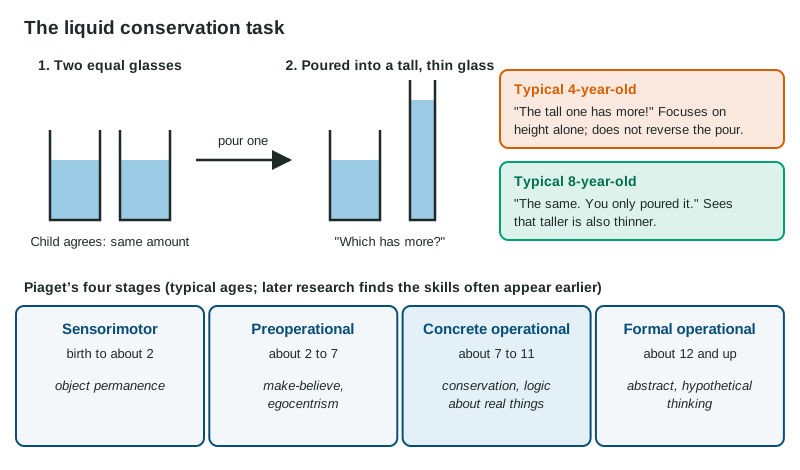
4. A 9-month-old watches his father hide a toy under a blanket and immediately pulls the blanket off to find it. According to the figure, which stage and concept does this show?
- Preoperational stage: conservation
- Concrete operational stage: reversibility
- Formal operational stage: hypothetical thinking
- Sensorimotor stage: object permanence
Show the answer
Babies who search for a hidden toy understand that out of sight is not out of existence.
- Preoperational stage: conservation: Conservation is about amount despite changes in shape, and it comes later.
- Concrete operational stage: reversibility: A 9-month-old is in the sensorimotor stage.
- Formal operational stage: hypothetical thinking: Hypothetical thinking comes around adolescence.
- Correct: Sensorimotor stage: object permanence: Right: knowing that a hidden object still exists develops during the sensorimotor stage.
5. A 3-year-old covers her eyes during hide-and-seek and says, "You can’t see me!" Which concept from the preoperational stage does this show?
- Object permanence
- Abstract reasoning
- Egocentrism
- Conservation
Show the answer
Egocentrism in Piaget’s sense is difficulty taking another person’s point of view, not selfishness.
- Object permanence: She knows you still exist; the error is about your point of view.
- Abstract reasoning: Abstract reasoning belongs to the formal operational stage.
- Correct: Egocentrism: Right: she assumes others see what she sees; if she cannot see you, you cannot see her.
- Conservation: Conservation is about amounts staying the same when appearance changes.
6. Sam, 15, debates what would happen to society if no one ever needed to sleep. Which stage in the figure does his reasoning fit?
- Sensorimotor
- Formal operational
- Concrete operational stage
- Preoperational
Show the answer
Abstract, "what if" reasoning about possibilities marks the formal operational stage.
- Sensorimotor: The sensorimotor stage is infancy, before language-based reasoning.
- Correct: Formal operational: Right: reasoning about a hypothetical situation that is not real is formal operational thought.
- Concrete operational stage: Concrete operational thinkers reason logically about real, present things.
- Preoperational: Preoperational children have trouble with logic about even concrete things.
7. A graduate student must finish her thesis in one year. She wants to compare how well 5-, 10- and 15-year-olds remember a list of pictures. Which design fits her deadline?
- A cross-sectional study of three age groups tested this year
- A longitudinal study following 5-year-olds until they are 15
- An experiment that randomly assigns children to ages
- A case study of one child at each age
Show the answer
Cross-sectional designs trade some accuracy about change for speed.
- Correct: A cross-sectional study of three age groups tested this year: Right: testing different age groups at one time gives age comparisons quickly.
- A longitudinal study following 5-year-olds until they are 15: That would take ten years.
- An experiment that randomly assigns children to ages: Age cannot be assigned; it can only be measured.
- A case study of one child at each age: One child per age gives too little to compare age groups.
8. Over one summer, 13-year-old Marcus grows 8 cm, his voice deepens and hair grows on his face. Which change is a secondary sex characteristic?
- His growth in height
- His voice deepening
- His testes producing sperm
- His first ejaculation
Show the answer
Primary sex characteristics are the reproductive organs; secondary ones are other sex-related traits (voice, body hair, breasts).
- His growth in height: Both sexes have growth spurts; height is not a sex characteristic.
- Correct: His voice deepening: Right: a deeper voice is a sex-related trait that is not part of the reproductive organs.
- His testes producing sperm: Changes in the reproductive organs are primary sex characteristics.
- His first ejaculation: That is spermarche, a milestone of the reproductive system.
9. By age 3, Mia insists that only girls wear dresses and corrects her brother when he picks up a doll. Which concept does her behavior show?
- Gender typing
- Gender identity
- Sexual orientation
- Menarche
Show the answer
Gender typing is the learning of traditional gender roles; young children often apply them rigidly before becoming more flexible.
- Correct: Gender typing: Right: she has learned her culture’s gender roles and applies them to herself and others.
- Gender identity: Her own sense of being a girl is gender identity; the scenario is about rules for what girls and boys do.
- Sexual orientation: Attraction is not part of the scenario.
- Menarche: Menarche is the first menstrual period, years away.
10. The word "unhappiness" can be split into "un," "happy" and "ness," each carrying meaning. What are these parts?
- Syntax rules
- Babbling sounds
- Morphemes
- Phonemes
Show the answer
Phonemes build morphemes; morphemes build words.
- Syntax rules: Syntax is about word order in sentences.
- Babbling sounds: Babbling is an infant stage of making syllables.
- Correct: Morphemes: Right: a morpheme is the smallest unit that carries meaning.
- Phonemes: Phonemes are sounds; "un" has two of them but one meaning.
11. Jade’s parents set clear rules, explain their reasons, listen to her views and are warm and supportive. Which parenting style is this?
- Authoritative
- Authoritarian
- Permissive
- Disorganized
Show the answer
Authoritative parenting combines high demands with high responsiveness.
- Correct: Authoritative: Right: high warmth plus clear, explained limits is authoritative parenting.
- Authoritarian: Authoritarian parents set strict rules with little warmth and expect them to be followed without discussion.
- Permissive: Permissive parents are warm but set few rules or limits.
- Disorganized: Disorganized is an attachment classification, not a parenting style.
12. A coach makes a player run extra laps every time he shows up late to practice, and he starts arriving on time. For the behavior of arriving late, the laps are
- positive punishment
- negative reinforcement
- negative punishment
- a primary reinforcer
Show the answer
Name the behavior first (being late). It decreases, so this is punishment; something unpleasant was added, so it is positive.
- Correct: positive punishment: Right: an unpleasant consequence is added, and lateness decreases.
- negative reinforcement: Negative reinforcement removes something unpleasant and increases a behavior. Laps were added, and lateness fell.
- negative punishment: Negative punishment removes something wanted. Laps are added, not taken away.
- a primary reinforcer: A primary reinforcer satisfies a biological need and increases a behavior. Laps lower the behavior.