Functions, Graphs and Notation
A function gives each input one output, written f(input) = output .
Part 1 · Hook
Why this matters
Part 2 · See it
See it first
Part 3 · Step by step
How it works, step by step
- Each input of a function has exactly one output names one point on the graph of
- A formula divides by an expression or takes its square rootthe domain leaves out inputs that make a denominator or a square root's inside negative
- An input gives the output is a zero of and the graph meets the -axis at
- A piecewise-defined function is evaluatedfirst find the piece whose condition holds for the input, then use only that piece
Part 4 · Key ideas
Key ideas
- Function: each input gives exactly one output. means the input gives the output .
- Domain: the inputs a function accepts. Range: the outputs it produces.
- Zero: an input with output , an -intercept of the graph. -intercept: the point .
- To evaluate, replace every with the input in parentheses: , .
Part 5 · Misconception
A common mistake
The wrong idea: is the same as .
What actually happens: changes the input: replace every with . changes the output: add after evaluating. For they are and , which differ.
Part 6 · Check yourself
Check yourself
Exam-style questions. Anything you miss goes into your review queue.
1. For , what is ?
Show the answer
Put in for every , inside parentheses:
- Correct: : Right:
. - : This squares only the , as if were . With parentheses, .
- : This uses . A negative times a negative is positive: .
- : Two sign slips: read as and read as .
2. For , write as an expression in .
Type an expression for .
Show the answer
Replace each with :
- Answer:
3. What is the domain of
- and
- and
Show the answer
Two rules: the expression under a square root cannot be negative (), and a denominator cannot be (). Both must hold.
- Correct: and : Right: the square root needs , and the denominator needs .
- : This misses the denominator: at it is , and division by is undefined.
- : This misses the square root: for , is negative and has no real square root.
- and : is allowed: , and is a real number.
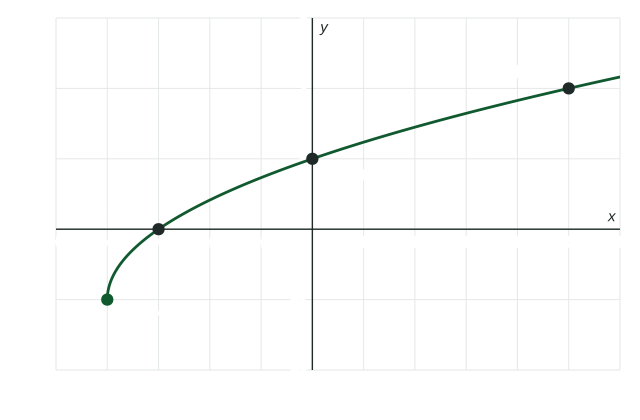
Graph
The graph of
4. Use the graph to find .
No calculator. Type the exact value (a fraction, π, e or a root is fine).
Show the answer
The graph crosses the -axis at , so : the -intercept.
- Answer: -1.5
5. Which table does NOT define as a function of ?
- : and :
- : and :
- : and :
- : and :
Show the answer
A function gives each input exactly one output. Look for a repeated input with different outputs; repeated outputs are fine.
- Correct: : and : : Right: the input has two outputs, and , so this is not a function.
- : and : : Every input has one output. Several inputs may share an output.
- : and : : Each input appears once, so each has exactly one output. and sharing is allowed.
- : and : : Each input appears once with one output: a function.
6. What is the zero of ?
No calculator. Type the exact value (a fraction, π, e or a root is fine).
Show the answer
Set the output to : , , . Check: .
- Answer: -5
Part 7 · Summary
Summary
Part 8 · Up next
What comes next
Part 9 · Connections