Displacement, Velocity and Acceleration
Average velocity is displacement over time, Δx/Δt, and average acceleration is change in velocity over time, Δv/Δt.
Part 1 · Hook
Why this matters
Part 2 · Before you start
What this builds on
Part 3 · Prerequisite check
Quick check before you start
1. A runner goes from x = +40 m to x = +10 m. What is her displacement?
- −30 m
- +30 m
- +50 m
- +10 m
Show the answer
Displacement = final − initial = 10 m − 40 m = −30 m.
- Correct: −30 m:
- +30 m:
- +50 m:
- +10 m:
2. What does Δv mean?
- Final velocity minus initial velocity
- Initial velocity minus final velocity
- The average of the two velocities
- The velocity times the time
Show the answer
Δ always means "change in": final minus initial.
- Correct: Final velocity minus initial velocity:
- Initial velocity minus final velocity:
- The average of the two velocities:
- The velocity times the time:
3. Solve v = Δx/Δt for Δx.
- Δx = vΔt
- Δx = v/Δt
- Δx = Δt/v
- Δx = v − Δt
Show the answer
Multiply both sides by Δt.
- Correct: Δx = vΔt:
- Δx = v/Δt:
- Δx = Δt/v:
- Δx = v − Δt:
Part 4 · See it
See it first
Part 5 · Step by step
How it works, step by step
- An object changes position over a time interval Δtits average velocity is Δx/Δt, with the sign of the displacement
- The time interval is made shorter and shorterthe average velocity approaches the instantaneous velocity at that moment
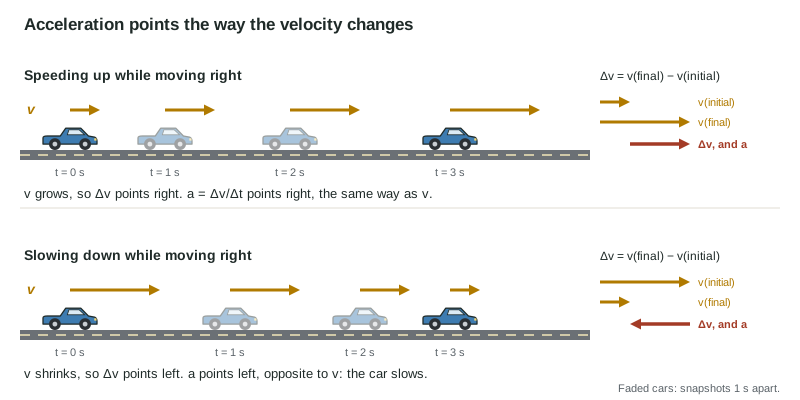
- The velocity changes in size or in directionthe object has an acceleration, a = Δv/Δt, pointing the same way as Δv
- The acceleration points the same way as the velocitythe object speeds up; if it points the opposite way, the object slows down
Part 6 · Key ideas
Key ideas
- The object model treats a car or a ball as a point with a position: size, shape and inner parts are ignored.
- Average velocity = Δx/Δt. It uses the displacement, so a round trip has zero average velocity. Average speed uses the distance.
- Average acceleration = Δv/Δt, in m/s². Acceleration is any change in velocity: speeding up, slowing down or turning.
- The sign of a alone does not tell you whether an object speeds up. Compare it with v: same sign, speeding up; opposite signs, slowing down.
- An instantaneous value is the average over a very short interval. An object can have v = 0 at an instant and still be accelerating.
Part 7 · Misconception
A common mistake
The wrong idea: A negative acceleration means the object is slowing down, and an object at rest has no acceleration.
What actually happens: A negative acceleration only points in the negative direction. A cart rolling down a ramp (negative v) with a negative a speeds up. At the top of its path, the cart has v = 0 but its velocity is still changing, so a is not zero.
Part 8 · Check yourself
Check yourself
Exam-style questions. Anything you miss goes into your review queue.
Data table
A cart rolls up a ramp and back
A student gives a cart a quick push up a long, straight ramp and lets go at t = 0. A motion detector at the bottom of the ramp records the cart's velocity, with up the ramp as positive.
| Time (s) | Velocity (m/s) |
|---|---|
| 0.0 | +1.20 |
| 0.5 | +0.80 |
| 1.0 | +0.40 |
| 1.5 | 0.00 |
| 2.0 | −0.40 |
| 2.5 | −0.80 |
1. The cart's velocity changes by the same amount in each 0.5 s interval. What is its acceleration at t = 1.5 s, the instant its velocity is zero?
- Zero, because the cart is momentarily at rest
- The same as at the other readings: negative, not zero
- Positive, because the cart is about to turn around
- It is undefined, because Δt is zero at a single instant
Show the answer
Acceleration is the rate of change of velocity, not the velocity. From 1.0 s to 2.0 s the velocity goes +0.40 → −0.40 m/s, the same steady change as before, including at the instant v = 0.
- Zero, because the cart is momentarily at rest: A zero velocity is not a zero acceleration. The velocity is still changing at that instant: it was positive and becomes negative.
- Correct: The same as at the other readings: negative, not zero: Right: the velocity keeps changing by −0.40 m/s every 0.5 s, straight through zero, so the acceleration has not changed.
- Positive, because the cart is about to turn around: The velocity goes from positive to negative, so Δv is negative; the acceleration does not flip sign at the top.
- It is undefined, because Δt is zero at a single instant: The table shows the same steady change before and after 1.5 s, so the acceleration there has the same value as at the other readings.
2. What is the cart's average acceleration from t = 0 to t = 1.0 s? Give a signed value and its unit.
Type a number and its unit.
Show the answer
a = Δv/Δt = (0.40 m/s − 1.20 m/s) ÷ (1.0 s − 0) = −0.80 m/s². The minus sign: the acceleration points down the ramp.
- Answer: -0.80 m/s^2
3. From t = 1.5 s to t = 2.5 s, the cart rolls back down the ramp. During this time its acceleration is negative. What is happening to its speed?
- It decreases, because a negative acceleration means slowing down
- It stays the same, because the acceleration does not change
- It decreases, because the velocity values are below zero
- It increases, because the velocity and acceleration have the same sign
Show the answer
Speeding up: velocity and acceleration point the same way. Slowing down: they point opposite ways. Here both are negative after 1.5 s, so the cart speeds up down the ramp.
- It decreases, because a negative acceleration means slowing down: Negative only gives a direction. Slowing down happens when acceleration and velocity have opposite signs.
- It stays the same, because the acceleration does not change: A steady acceleration means the velocity changes steadily; the speed goes from 0 to 0.80 m/s.
- It decreases, because the velocity values are below zero: The speed is the size of the velocity: 0.40 then 0.80 m/s, which is growing.
- Correct: It increases, because the velocity and acceleration have the same sign: Right: both are negative, so the velocity grows more negative and the speed (its size) grows from 0 to 0.80 m/s.
Diagram
Four cars on a straight road
Each car is shown at one instant, with its velocity (v, gold) and its acceleration (a, red). Right is positive. Each car's acceleration stays the same for the next few seconds.
Key: gold arrow, velocity v; red arrow, acceleration a. Right is positive. Arrows show directions, not sizes.
4. Which car has a negative acceleration and is speeding up?
- Car 3
- Car 2
- Car 4
- Car 1
Show the answer
Speeding up means v and a point the same way. Only car 3 has both pointing in the negative direction.
- Correct: Car 3: Right: its velocity and acceleration both point left (negative), so its speed grows.
- Car 2: Car 2 has a negative acceleration, but its velocity is positive, so it is slowing down.
- Car 4: Car 4 has a positive acceleration, opposite to its leftward velocity, so it is slowing down.
- Car 1: Car 1 is speeding up, but its acceleration points right, so it is positive.
5. Car 2 has a velocity of +12 m/s and an acceleration of −3.0 m/s². What is its velocity 2.0 s later?
Type a number in m/s.
Show the answer
From a = Δv/Δt, Δv = aΔt = (−3.0 m/s²)(2.0 s) = −6.0 m/s. New velocity = +12 m/s + (−6.0 m/s) = +6.0 m/s: still moving right, but slower.
- Answer: 6.0 m/s
6. A delivery van drives 12.0 km east in 10.0 min, then 4.0 km west in 5.0 min. What is the size of its average velocity for the whole trip, in m/s?
Type a number in m/s.
Show the answer
Displacement = +12.0 km − 4.0 km = +8.0 km = 8000 m. Δt = 15.0 min = 900 s. v(avg) = 8000 m ÷ 900 s = 8.9 m/s (east).
- Answer: 8.9 m/s
Part 9 · Summary
Summary
Part 10 · Up next
What comes next
Part 11 · Connections