Rearranging Equations with Symbols
Symbols stand for quantities with units, subscripts are labels and Δ means final minus initial.
Part 1 · Hook
Why this matters
Part 2 · Prerequisite check
Quick check before you start
1. What is the SI unit of velocity?
- m/s
- km/h
- m
- s/m
Show the answer
Velocity is a displacement in meters per time in seconds.
- Correct: m/s:
- km/h:
- m:
- s/m:
2. A ball moves from x = 2.0 m to x = 5.0 m. What is its displacement?
- +3.0 m
- +7.0 m
- −3.0 m
- +5.0 m
Show the answer
Displacement is final position minus starting position: 5.0 m − 2.0 m = +3.0 m.
- Correct: +3.0 m:
- +7.0 m:
- −3.0 m:
- +5.0 m:
Part 3 · See it
See it first
Part 4 · Step by step
How it works, step by step
- Each letter in an equation stands for a quantity with a unityou can check any rearranged equation by checking its units
- An equation stays true when you do the same thing to both sidesyou can isolate any symbol by undoing operations in reverse order
- You solve in symbols before putting in numbersthe result shows how the answer depends on each quantity, and you substitute only once
- Δ means final minus initiala change can be negative, and its sign carries the direction
Part 5 · Key ideas
Key ideas
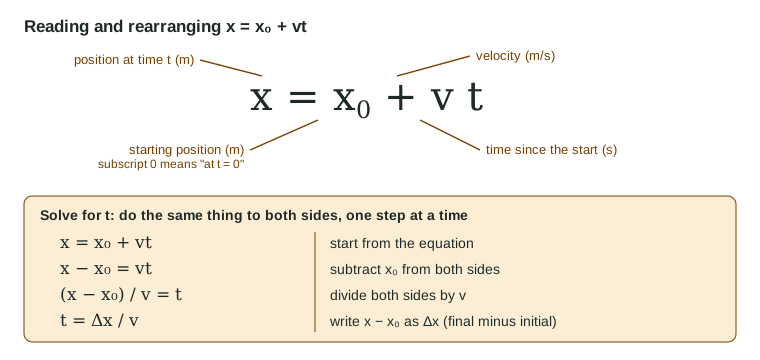
- A symbol is a quantity with a unit: x position (m), v velocity (m/s), t time (s). Subscripts are labels: x₀ is the starting position.
- Δ means "change in" and is always final minus initial: Δx = x − x₀. A negative Δ means the quantity went down.
- To rearrange, undo operations in reverse order, doing the same to both sides: from x = x₀ + vt, subtract x₀, then divide by v.
- Solve in symbols first, then substitute numbers with units once. Check that the units of the result make sense.
Part 6 · Misconception
A common mistake
The wrong idea: To solve d = vt for t, divide v by d, because t is "on the other side" of v.
What actually happens: Divide both sides by v: t = d/v. A units check catches the slip: d/v is m ÷ (m/s) = s, while v/d is 1/s.
Part 7 · Check yourself
Check yourself
Exam-style questions. Anything you miss goes into your review queue.
1. Solve d = vt for t.
- t = v / d
- t = d / v
- t = dv
- t = d − v
Show the answer
d = vt. Divide both sides by v: d/v = t. Units check: m ÷ (m/s) = s.
- t = v / d: This flips the fraction. Check with units: (m/s) ÷ m = 1/s, not seconds.
- Correct: t = d / v: Right: divide both sides by v, and v cancels on the right.
- t = dv: Multiplying by v does not undo multiplying by v; divide instead.
- t = d − v: v multiplies t, so it is removed by dividing, not subtracting.
2. Solve x = x₀ + vt for v.
- v = (x − x₀) / t
- v = x / t − x₀
- v = (x + x₀) / t
- v = t / (x − x₀)
Show the answer
Undo in reverse order: x − x₀ = vt, then v = (x − x₀)/t.
- Correct: v = (x − x₀) / t: Right: subtract x₀ from both sides, then divide both sides by t.
- v = x / t − x₀: Dividing first leaves x₀/t, not x₀. Undo the addition before the multiplication.
- v = (x + x₀) / t: x₀ was added on the right, so it is removed by subtracting it from both sides.
- v = t / (x − x₀): The fraction is upside down; check units: s ÷ m is not m/s.
3. A thermometer reads 14.5 °C at noon and 9.0 °C at 6 p.m. What is ΔT, the change in temperature? Give a signed value.
Type a number in °C.
Show the answer
Δ always means final minus initial: ΔT = 9.0 °C − 14.5 °C = −5.5 °C. The minus sign says the temperature went down.
- Answer: -5.5 °C
4. A rolling ball starts at x₀ = 1.20 m and moves at a steady v = 0.45 m/s. Using x = x₀ + vt, where is it at t = 4.0 s?
Type a number in m.
Show the answer
Substitute with units: x = 1.20 m + (0.45 m/s)(4.0 s) = 1.20 m + 1.8 m = 3.0 m. 0.45 and 4.0 each have two significant figures.
- Answer: 3.0 m
5. A student derives t = v / d for the time to cover distance d at speed v. Which check shows the expression is wrong?
- Its units are (m/s) ÷ m = 1/s, not seconds
- It contains two symbols instead of one number
- It does not include the starting position x₀
- It does not depend on the distance d at all
Show the answer
Units check: (m/s)/m = 1/s. A time must be in s, so the expression is upside down; t = d/v gives m ÷ (m/s) = s. It also gives less time for a faster speed, as it should.
- Correct: Its units are (m/s) ÷ m = 1/s, not seconds: Right: a correct expression for a time must come out in seconds. Checking units catches upside-down fractions.
- It contains two symbols instead of one number: A symbolic answer is supposed to contain symbols; that is not the problem.
- It does not include the starting position x₀: The question asks only for a time over a distance; x₀ is not needed.
- It does not depend on the distance d at all: d is in the expression; the time does depend on it, but upside down, which is the real problem.
6. Solve x = x₀ + vt for t, then find t when x = 9.0 m, x₀ = 3.0 m and v = 1.5 m/s.
Type a number in s.
Show the answer
t = (x − x₀)/v = (9.0 m − 3.0 m) ÷ 1.5 m/s = 4.0 s. Rearrange in symbols first, then substitute once.
- Answer: 4.0 s
Part 8 · Summary
Summary
Part 9 · Up next
What comes next
Part 10 · Connections