Conservation of Energy
Pick the system first.
Part 1 · Hook
Why this matters
Part 2 · Before you start
What this builds on
Part 3 · Prerequisite check
Quick check before you start
1. Near Earth's surface, the change in gravitational potential energy of an object-Earth system is
- mgΔy
- ½mv²
- ½k(Δx)²
- mg/Δy
Show the answer
ΔU_g = mgΔy.
- Correct: mgΔy:
- ½mv²:
- ½k(Δx)²:
- mg/Δy:
2. The net work done on an object equals its
- change in kinetic energy
- kinetic energy
- change in potential energy
- speed
Show the answer
The work-energy theorem: W_net = ΔK.
- Correct: change in kinetic energy:
- kinetic energy:
- change in potential energy:
- speed:
3. A force exerted on the system by an object outside it is
- an external force
- an internal force
- a conservative force
- a normal force
Show the answer
External forces come from outside the chosen system.
- Correct: an external force:
- an internal force:
- a conservative force:
- a normal force:
Part 4 · See it
See it first
Part 5 · Step by step
How it works, step by step
- Choose a system and draw its boundaryevery energy is either inside it (K, U, thermal) or crossing the boundary as work done by external forces
- External forces do work on the systemthe system's energy changes by exactly that work: ΔE_system = W_external
- No external work, and no friction insidemechanical energy K + U is constant: K_i + U_i = K_f + U_f
- Kinetic friction acts inside the systemmechanical energy decreases and thermal energy increases by the same amount
- The energies are drawn as barsthe bars before plus any work in equal the bars after: the bar chart is the equation
Part 6 · Key ideas
Key ideas
- A one-object system has only kinetic energy. Potential energy appears only when the interacting objects (Earth, a spring) are inside the system.
- Mechanical energy is K + U. It is constant in a closed system with no external work and no internal nonconservative forces.
- Conservation of energy: total energy never changes; it moves across the boundary as work or changes form inside.
- Kinetic friction turns mechanical energy into thermal energy; only mechanical energy is calculated, but the loss equals f_k d.
- An energy bar chart shows each energy at two moments; the bars must add up (with any work) and match the situation.
Part 7 · Misconception
A common mistake
The wrong idea: Mechanical energy is conserved because energy is always conserved.
What actually happens: Total energy is always conserved. Mechanical energy K + U stays constant only when no external force does work on the system and no friction acts inside it. A justification must state that condition.
Part 8 · Check yourself
Check yourself
Exam-style questions. Anything you miss goes into your review queue.
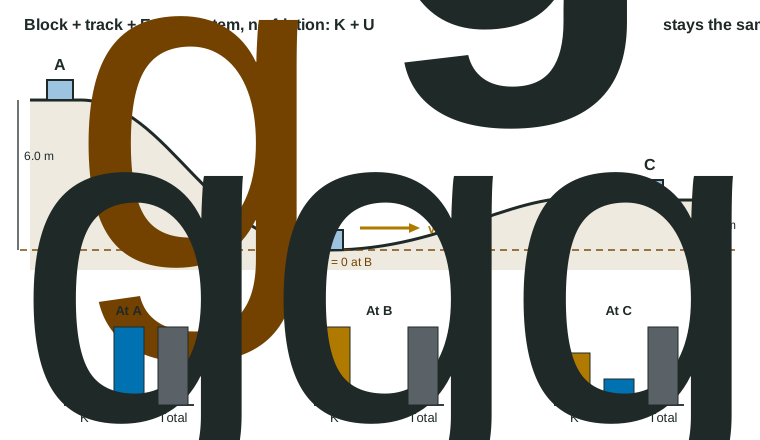
Diagram
A block on a frictionless track
The block has a mass of 2.0 kg. Use g = 9.8 m/s². Air resistance is negligible.
1. How fast is the block moving at B, in m/s?
Type a number in m/s.
Show the answer
System: block + track + Earth, no friction, so K + U_g is constant: mg(6.0 m) = ½mv_B². v_B = √(2 × 9.8 m/s² × 6.0 m) = 11 m/s.
- Answer: 11 m/s
2. How fast is the block moving at C, in m/s?
Type a number in m/s.
Show the answer
mg(6.0 m) = mg(2.0 m) + ½mv_C², so v_C = √(2g(4.0 m)) = √(78.4) m/s = 8.9 m/s.
- Answer: 8.9 m/s
3. Which describes an energy bar chart for the block-track-Earth system at C, with the zero of U_g at B?
- K is twice U_g, and K + U_g equals the U_g bar at A
- K and U_g are equal, each one half of the total energy
- U_g is twice K, because C is high on the track
- K is twice U_g, and the total is less than at A
Show the answer
Total = mg(6.0 m). At C: U_g = mg(2.0 m) = ⅓ of the total and K = ⅔ of it. The bars must add to the same total at every point.
- Correct: K is twice U_g, and K + U_g equals the U_g bar at A: Right: at C, U_g = mg(2.0 m) and K = mg(4.0 m), adding to mg(6.0 m).
- K and U_g are equal, each one half of the total energy: Bars are not split evenly by default; the heights decide. C is at one third of A's height.
- U_g is twice K, because C is high on the track: C is 2.0 m up out of 6.0 m, so U_g is one third of the total, not two thirds.
- K is twice U_g, and the total is less than at A: With no friction the total stays the same as at A.
4. Now take the block alone as the system. Which statement is correct as it slides from A to B?
- The block alone has gravitational potential energy that turns into kinetic energy
- The block's energy is constant, because the track is frictionless and nothing slows it
- It has just kinetic energy, and Earth's pull, now external, does positive work on it
- The normal force from the track does the work that speeds the block up
Show the answer
Choosing the system decides the bookkeeping. Block alone: only K, and W_grav = +mg(6.0 m) = ΔK. Block + Earth: U_g changes into K with no external work. Both give the same speed.
- The block alone has gravitational potential energy that turns into kinetic energy: Potential energy belongs to a system of interacting objects. With Earth outside, there is no U_g.
- The block's energy is constant, because the track is frictionless and nothing slows it: Earth is outside the system and does positive work, so the block's energy (all kinetic) increases.
- Correct: It has just kinetic energy, and Earth's pull, now external, does positive work on it: Right: a one-object system has no potential energy, so gravity's work is an energy transfer in.
- The normal force from the track does the work that speeds the block up: The normal force is perpendicular to the track, so it does no work.
5. A block slides down a frictionless ramp. Which is the best justification that the mechanical energy of the block-Earth system stays constant?
- Mechanical energy is constant because energy is conserved
- The block's speed stays constant as it slides down the ramp
- Gravity does no work on the block, since the ramp supports it
- No friction acts, and the normal force is perpendicular to the motion, so it does no work
Show the answer
K + U_g stays constant when no external force does net work on the system and no nonconservative force acts inside it. State that condition, not just the conservation law.
- Mechanical energy is constant because energy is conserved: This is circular. Total energy is always conserved; mechanical energy is constant only under a condition, which must be stated.
- The block's speed stays constant as it slides down the ramp: The block speeds up; its kinetic energy grows as U_g falls.
- Gravity does no work on the block, since the ramp supports it: Gravity does positive work. Inside the block-Earth system that appears as a drop in U_g.
- Correct: No friction acts, and the normal force is perpendicular to the motion, so it does no work: Right: it names the condition (no external work, no internal nonconservative force).
6. A roller coaster car passes over a 30.0 m high hill at 4.00 m/s. Friction is negligible. How fast is it moving when it is 10.0 m above the ground? Use g = 9.8 m/s².
Type a number in m/s.
Show the answer
½mv_i² + mg(30.0 m) = ½mv_f² + mg(10.0 m), so v_f = √(v_i² + 2g(20.0 m)) = √(16.0 + 392) m/s = 20.2 m/s.
- Answer: 20.2 m/s
Part 9 · Summary
Summary
Part 10 · Up next
What comes next
Part 11 · Connections