Internal Structure and Density
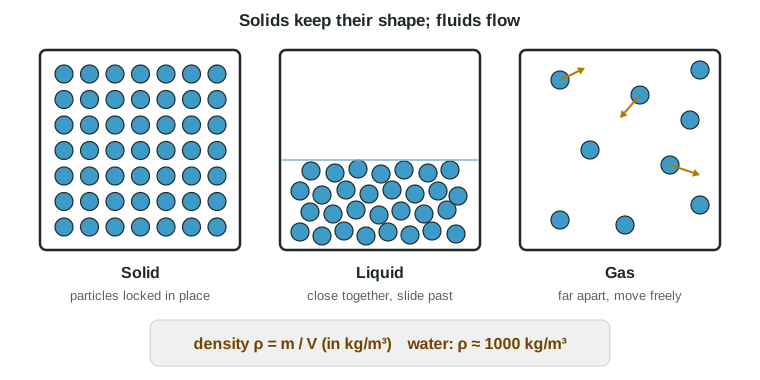
Fluids (liquids and gases) flow because their particles can move past one another; density ρ = m/V is a property of the material, and an ideal fluid is incompressible and nonviscous, so its density is constant.
Part 1 · Hook
Why this matters
Part 2 · Before you start
What this builds on
Part 3 · Prerequisite check
Quick check before you start
1. Which is the SI unit of mass?
- kilogram
- gram
- newton
- liter
Show the answer
Mass is measured in kilograms in SI; the newton is a unit of force.
- Correct: kilogram:
- gram:
- newton:
- liter:
2. How many cubic centimeters are in 1 m³?
- 1,000,000
- 100
- 1000
- 10,000
Show the answer
1 m = 100 cm, so 1 m³ = (100 cm)³ = 10⁶ cm³.
- Correct: 1,000,000:
- 100:
- 1000:
- 10,000:
Part 4 · See it
See it first
Part 5 · Step by step
How it works, step by step
- In a solid the particles are held in fixed positionsthe solid keeps its own shape
- In a liquid or gas the particles can move past one anotherthe material flows and takes its container's shape: it is a fluid
- Liquid particles are already touchinga liquid is nearly incompressible, so its density stays almost constant
- The model of an ideal fluid ignores compression and internal frictiona fluid is described by one fixed density ρ = m/V
Part 6 · Key ideas
Key ideas
- A fluid is a substance that flows: a liquid or a gas. Its particles can slide past each other, so it has no fixed shape.
- Density is mass per volume, ρ = m/V, in kg/m³. It belongs to the material: cut a sample in half and its density does not change.
- Unit check: 1 g/cm³ = 1000 kg/m³. Water is about 1000 kg/m³, aluminum 2700 kg/m³, air about 1.2 kg/m³.
- An ideal fluid is incompressible (constant density) and nonviscous (no internal friction). Treat every fluid on the exam as ideal unless told otherwise.
Part 7 · Misconception
A common mistake
The wrong idea: A bigger or heavier object has a greater density.
What actually happens: Density is mass per volume. A large block of aluminum and a small one have the same density; a small gold ring is denser than a large aluminum pan.
Part 8 · Check yourself
Check yourself
Exam-style questions. Anything you miss goes into your review queue.
Data table
Four metal samples
A student measures the mass of four small metal samples on a balance and finds each volume by lowering the sample into a graduated cylinder of water and reading the rise in the water level.
| Sample | Mass (g) | Volume (cm³) |
|---|---|---|
| A | 27.0 | 10.0 |
| B | 89.6 | 10.0 |
| C | 54.0 | 20.0 |
| D | 19.3 | 1.0 |
1. What is the density of sample B in SI units? Give the value and its unit.
Type a number and its unit.
Show the answer
ρ = m/V = 89.6 g / 10.0 cm³ = 8.96 g/cm³. Since 1 g/cm³ = 1000 kg/m³ (1 g = 10⁻³ kg and 1 cm³ = 10⁻⁶ m³), ρ = 8.96 × 10³ kg/m³.
- Answer: 8.96 × 10³ kg/m^3
2. Which two samples could be made of the same metal?
- A and C
- A and B
- B and D
- C and D
Show the answer
Density is a property of the material, not of the sample's size. A: 27.0/10.0 = 2.70 g/cm³; C: 54.0/20.0 = 2.70 g/cm³. Same density, likely the same metal (aluminum has 2.70 g/cm³).
- Correct: A and C: Right: C has twice the mass and twice the volume of A, so the same density.
- A and B: A has 2.70 g/cm³ and B has 8.96 g/cm³: same volume, very different masses.
- B and D: B has 8.96 g/cm³ and D has 19.3 g/cm³.
- C and D: C has 2.70 g/cm³ and D has 19.3 g/cm³; D's small volume makes its mass misleading.
3. Sample C is cut into two pieces, one twice the volume of the other. How does the density of the smaller piece compare with the density of sample C?
- It is the same
- It is one third as large
- It is half as large
- It is two thirds as large
Show the answer
Cutting reduces mass and volume in the same ratio, so m/V does not change. Density belongs to the material.
- Correct: It is the same: Right: density does not depend on how much of the material you have.
- It is one third as large: The smaller piece has one third of the mass and one third of the volume, so the ratio is unchanged.
- It is half as large: Halving would need the mass to drop without the volume dropping.
- It is two thirds as large: Both mass and volume shrink by the same factor.
4. A block of the same metal as sample D has a volume of 2.0 × 10⁻⁴ m³. What is its mass? Give the value and its unit.
Type a number and its unit.
Show the answer
ρ = 19.3 g/cm³ = 1.93 × 10⁴ kg/m³. m = ρV = (1.93 × 10⁴ kg/m³)(2.0 × 10⁻⁴ m³) = 3.86 kg ≈ 3.9 kg.
- Answer: 3.9 kg
5. Cube X is made of the same material as cube Y but has sides twice as long. How does the mass of X compare with the mass of Y?
- 8 times as large
- 2 times as large
- 4 times as large
- The same
Show the answer
Same material, same density. Volume = side³, so doubling the side gives 2³ = 8 times the volume, and m = ρV gives 8 times the mass.
- Correct: 8 times as large: Right: volume, and so mass, goes as the cube of the side.
- 2 times as large: This treats the volume as proportional to the side length.
- 4 times as large: This uses the area of one face (side²) instead of the volume.
- The same: Density is the same, but a bigger cube contains more material.
6. A 250 cm³ sample of olive oil has a mass of 0.229 kg. What is its density in SI units? Give the value and its unit.
Type a number and its unit.
Show the answer
V = 250 cm³ = 250 × 10⁻⁶ m³ = 2.50 × 10⁻⁴ m³. ρ = m/V = 0.229 kg / 2.50 × 10⁻⁴ m³ = 916 kg/m³, a little less than water.
- Answer: 916 kg/m^3
Part 9 · Summary
Summary
Part 10 · Up next
What comes next
Part 11 · Connections