Unit 9 practice test: Global Change
12 exam-style questions from the unit, free, with an explanation for every option. Most have four answer choices, as on the real exam, and a few ask you to type a calculation with its units; sets share one data table, graph, model or passage.
Covers: Stratospheric Ozone Depletion; Reducing Ozone Depletion; The Greenhouse Effect; Increases in the Greenhouse Gases; Global Climate Change; Ocean Warming; Ocean Acidification; Invasive Species; Endangered Species; Human Impacts on Biodiversity.
Model or diagram
Two positive feedback loops
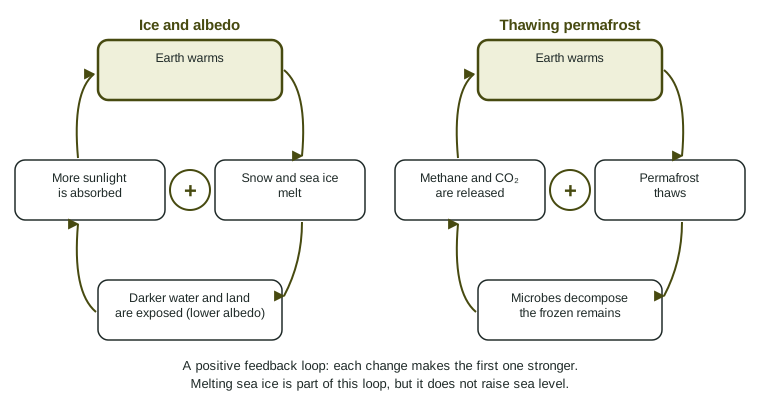
1. In the left loop of the figure, what happens after snow and sea ice melt?
- Darker surfaces lower the albedo
- More sunlight is reflected to space
- Earth cools and the loop stops
- Sea level rises sharply
Show the answer
Ice is bright and reflective; water and land are darker, so albedo falls and more energy is absorbed.
- Correct: Darker surfaces lower the albedo: Right: dark water and land reflect less sunlight than white ice.
- More sunlight is reflected to space: Less ice means less reflection, not more.
- Earth cools and the loop stops: The loop continues: more sunlight is absorbed.
- Sea level rises sharply: Floating sea ice does not raise sea level as it melts.
2. Why are both loops called positive feedback loops?
- Each one is good for the environment
- Each one makes warming stronger
- Each one slows warming down
- Each one starts with a decrease in CO₂
Show the answer
Positive feedback amplifies; negative feedback dampens.
- Each one is good for the environment: "Positive" describes amplifying a change, not a good outcome.
- Correct: Each one makes warming stronger: Right: "positive" means the loop amplifies the change, not that it is good.
- Each one slows warming down: A loop that slows the change is a negative feedback.
- Each one starts with a decrease in CO₂: Both start with warming.
3. The figure says melting sea ice is part of a feedback loop but does not raise sea level. How can both be true?
- It raises sea level a lot, so the caption is wrong
- It does not melt in a warming climate
- Its melt adds no water, but it lowers albedo
- It is part of land ice, which adds water
Show the answer
Sea ice: an albedo feedback, but no sea level rise. Land ice: sea level rise.
- It raises sea level a lot, so the caption is wrong: Floating ice already displaces its weight in water.
- It does not melt in a warming climate: Arctic sea ice has shrunk sharply.
- Correct: Its melt adds no water, but it lowers albedo: Right: sea ice matters for heat absorbed, not for ocean volume.
- It is part of land ice, which adds water: Sea ice floats on the ocean; land ice sits on land.
Model or diagram
Carbon dioxide in ice cores over 800,000 years
4. In the ice core record, what was the highest CO₂ level before the industrial era?
- About 420 ppm
- About 180 ppm
- About 290 ppm
- About 800 ppm
Show the answer
The peaks of the record, during warm periods between ice ages, reach about 290 ppm.
- About 420 ppm: That is today’s level, measured directly, not in the ice core record.
- About 180 ppm: That is the lowest level, during ice ages.
- Correct: About 290 ppm: Right: the highest peaks reach about 290 ppm.
- About 800 ppm: 800 is the number of thousands of years the record covers, not ppm.
5. What pattern does the record show over 800,000 years?
- CO₂ rose steadily the whole time
- CO₂ stayed at about 280 ppm the whole time
- CO₂ fell steadily to today
- CO₂ cycled between about 180 and 290 ppm
Show the answer
Natural cycles, tied to ice ages, moved CO₂ up and down within a range.
- CO₂ rose steadily the whole time: It rose and fell many times.
- CO₂ stayed at about 280 ppm the whole time: It swung by about 100 ppm.
- CO₂ fell steadily to today: It cycled up and down.
- Correct: CO₂ cycled between about 180 and 290 ppm: Right: low in ice ages, high in warm periods, again and again.
6. How does today’s CO₂ level of over 420 ppm compare with the ice core record?
- It is far above the highest natural peak
- It is within the natural range
- It is lower than in past warm periods
- It matches the lowest point of the last ice age
Show the answer
Human emissions have pushed CO₂ well beyond anything in the last 800,000 years.
- Correct: It is far above the highest natural peak: Right: 420 ppm is about 130 ppm above the record’s highest peak.
- It is within the natural range: The highest natural value was about 290 ppm.
- It is lower than in past warm periods: Past warm periods reached about 290 ppm, far below 420.
- It matches the lowest point of the last ice age: Ice ages were near 180 ppm.
7. Which health effect is most directly linked to thinning of the stratospheric ozone layer?
- More skin cancer and cataracts from extra UV
- More asthma attacks from breathing ozone
- More heat stroke from a warmer climate
- More lung cancer from breathing CFCs
Show the answer
Stratospheric ozone absorbs UV-B; thinning lets more reach the surface, raising skin cancer and cataract rates.
- Correct: More skin cancer and cataracts from extra UV: Right: less ozone lets more UV-B through, damaging skin and eyes.
- More asthma attacks from breathing ozone: That is ground-level ozone in smog, a different problem.
- More heat stroke from a warmer climate: Warming comes from heat-trapping gases, not from ozone loss.
- More lung cancer from breathing CFCs: CFCs harm health by destroying ozone, which lets in UV.
8. Why were HCFCs used as replacements for CFCs, and why are they being phased out too?
- They contain no chlorine, but they are toxic to breathe
- They destroy less ozone, but still contain some chlorine
- They make more ozone than CFCs destroy, so they are too strong
- They are cheaper than CFCs, but they cause acid rain
Show the answer
HCFCs were a stopgap: less ozone-depleting than CFCs, not harmless. They are being phased out on a later schedule.
- They contain no chlorine, but they are toxic to breathe: HCFCs do contain chlorine; that is why they still deplete some ozone.
- Correct: They destroy less ozone, but still contain some chlorine: Right: HCFCs break down lower in the atmosphere, so less chlorine reaches the stratosphere, but some does.
- They make more ozone than CFCs destroy, so they are too strong: HCFCs do not make ozone.
- They are cheaper than CFCs, but they cause acid rain: Acid rain comes from NOx and SOx, not HCFCs.
9. Without any greenhouse effect, Earth’s average surface temperature would be about −18 °C instead of about 15 °C. What does this show?
- The greenhouse effect began with the Industrial Revolution
- The natural effect keeps Earth warm enough for life
- Earth would be warmer without greenhouse gases
- Greenhouse gases block sunlight from reaching the surface
Show the answer
The greenhouse effect is natural and necessary; the problem is the enhanced effect from added gases.
- The greenhouse effect began with the Industrial Revolution: The natural effect existed long before people; humans are strengthening it.
- Correct: The natural effect keeps Earth warm enough for life: Right: natural greenhouse gases warm the surface by about 33 °C.
- Earth would be warmer without greenhouse gases: Without them it would be about 33 °C colder.
- Greenhouse gases block sunlight from reaching the surface: Most sunlight passes through; the gases absorb outgoing infrared.
10. Why does a warmer ocean hold less dissolved oxygen?
- Warm water has more algae that eat the oxygen
- Warm water is denser, squeezing oxygen out
- Gases dissolve less in warm water
- Fish breathe less in warm water
Show the answer
Lower solubility plus a warm surface layer that mixes less both lower the oxygen in parts of the ocean.
- Warm water has more algae that eat the oxygen: The main reason is solubility; algae make oxygen by photosynthesis.
- Warm water is denser, squeezing oxygen out: Warm water is less dense, not more.
- Correct: Gases dissolve less in warm water: Right: oxygen is less soluble as water warms, like a soda going flat faster when warm.
- Fish breathe less in warm water: Fish need more oxygen in warm water, which makes the drop worse.
11. Surface ocean pH has fallen from about 8.2 to about 8.1 since the 1700s. Which statement is correct?
- Seawater is now an acid, with a pH below 7
- The change is too small to matter, since pH barely moved
- Seawater has become neutral, with a pH of 7
- Seawater is still basic, but it is less basic than before
Show the answer
Acidification describes a direction: pH falling toward 7, not that the ocean is acidic.
- Seawater is now an acid, with a pH below 7: A pH of 8.1 is above 7, so it is still basic.
- The change is too small to matter, since pH barely moved: The pH scale is logarithmic, so 0.1 is about 26% more hydrogen ions.
- Seawater has become neutral, with a pH of 7: 8.1 is not 7.
- Correct: Seawater is still basic, but it is less basic than before: Right: pH above 7 is basic; "acidification" means moving toward acid.
12. A student writes that an invasive species succeeds because of its trait "no predators." Why would an exam reader not accept this as a trait?
- Invasive species usually have many predators in their new home
- Predators have no effect on how a species spreads
- Lacking predators describes its new habitat, not the species
- The answer should name a predator that eats it
Show the answer
Name a trait of the organism (generalist diet, high reproductive rate, tolerance of many conditions); "no natural predators" describes the new ecosystem.
- Invasive species usually have many predators in their new home: Invasive species often meet few predators; that is about the setting, not a trait.
- Predators have no effect on how a species spreads: Few predators do help spread; the issue is that it is not a trait.
- Correct: Lacking predators describes its new habitat, not the species: Right: a trait belongs to the organism, such as fast reproduction or a broad diet.
- The answer should name a predator that eats it: The question asks for a trait of the species itself.
Keep going
Practice has every question in the unit, with feedback after each one; the notes for every topic are free. Other units: Unit 1 · Unit 2 · Unit 3 · Unit 4 · Unit 5 · Unit 6 · Unit 7 · Unit 8 · Unit 9.