Unit 5 practice test: Land and Water Use
12 exam-style questions from the unit, free, with an explanation for every option. Most have four answer choices, as on the real exam, and a few ask you to type a calculation with its units; sets share one data table, graph, model or passage.
Covers: The Tragedy of the Commons; Clearcutting; The Green Revolution; Impacts of Agricultural Practices; Irrigation Methods; Pest Control Methods; Meat Production Methods; Impacts of Overfishing; Impacts of Mining; Impacts of Urbanization; Ecological Footprints; Introduction to Sustainability; Methods to Reduce Urban Runoff; Integrated Pest Management; Sustainable Agriculture; Aquaculture; Sustainable Forestry.
Model or diagram
A tilled field and an untilled field in cross-section
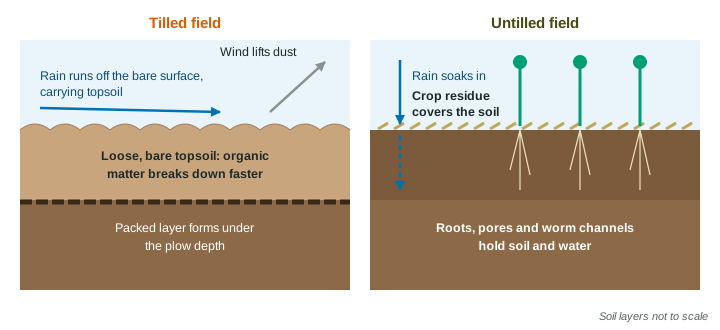
1. According to the diagram, what covers the surface of the untilled field?
- Crop residue left from the last harvest
- A packed layer under the plow depth
- Loose, bare topsoil lifted by the wind
- Dust blown in from the tilled field nearby
Show the answer
The untilled panel labels crop residue covering the soil.
- Correct: Crop residue left from the last harvest: Right: residue covers the untilled surface.
- A packed layer under the plow depth: The packed layer is in the tilled panel, below the surface.
- Loose, bare topsoil lifted by the wind: Bare topsoil is in the tilled panel.
- Dust blown in from the tilled field nearby: The diagram shows dust leaving the tilled field, not landing on the other.
2. Using the diagram, why would a heavy rain cause more runoff from the tilled field?
- Water runs off bare soil, and the packed layer below slows water from soaking in
- Crop residue on the tilled field soaks up the rain before it reaches the soil
- Worm channels in the tilled field carry the water quickly down to groundwater
- Roots in the tilled field pull water out of the soil as fast as it falls
Show the answer
The tilled field has a bare surface and a packed layer; the untilled field has residue, roots and channels that let water in.
- Correct: Water runs off bare soil, and the packed layer below slows water from soaking in: Right: a bare surface and a packed layer push water to run off.
- Crop residue on the tilled field soaks up the rain before it reaches the soil: Residue is on the untilled field, not the tilled one.
- Worm channels in the tilled field carry the water quickly down to groundwater: Worm channels are drawn in the untilled field.
- Roots in the tilled field pull water out of the soil as fast as it falls: Roots and their channels are in the untilled field.
3. The Dust Bowl of the 1930s struck farms on the southern Great Plains. Which part of the diagram best explains it?
- The tilled field: bare, loose topsoil that wind lifts as dust in a drought
- The untilled field: residue that dries out and blows away in a strong wind
- The untilled field: worm channels that drain the soil and leave it dry
- The tilled field: the packed layer, which blows away before the topsoil
Show the answer
Plowed grassland left loose, bare soil; in years of drought, wind carried it away in dust storms.
- Correct: The tilled field: bare, loose topsoil that wind lifts as dust in a drought: Right: plowed, bare soil plus drought equals dust storms.
- The untilled field: residue that dries out and blows away in a strong wind: Residue protects soil from wind; it is not what blew away.
- The untilled field: worm channels that drain the soil and leave it dry: Worm channels help water soak in; they did not cause the dust storms.
- The tilled field: the packed layer, which blows away before the topsoil: The packed layer is below the topsoil; the topsoil blew away.
Model or diagram
A hillside before and after clearcutting
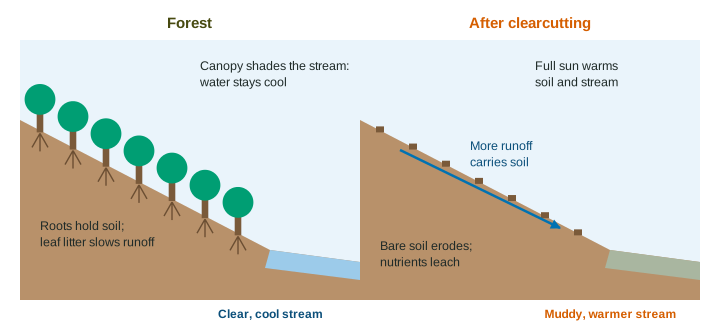
4. In the diagram, what keeps the stream in the forested panel cool?
- The canopy shades the stream from direct sun
- Runoff from the slope brings cold soil into it
- Leaf litter on the slope cools the water as it flows
- Roots pull warm water out of the stream at night
Show the answer
The forest label says the canopy shades the stream, so the water stays cool.
- Correct: The canopy shades the stream from direct sun: Right: shade from the canopy.
- Runoff from the slope brings cold soil into it: Soil carried by runoff makes water muddy, not cool.
- Leaf litter on the slope cools the water as it flows: Leaf litter slows runoff and holds soil; it does not cool the stream.
- Roots pull warm water out of the stream at night: The diagram shows roots holding soil, not pulling water from the stream.
5. Which pair of labels in the clearcut panel are linked as cause and effect?
- "More runoff carries soil" causes the "muddy" stream
- "Full sun warms soil and stream" causes "more runoff"
- "Bare soil erodes" causes the stream to be "warmer"
- "Nutrients leach" causes "full sun" to reach the stream
Show the answer
Runoff carrying soil is what makes the stream muddy. Sun causes the warming.
- Correct: "More runoff carries soil" causes the "muddy" stream: Right: runoff carries soil into the stream and makes it muddy.
- "Full sun warms soil and stream" causes "more runoff": Sunlight warms the ground; it does not cause the extra runoff (bare soil does).
- "Bare soil erodes" causes the stream to be "warmer": Erosion makes the stream muddy; the sun makes it warmer.
- "Nutrients leach" causes "full sun" to reach the stream: Leaching does not cause sunlight; losing the canopy does.
6. A town takes its drinking water from a river fed by the stream in the right-hand panel. Which effect on the town is most likely?
- More sediment in the water, so cleaning it for drinking costs more
- Colder water, so less energy is needed to heat it in homes
- More dissolved oxygen, so the water tastes fresher than before
- Less nitrate, so the water meets drinking standards more easily
Show the answer
Sediment washed from the clearcut makes water muddier, and removing it at a treatment plant costs money.
- Correct: More sediment in the water, so cleaning it for drinking costs more: Right: muddy water costs more to clean.
- Colder water, so less energy is needed to heat it in homes: The stream is warmer after clearcutting, not colder.
- More dissolved oxygen, so the water tastes fresher than before: Warmer water holds less oxygen, not more.
- Less nitrate, so the water meets drinking standards more easily: Nitrate rises after clearcutting, as the roots no longer take it up.
7. Forty farms pump irrigation water from the same aquifer, and no rule limits how much each farm pumps. Over 20 years the water table drops 30 meters. Which statement best explains the drop?
- Each farm gains the full value of the water it pumps, while the lower water table is a cost shared by all forty farms
- The aquifer is recharged by rain faster than the forty farms together can pump it, so the water table drops just in the driest years
- Each farm pumps less each year because the cost of pumping falls as the water table drops
- Groundwater is a private resource, so each farm owner protects the water under their own land
Show the answer
This is the tragedy of the commons: the gain from pumping goes to one farm, the cost (a falling water table) is spread over all of them.
- Correct: Each farm gains the full value of the water it pumps, while the lower water table is a cost shared by all forty farms: Right: individual gain and shared cost push every farm to pump more than the aquifer can renew.
- The aquifer is recharged by rain faster than the forty farms together can pump it, so the water table drops just in the driest years: If recharge were faster than pumping, the water table would not fall 30 meters.
- Each farm pumps less each year because the cost of pumping falls as the water table drops: Pumping costs rise as the water table drops, because water must be lifted farther.
- Groundwater is a private resource, so each farm owner protects the water under their own land: The water is shared: pumping on one farm lowers the water table under its neighbors too.
8. Which is a cost of growing one high-yield rice variety on almost every farm in a region?
- A disease that attacks that variety can spread through the whole crop at once
- The rice will produce less grain per hectare than the older varieties it replaced
- The region will need to clear more forest to grow the same amount of rice
- The rice will need less fertilizer, so fertilizer factories will close
Show the answer
A monoculture of one variety has low genetic diversity, so plants share the same weaknesses.
- Correct: A disease that attacks that variety can spread through the whole crop at once: Right: identical plants share the same weakness to a disease.
- The rice will produce less grain per hectare than the older varieties it replaced: High-yield varieties produce more grain per hectare, not less.
- The region will need to clear more forest to grow the same amount of rice: Higher yields mean less land is needed for the same harvest.
- The rice will need less fertilizer, so fertilizer factories will close: High-yield varieties need more fertilizer, not less.
9. A farmer in a poor region is choosing an irrigation method. Which is the main drawback of drip irrigation for this farmer?
- It costs the most to buy and install
- It wastes the most water of the four methods
- It is the most likely to cause waterlogging
- It needs the field to be covered with water
Show the answer
Drip irrigation saves water, but its tubing and fittings are expensive to install and maintain.
- Correct: It costs the most to buy and install: Right: high cost is drip's main drawback.
- It wastes the most water of the four methods: Drip wastes the least water.
- It is the most likely to cause waterlogging: Drip applies small amounts, so it rarely waterlogs soil.
- It needs the field to be covered with water: That describes flood irrigation.
10. Which is an advantage of using a pesticide on a large cornfield?
- It can quickly cut crop losses to pests, so yields rise
- It increases the number of bees that pollinate the crop
- It adds nitrogen to the soil, so less fertilizer is needed
- It makes pests less likely to evolve resistance over time
Show the answer
Pesticides protect the crop, so more of it reaches harvest.
- Correct: It can quickly cut crop losses to pests, so yields rise: Right: fewer losses to pests means a bigger harvest.
- It increases the number of bees that pollinate the crop: Pesticides often kill bees and other pollinators.
- It adds nitrogen to the soil, so less fertilizer is needed: Pesticides do not supply nutrients.
- It makes pests less likely to evolve resistance over time: Repeated spraying is what causes resistance.
11. A large hog CAFO stores manure in an open lagoon. A hurricane floods the lagoon. Which is the most likely effect on the river nearby?
- Manure washes into the river, adding nutrients and bacteria
- The river gets cooler water from the lagoon, which raises its dissolved oxygen
- The manure stays in the lagoon because it is heavier than the floodwater
- The river gets less nitrogen because the flood dilutes it across the land
Show the answer
Concentrated manure is a large store of nutrients and bacteria; floods and leaks carry it into rivers.
- Correct: Manure washes into the river, adding nutrients and bacteria: Right: manure brings nutrients and bacteria into the river.
- The river gets cooler water from the lagoon, which raises its dissolved oxygen: Lagoon water is not cooler or oxygen-rich.
- The manure stays in the lagoon because it is heavier than the floodwater: Floodwater carries manure out; it does not hold it in.
- The river gets less nitrogen because the flood dilutes it across the land: Adding manure adds nitrogen to the river.
12. Bottom trawlers drag heavy nets along the sea floor. Besides catching fish, what harm does this cause?
- It crushes corals and sponges that shelter young fish and other sea life
- It raises the temperature of the water near the bottom of the sea
- It adds nutrients to the sea floor, so the fish grow more slowly than before
- It lowers the salinity of the water near the bottom of the sea
Show the answer
Trawl nets scrape the bottom flat, destroying the structures many young fish and invertebrates live in.
- Correct: It crushes corals and sponges that shelter young fish and other sea life: Right: the sea floor habitat is destroyed.
- It raises the temperature of the water near the bottom of the sea: Trawling does not warm the water.
- It adds nutrients to the sea floor, so the fish grow more slowly than before: Nutrients are not the main harm of trawling.
- It lowers the salinity of the water near the bottom of the sea: Trawling does not change salinity.
Keep going
Practice has every question in the unit, with feedback after each one; the notes for every topic are free. Other units: Unit 1 · Unit 2 · Unit 3 · Unit 4 · Unit 5 · Unit 6 · Unit 7 · Unit 8 · Unit 9.