Total Fertility Rate
The total fertility rate is the average number of children a woman would have in her lifetime.
Part 1 · Hook
Why this matters
Part 2 · Before you start
What this builds on
Part 3 · Prerequisite check
Quick check before you start
1. What does a wide base on a population pyramid predict?
- Rapid population growth
- A shrinking population
- No change in population
- A population of mostly older people
Show the answer
A wide base means many young people who will soon have children.
- Correct: Rapid population growth:
- A shrinking population:
- No change in population:
- A population of mostly older people:
2. Why can a population keep growing for decades after families get smaller?
- Population momentum: large young cohorts are still reaching parenting age
- People live forever
- Families get larger again
- Deaths stop
Show the answer
The large young cohorts still have to have their own children.
- Correct: Population momentum: large young cohorts are still reaching parenting age:
- People live forever:
- Families get larger again:
- Deaths stop:
Part 4 · See it
See it first
Part 5 · Step by step
How it works, step by step
- Girls and women get more years of schooling and more chances to work for paythey tend to marry and have children later, and choose to have fewer
- Infant mortality falls, and family planning becomes easier to getparents no longer need many births to be sure some children survive, and they can choose how many to have
- The total fertility rate falls toward or below replacement level, about 2.1population growth slows, and in time the population can stop growing or start to shrink
Part 6 · Key ideas
Key ideas
- The total fertility rate (TFR) is the average number of children a woman would have in her lifetime at a population’s current birth patterns.
- Replacement-level fertility is the TFR at which each generation just replaces itself: about 2.1 in countries where few children die young. It is a little above 2 because some children die before adulthood and slightly more boys than girls are born.
- Infant mortality is the number of babies who die before their first birthday, per 1,000 live births. Where it is high, families tend to have more children; as it falls, TFR tends to fall too.
- Factors that lower TFR: more education and paid work for women, access to family planning, lower infant mortality, people moving to cities, pensions for old age. Factors that raise it: early marriage, children working on family farms, religious and cultural values that favor large families.
Part 7 · Misconception
A common mistake
The wrong idea: A TFR of 2.0 means the population is growing slowly, because 2 is more than 0.
What actually happens: Two children replace two parents, but not quite: some children die before having their own, so a population needs about 2.1 to replace itself. Over the long run, a TFR of 2.0 means a slowly shrinking population.
Part 8 · Check yourself
Check yourself
Exam-style questions. Anything you miss goes into your review queue.
Model or diagram
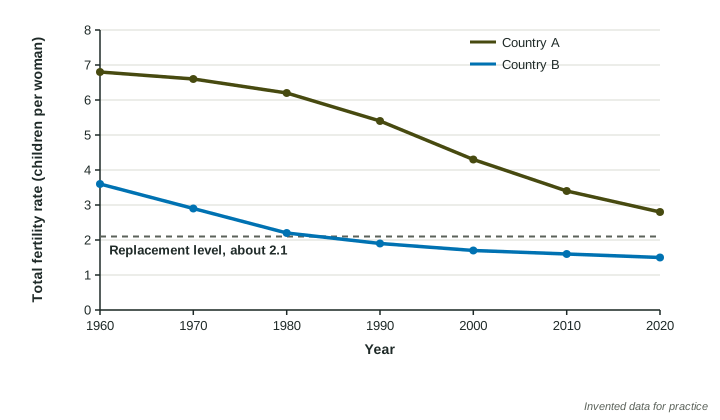
Total fertility rate in two countries
1. In about which year did Country B’s total fertility rate first fall below replacement level?
- Between 1980 and 1990
- Between 1960 and 1970
- Between 2000 and 2010
- It stays above replacement through 2020
Show the answer
Find where the line crosses the dashed replacement level.
- Correct: Between 1980 and 1990: Right: it was 2.2 in 1980, just above 2.1, and 1.9 in 1990, below it.
- Between 1960 and 1970: In 1970 Country B’s TFR was 2.9, still above 2.1.
- Between 2000 and 2010: By 2000 it was already 1.7, below replacement.
- It stays above replacement through 2020: From 1990 on, it is below the 2.1 line.
2. Write the setup for the percent change in Country A’s total fertility rate from 1960 to 2020, then give the answer, rounded to one decimal place.
Type the setup as on the exam, with brackets and units, then the answer.
Show the answer
Start at 6.8:
- Setup: ; answer -58.8 %
3. Country A’s TFR in 2020 is 2.8. What does this predict for its population, if nothing else changes?
- It will shrink, because the TFR has been falling
- It keeps growing: 2.8 is above 2.1
- It holds steady, since 2.8 is close to 2
- It will double each year from now on
Show the answer
Compare TFR with about 2.1 to predict long-run growth or decline.
- It will shrink, because the TFR has been falling: A falling TFR still above 2.1 means slower growth, not decline.
- Correct: It keeps growing: 2.8 is above 2.1: Right: each generation more than replaces itself.
- It holds steady, since 2.8 is close to 2: Replacement is about 2.1; 2.8 is well above it.
- It will double each year from now on: A TFR of 2.8 means growth, but nowhere near doubling each year.
4. Country B has been below replacement since about 1990. Which long-run problem is it most likely to face?
- Too few schools for a growing number of children
- Rapid population growth that outruns its food
- Fewer workers and a larger share of older people
- A sharp rise in infant mortality
Show the answer
Low fertility over decades shrinks young cohorts and ages the population.
- Too few schools for a growing number of children: Below-replacement fertility means fewer children, not more.
- Rapid population growth that outruns its food: A TFR of 1.5 means the population will tend to shrink.
- Correct: Fewer workers and a larger share of older people: Right: fewer births mean smaller young cohorts, so in time fewer workers support more retirees.
- A sharp rise in infant mortality: A low TFR does not cause infant mortality to rise.
Data
Schooling, infant mortality and fertility
| Country | Women’s schooling (years) | Infant mortality (deaths per 1,000 live births) | Total fertility rate |
|---|---|---|---|
| P | 2 | 85 | 6.1 |
| Q | 5 | 50 | 4.4 |
| R | 8 | 25 | 3.0 |
| S | 11 | 8 | 2.0 |
| T | 13 | 4 | 1.6 |
5. What relationship does the table show between women’s years of schooling and total fertility rate?
- As schooling increases, TFR increases
- As schooling increases, TFR decreases
- There is no relationship between them
- TFR is highest where schooling is highest
Show the answer
Describe the direction of the relationship, with the end values.
- As schooling increases, TFR increases: TFR falls as schooling rises.
- Correct: As schooling increases, TFR decreases: Right: from 2 years and 6.1 children down to 13 years and 1.6.
- There is no relationship between them: TFR falls steadily across the five countries.
- TFR is highest where schooling is highest: Country T, with the most schooling, has the lowest TFR.
6. Which explanation best links infant mortality to the total fertility rates in the table?
- Low infant mortality makes families want more children
- Infant mortality and TFR are unrelated
- Where many babies die, families have more births
- High TFR causes infant mortality to fall
Show the answer
When fewer children die, parents need fewer births to raise the family size they want.
- Low infant mortality makes families want more children: The table shows lower infant mortality with lower TFR.
- Infant mortality and TFR are unrelated: They fall together across the five countries.
- Correct: Where many babies die, families have more births: Right: Country P has 85 infant deaths per 1,000 and a TFR of 6.1; Country T has 4 and 1.6.
- High TFR causes infant mortality to fall: The pattern runs the other way: high TFR goes with high infant mortality.
7. A country wants to lower its high total fertility rate without forcing anyone. Which policy is most likely to work, based on this topic?
- Free schooling for girls, and clinics
- Paying families a bonus for each new child
- Lowering the legal age of marriage
- Closing clinics that care for infants
Show the answer
Expanding education and choice lowers fertility without force.
- Correct: Free schooling for girls, and clinics: Right: both lower TFR by expanding choice, and both have worked in many countries.
- Paying families a bonus for each new child: Payments per child tend to raise fertility.
- Lowering the legal age of marriage: Earlier marriage tends to raise fertility.
- Closing clinics that care for infants: Higher infant mortality tends to raise TFR, and it harms children.
Part 9 · Summary
Summary
Part 10 · Up next
What comes next
Part 11 · Connections