Human Population Dynamics
Crude birth and death rates count births and deaths per 1,000 people per year.
Part 1 · Hook
Why this matters
Part 2 · Before you start
What this builds on
Part 3 · Prerequisite check
Quick check before you start
1. A population grows 2% a year. Using the rule of 70, what is its doubling time?
- 35 years
- 2 years
- 140 years
- 0.35 years
Show the answer
70 divided by the growth rate in percent: 70 / 2 = 35 years.
- Correct: 35 years:
- 2 years:
- 140 years:
- 0.35 years:
2. What is replacement-level fertility in a country where few children die young?
- About 2.1 children per woman
- Exactly 1 child per woman
- About 4 children per woman
- Exactly 3 children per woman
Show the answer
About 2.1, a little above 2, because some children die before adulthood.
- Correct: About 2.1 children per woman:
- Exactly 1 child per woman:
- About 4 children per woman:
- Exactly 3 children per woman:
Part 4 · See it
See it first
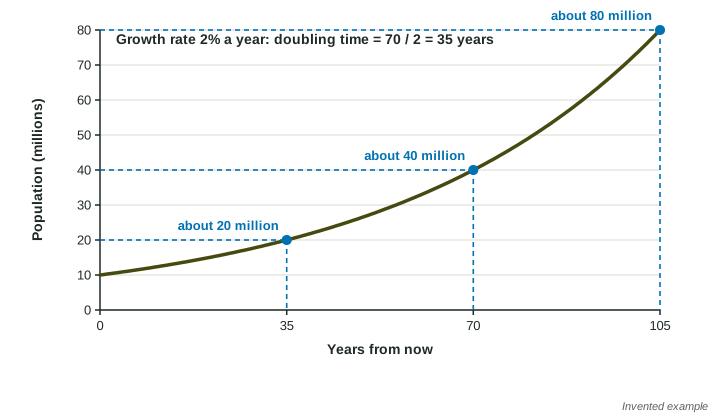
Part 5 · Step by step
How it works, step by step
- Births and deaths are counted per 1,000 people per year (crude birth rate and crude death rate)their difference is the natural increase per 1,000 people per year
- Dividing that difference by 10 turns "per 1,000" into "per 100"the result is the rate of natural increase in percent
- Dividing 70 by the growth rate in percentgives the doubling time in years; adding it to the start year gives the year the population doubles
- Immigration adds people and emigration removes thema country’s total growth can differ from its natural increase
Part 6 · Key ideas
Key ideas
- Crude birth rate (CBR): births per 1,000 people per year. Crude death rate (CDR): deaths per 1,000 people per year.
- Rate of natural increase (in %) . The 10 turns a rate per 1,000 into a percent (per 100).
- Doubling time (years) . For "in what year", add the doubling time to the start year.
- Total growth also counts immigration (people moving in) and emigration (people moving out). Malthusian theory holds that population grows faster than food, so famine, disease or war will check it.
Part 7 · Misconception
A common mistake
The wrong idea: A crude birth rate of 36 and a crude death rate of 8 mean the population grows 28% a year.
What actually happens: Both rates are per 1,000 people, so the gap of 28 per 1,000 is 2.8 per 100: a growth rate of 2.8% a year. Divide by 10, not 100, and do not leave it at 28.
Part 8 · Check yourself
Check yourself
Exam-style questions. Anything you miss goes into your review queue.
Data
Birth and death rates in four countries
| Country | Crude birth rate | Crude death rate |
|---|---|---|
| Country J | 36 | 8 |
| Country K | 22 | 7 |
| Country L | 11 | 9 |
| Country M | 8 | 11 |
1. Which country in the table has the highest rate of natural increase?
- Country J
- Country K
- Country L
- Country M
Show the answer
The rate of natural increase depends on the gap between the birth and death rates, not on either one alone.
- Correct: Country J: Right: 36 - 8 = 28 per 1,000, the largest gap, which is 2.8%.
- Country K: K’s gap is 22 - 7 = 15 per 1,000, or 1.5%.
- Country L: L’s gap is 11 - 9 = 2 per 1,000, or 0.2%.
- Country M: M has more deaths than births: 8 - 11 = -3 per 1,000.
2. What is Country K’s rate of natural increase, in percent?
Type a number, then its unit (%). Scale words (2.5 million) and powers of ten (2.5 × 10^6) are read.
Show the answer
a year. The difference is per 1,000 people; dividing by 10 makes it per 100, a percent.
- Answer: 1.5 %
3. Country J’s rate of natural increase is 2.8%. Write the setup for its doubling time by the rule of 70, then give the answer with its unit.
Type the setup as on the exam, with brackets and units, then the answer.
Show the answer
years.
- Setup: ; answer 25 yr
4. Country J had 40 million people in 2025. If its rate of natural increase stays at 2.8% and no one moves in or out, in what year will it have about 80 million people?
Type a number. Scale words (2.5 million) and powers of ten (2.5 × 10^6) are read.
Show the answer
Doubling time years, so . The question asks for a year, so add the doubling time to the start year.
- Answer: 2050
5. What does a crude death rate of 9 mean?
- 9% of people die each year
- 9 deaths per 1,000 people per year
- 9 deaths per woman over her lifetime
- 9 deaths per 100 people per year
Show the answer
Crude rates are per 1,000 people per year.
- 9% of people die each year: 9% would be 90 per 1,000, ten times more.
- Correct: 9 deaths per 1,000 people per year: Right: crude rates count per 1,000 people per year.
- 9 deaths per woman over her lifetime: Rates per woman describe fertility, not deaths.
- 9 deaths per 100 people per year: Per 100 is a percent; crude rates are per 1,000.
6. Explain how a country’s population can grow even though its crude death rate is higher than its crude birth rate.
Build the answer part by part, then write it in your own words.
Show the answer
Natural decrease, outweighed by net immigration.
- An answer that earns the point: Its natural increase is negative, because deaths outnumber births, but more people move in than move out, so net immigration adds more people than natural decrease removes and the population grows.
7. Which changes would raise a country’s total population growth rate, if nothing else changes? Select all that apply.
- The crude death rate falls while births stay the same
- Both crude rates fall by 2 per 1,000
- The crude birth rate falls
- More people emigrate
Show the answer
Growth rises with more births or immigrants and with fewer deaths or emigrants. A fall in births that matches a fall in deaths leaves the gap unchanged.
- Correct: The crude death rate falls while births stay the same: Right: fewer deaths widen the gap between births and deaths.
- Both crude rates fall by 2 per 1,000: If births and deaths both fall by 2 per 1,000, the gap, and so the growth rate, stays the same.
- The crude birth rate falls: Fewer births lower the growth rate.
- More people emigrate: Emigrants leave, lowering the growth rate.
Part 9 · Summary
Summary
Part 10 · Up next
What comes next
Part 11 · Connections