Percents and Percent Change
A percent is a part out of 100: part ÷ whole × 100.
Part 1 · Hook
Why this matters
Part 2 · Prerequisite check
Quick check before you start
1. What is a per-capita value?
- A total divided by the number of people
- A total times the number of people
- A rate per year
- A rate per area
Show the answer
Per capita means per person.
- Correct: A total divided by the number of people:
- A total times the number of people:
- A rate per year:
- A rate per area:
2. What is NPP if GPP = 5,000 and R = 3,000 (both kcal/m²/yr)?
- 2,000 kcal/m²/yr
- 8,000 kcal/m²/yr
- 1.67 kcal/m²/yr
- 3,000 kcal/m²/yr
Show the answer
NPP = GPP - R.
- Correct: 2,000 kcal/m²/yr:
- 8,000 kcal/m²/yr:
- 1.67 kcal/m²/yr:
- 3,000 kcal/m²/yr:
Part 3 · See it
See it first
Part 4 · Step by step
How it works, step by step
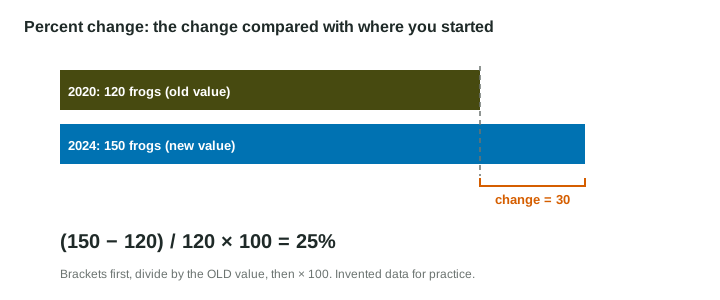
- Subtract old from new, in bracketsyou get the change, with its sign
- Divide the change by the old valueyou get the change as a fraction of where you started
- Multiply by 100you get the percent change: positive for a rise, negative for a fall
Part 5 · Key ideas
Key ideas
- A percent is a number out of 100: part ÷ whole × 100.
- Percent of a quantity: (percent ÷ 100) × quantity. 18% of 4.0 million = 0.18 × 4,000,000 = 720,000.
- Percent change = (new - old) / old × 100. Brackets first, divide by the old value, then × 100.
- Percent changes from different starting values do not add: +25% then -10% is +12.5%, not +15%.
Part 6 · Misconception
A common mistake
The wrong idea: Percent change divides by the new value, or by whichever number is bigger.
What actually happens: Always divide by the old (starting) value. A rise from 120 to 150 is 30 / 120 = 25%; a fall from 150 to 120 is -30 / 150 = -20%.
Part 7 · Check yourself
Check yourself
Exam-style questions. Anything you miss goes into your review queue.
1. A town’s water use rose from 4,000 to 5,000 liters per day. Write the setup for the percent change, then give the answer.
Type the setup as on the exam, with brackets and units, then the answer.
Show the answer
- Setup: ; answer 25 %
2. Coal provides 18% of a country’s 4.0 million GWh of electricity. How many GWh is that?
Type a number, then its unit (GWh). Scale words (2.5 million) and powers of ten (2.5 × 10^6) are read.
Show the answer
- Answer: 720,000 GWh
3. Which setup gives the percent change from 80 to 60?
- (60 - 80) / 80 × 100
- 60 - 80 / 80 × 100
- (80 - 60) / 60 × 100
- (60 - 80) / 60 × 100
Show the answer
New minus old, in brackets, divided by the old value, times 100: .
- Correct: (60 - 80) / 80 × 100: Right: brackets, old value on the bottom, × 100.
- 60 - 80 / 80 × 100: Without brackets the division happens first, so it is not the change.
- (80 - 60) / 60 × 100: That divides by the new value and reverses the sign.
- (60 - 80) / 60 × 100: That divides by the new value.
Data
Frogs counted in a wetland
| Year | Frogs counted |
|---|---|
| 2020 | 120 |
| 2022 | 150 |
| 2024 | 135 |
4. Write the setup for the percent change in frogs from 2020 to 2022, then give the answer.
Type the setup as on the exam, with brackets and units, then the answer.
Show the answer
- Setup: ; answer 25 %
5. What was the percent change in frogs from 2022 to 2024?
Type a number, then its unit (%). Scale words (2.5 million) and powers of ten (2.5 × 10^6) are read.
Show the answer
- Answer: -10 %
6. What was the percent change in frogs over the whole period, from 2020 to 2024?
Type a number, then its unit (%). Scale words (2.5 million) and powers of ten (2.5 × 10^6) are read.
Show the answer
- Answer: 12.5 %
7. Which statement describes the frog counts?
- They rose 25%, then fell 10%, ending 12.5% above 2020.
- They rose 25% and kept rising.
- They fell over the whole period.
- They rose 15% overall, since 25 - 10 = 15.
Show the answer
120 → 150 is +25%; 150 → 135 is -10%; 120 → 135 is +12.5% overall.
- Correct: They rose 25%, then fell 10%, ending 12.5% above 2020.: Right: each change computed from its own start.
- They rose 25% and kept rising.: The count fell from 2022 to 2024.
- They fell over the whole period.: 135 is above 120.
- They rose 15% overall, since 25 - 10 = 15.: Percent changes from different starting values do not simply add.
Part 8 · Summary
Summary
Part 9 · Up next
What comes next
Part 10 · Connections