Introduction to Ecosystems
An ecosystem joins a community of species to the abiotic conditions around it.
Part 1 · Hook
Why this matters
Part 2 · See it
See it first
Part 3 · Step by step
How it works, step by step
- Two species need the same limited resourceeach gets less, so both are harmed: competition
- They split the resource by place, time or food sizethey overlap less: resource partitioning
- Less overlap means less competitionboth species can live in the same community
Part 4 · Key ideas
Key ideas
- An ecosystem is the living (biotic) and nonliving (abiotic) parts of an area and how they interact.
- A population is one species in one area; a community is every population living and interacting there.
- A habitat is where a species lives; its niche is its role: what it eats, when, where and under what conditions.
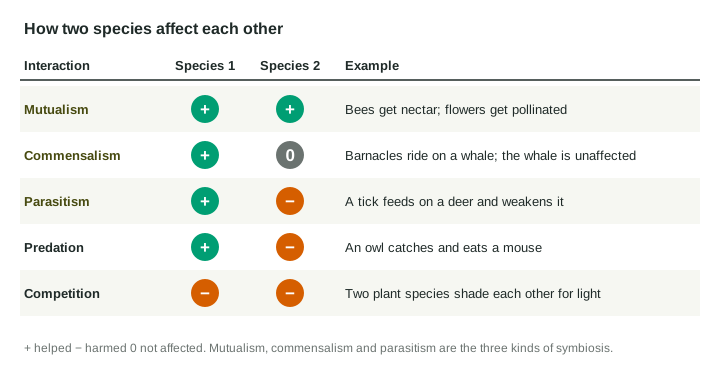
- Symbiosis is a close, long-term relationship: mutualism (+/+), commensalism (+/0), parasitism (+/−). Predation is +/−, competition is −/−.
Part 5 · Misconception
A common mistake
The wrong idea: Any relationship where one species eats part of another is predation.
What actually happens: A predator kills and eats its prey. A parasite lives on or in a host for a long time and harms it, usually without killing it right away. Ask: does the host stay alive while it is fed on?
Part 6 · Check yourself
Check yourself
Exam-style questions. Anything you miss goes into your review queue.
1. A fungus grows on and around the roots of a pine tree. The fungus gets sugar from the tree, and its threads absorb water and minerals from the soil that the tree then uses. Which interaction is this between the fungus and the tree?
- Commensalism, because the tree is not affected
- Mutualism, because both species benefit
- Parasitism, because the fungus feeds on the tree
- Competition, because both need soil water
Show the answer
The fungus gains sugar and the tree gains water and minerals: both are helped (+/+), so this is mutualism.
- Commensalism, because the tree is not affected: The tree gains water and minerals, so it is affected (helped).
- Correct: Mutualism, because both species benefit: Right: the fungus gets sugar and the tree gets water and minerals.
- Parasitism, because the fungus feeds on the tree: A parasite harms its host; here the tree is helped in return.
- Competition, because both need soil water: Competition harms both species; here both are helped.
2. Two lizard species on an island both eat insects. One hunts on tree trunks during the day, and the other hunts on the ground at night. How does this help both species survive?
- They partition resources, which reduces competition between them.
- They form a mutualism in which each helps the other find insects.
- One species preys on the other, which keeps both numbers stable.
- They increase the total number of insects on the island.
Show the answer
Using a resource at different places or times is resource partitioning; it lowers competition, so both species can persist.
- Correct: They partition resources, which reduces competition between them.: Right: different places and times mean less overlap, so less competition.
- They form a mutualism in which each helps the other find insects.: Neither lizard helps the other; they simply avoid each other.
- One species preys on the other, which keeps both numbers stable.: The passage says both eat insects, not each other.
- They increase the total number of insects on the island.: Splitting the hunting does not make more insects; it divides them.
3. Two species of barnacles live on the same rocky shore. Species X is found only high on the rocks. When researchers scraped species Y off the lower rocks, species X spread down onto them. What does this show?
- Species X does not survive in the wetter, lower areas of the shore.
- Species Y is a parasite of species X.
- Competition from species Y kept species X off the lower rocks.
- The two species have a mutualism on the lower rocks.
Show the answer
Once its competitor was removed, species X used space it could live in. So competition, not the conditions, limited where it lived.
- Species X does not survive in the wetter, lower areas of the shore.: Species X spread down once species Y was gone, so the lower rocks suit it.
- Species Y is a parasite of species X.: Nothing in the study shows one barnacle feeding on the other.
- Correct: Competition from species Y kept species X off the lower rocks.: Right: removing the competitor let species X use the lower rocks.
- The two species have a mutualism on the lower rocks.: In a mutualism removing one species would hurt the other, not help it.
Data
Growth of species grown alone and together
| Pair | Species | Grown alone (g) | Grown together (g) |
|---|---|---|---|
| 1 | Clover | 40 | 52 |
| 1 | Root fungus | 10 | 15 |
| 2 | Grass P | 60 | 35 |
| 2 | Grass Q | 55 | 30 |
| 3 | Moss | 12 | 12 |
| 3 | Oak seedling | 80 | 80 |
4. Which interaction best explains the results for pair 1?
- Mutualism
- Competition
- Commensalism
- Parasitism
Show the answer
Both the clover (40 g to 52 g) and the fungus (10 g to 15 g) grew more together, so both benefit.
- Correct: Mutualism: Right: both species grew more when grown together.
- Competition: Competition lowers growth of both; both rose.
- Commensalism: In commensalism one species is unaffected; both changed here.
- Parasitism: In parasitism one species is harmed; neither was.
5. Which interaction best explains the results for pair 2?
- Mutualism
- Competition
- Commensalism
- Predation
Show the answer
Both grasses grew less together (60 g to 35 g and 55 g to 30 g): each is harmed by the other, the sign of competition.
- Mutualism: Both grew less together, so neither benefits.
- Correct: Competition: Right: both species were harmed when grown together.
- Commensalism: Both species changed, so neither was unaffected.
- Predation: Neither grass eats the other.
6. By how many grams did the growth of grass P fall when it was grown with grass Q?
- 5 g
- 25 g
- 35 g
- 60 g
Show the answer
Alone 60 g, together 35 g, so the drop is 60 - 35 = 25 g.
- 5 g: 5 g is the gap between the two grasses grown alone (60 and 55).
- Correct: 25 g: Right: 60 - 35 = 25 g.
- 35 g: 35 g is the growth together, not the drop.
- 60 g: 60 g is the growth alone, not the drop.
7. What conclusion do the data for pair 3 support?
- The moss and the oak seedling compete for light.
- The oak seedling is a parasite of the moss.
- In this trial neither species affected the other’s growth.
- The moss benefits from the oak seedling, so this is commensalism.
Show the answer
Each grew the same amount alone and together (12 g and 80 g), so neither affected the other in this trial.
- The moss and the oak seedling compete for light.: Competition would lower growth; neither changed.
- The oak seedling is a parasite of the moss.: A parasite harms its host; the moss grew the same.
- Correct: In this trial neither species affected the other’s growth.: Right: both growth values are unchanged.
- The moss benefits from the oak seedling, so this is commensalism.: For commensalism the moss would need to grow more with the oak; it did not.
Part 7 · Summary
Summary
Part 8 · Up next
What comes next
Part 9 · Connections