Integrated Pest Management
Integrated pest management keeps pests below damaging levels by monitoring them, preventing outbreaks, and using biological, physical and cultural controls first and targeted pesticides only when counts pass an action threshold.
Part 1 · Hook
Why this matters
Part 2 · Before you start
What this builds on
Part 3 · Prerequisite check
Quick check before you start
1. How does a pest population become resistant to a pesticide?
- Spraying kills susceptible pests, and resistant survivors breed
- Each pest gets used to the pesticide over its life
- The pesticide changes the pests' genes directly
- Pests learn to avoid sprayed plants and teach their young
Show the answer
Resistance is natural selection on existing variation.
- Correct: Spraying kills susceptible pests, and resistant survivors breed:
- Each pest gets used to the pesticide over its life:
- The pesticide changes the pests' genes directly:
- Pests learn to avoid sprayed plants and teach their young:
2. Why can spraying an insecticide make a pest problem worse?
- It kills the pest's predators too, so the pest rebounds
- It fertilizes the crop, so the crop grows faster
- It makes the crop taste better to pests
- It adds water to the soil, so pests multiply
Show the answer
Killing natural enemies removes a check on the pest.
- Correct: It kills the pest's predators too, so the pest rebounds:
- It fertilizes the crop, so the crop grows faster:
- It makes the crop taste better to pests:
- It adds water to the soil, so pests multiply:
Part 4 · See it
See it first
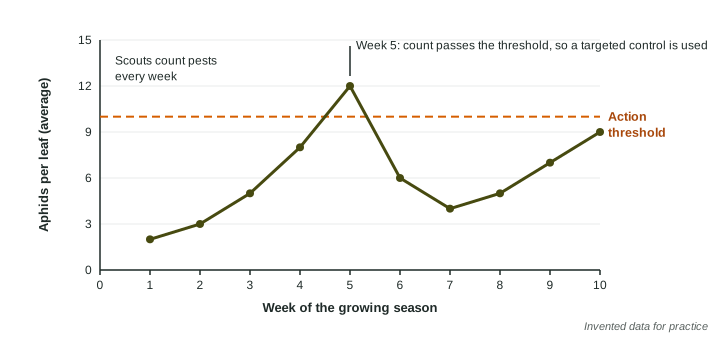
Part 5 · Step by step
How it works, step by step
- Farmers count pests regularly (monitoring)they know when pests are near a damaging level and when they are not
- Control is used only when pests pass an action thresholdfar less pesticide is sprayed than on a fixed schedule
- Less spraying and choosing narrow-acting methodspredators and pollinators survive and keep pests in check
- Fewer sprayings select less strongly for resistancethe pesticides that are used keep working longer
Part 6 · Key ideas
Key ideas
- Integrated pest management (IPM) combines methods to keep pests below the level that causes real damage, using as little pesticide as possible.
- Steps: monitor pests, set an action threshold, prevent problems (changing which crop grows in a field each year, resistant varieties, timing of planting), and control pests with the narrowest tool first.
- Biological control uses natural enemies: ladybugs and lacewings eat aphids, tiny wasps lay eggs in caterpillars. Physical methods include traps, barriers and hand weeding.
- Benefits: less pesticide, lower costs, less harm to nontarget species and water, slower resistance. Drawbacks: it takes knowledge, labor and time, and can be slower to act.
Part 7 · Misconception
A common mistake
The wrong idea: Integrated pest management means never using pesticides.
What actually happens: IPM uses pesticides as a last resort: only when monitoring shows pests above the action threshold, and then the most targeted product, in the smallest amount, at the right time.
Part 8 · Check yourself
Check yourself
Exam-style questions. Anything you miss goes into your review queue.
1. What is the main goal of integrated pest management?
- Keep pests below damaging levels with little pesticide
- Kill each pest on a farm with the strongest spray that is sold
- Grow crops with no monitoring of the pests in the fields
- Replace each pesticide with a stronger one each year
Show the answer
IPM aims to control damage, not to wipe out every pest, while limiting pesticide use.
- Correct: Keep pests below damaging levels with little pesticide: Right: control below a damaging level, with little spraying.
- Kill each pest on a farm with the strongest spray that is sold: Total elimination with strong sprays is the approach IPM moves away from.
- Grow crops with no monitoring of the pests in the fields: Monitoring is the heart of IPM.
- Replace each pesticide with a stronger one each year: Escalating sprays is the pesticide treadmill.
2. Why does IPM slow the evolution of pesticide resistance?
- Spraying less often selects less for resistance
- IPM sprays more often, so no pests survive to breed
- IPM uses one pesticide each year so pests are unable to adapt
- Natural enemies make the pests' genes change back
Show the answer
Fewer sprayings means less selection pressure, so resistant pests gain less advantage.
- Correct: Spraying less often selects less for resistance: Right: less spraying, weaker selection.
- IPM sprays more often, so no pests survive to breed: IPM sprays less, not more.
- IPM uses one pesticide each year so pests are unable to adapt: Using one product repeatedly speeds resistance; IPM rotates methods.
- Natural enemies make the pests' genes change back: Predators do not change pests' genes.
Model or diagram
Weekly pest counts on one farm
3. In which week did the pest count pass the action threshold?
- Week 5
- Week 4
- Week 10
- Week 1
Show the answer
Week 5 had 12 aphids per leaf, above the threshold of 10.
- Correct: Week 5: Right: 12 is above 10.
- Week 4: Week 4 had 8, below the threshold.
- Week 10: Week 10 had 9, below the threshold.
- Week 1: Week 1 had 2.
4. Write the setup for the percent change in the aphid count from week 5 to week 6, after the targeted control, then give the answer.
Type the setup as on the exam, with brackets and units, then the answer.
Show the answer
: the count halved.
- Setup: ; answer -50 %
5. A farm on a fixed schedule sprays every two weeks. How many sprayings would it make in these 10 weeks, compared with the IPM farm's one?
- 5 sprayings, compared with 1
- 10 sprayings, compared with 1
- 2 sprayings, compared with 1
- 1 spraying, the same as IPM
Show the answer
Every two weeks over 10 weeks is sprayings; IPM sprayed once, in week 5.
- Correct: 5 sprayings, compared with 1: Right: 10 ÷ 2 = 5.
- 10 sprayings, compared with 1: That would be weekly spraying.
- 2 sprayings, compared with 1: Every two weeks gives more than 2 in 10 weeks.
- 1 spraying, the same as IPM: The fixed schedule sprays regardless of counts.
6. In weeks 7 to 10 the count rose again from 4 to 9. What should the IPM farmer do?
- Keep monitoring and act again if the count passes 10
- Spray right away because the count is rising
- Stop monitoring because the count is below 10
- Release a new pesticide each week to stop the rise
Show the answer
IPM acts on the threshold, not on any rise; at 9 the count is still below 10.
- Correct: Keep monitoring and act again if the count passes 10: Right: watch and wait until the threshold.
- Spray right away because the count is rising: A rise below the threshold does not call for spraying.
- Stop monitoring because the count is below 10: Monitoring continues all season.
- Release a new pesticide each week to stop the rise: Weekly pesticides are the opposite of IPM.
7. A farm used 24 kg of insecticide per hectare on a fixed schedule. After switching to IPM, it uses 30% of that amount. How many kilograms per hectare does it use now?
Type a number, then its unit (kg/ha). Scale words (2.5 million) and powers of ten (2.5 × 10^6) are read.
Show the answer
kg per hectare.
- Answer: 7.2 kg/ha
Part 9 · Summary
Summary
Part 10 · Up next
What comes next
Part 11 · Connections