Ecosystem Services
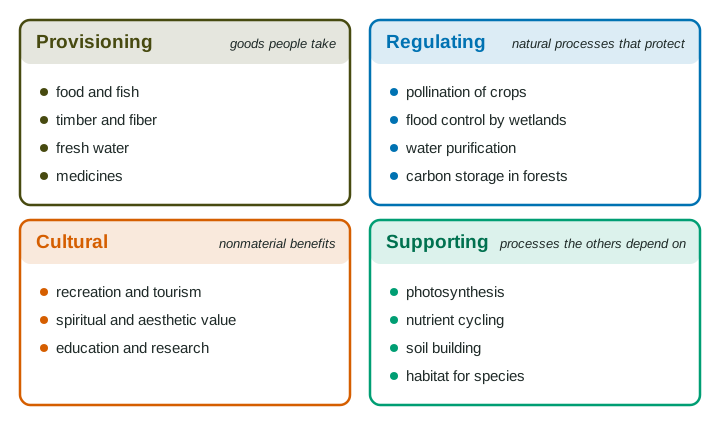
Ecosystem services are the benefits people get from working ecosystems: provisioning (goods such as food, timber and water), regulating (pollination, water purification, flood control, carbon storage), cultural (recreation, tourism, beauty) and supporting (photosynthesis, nutrient cycling, soil building).
Part 1 · Hook
Why this matters
Part 2 · Before you start
What this builds on
Part 3 · Prerequisite check
Quick check before you start
1. Which process moves water from the soil, through a plant and into the air?
- Transpiration
- Condensation
- Infiltration
- Runoff
Show the answer
Plants pull water up from the soil and release it as vapor through their leaves: transpiration.
- Correct: Transpiration:
- Condensation:
- Infiltration:
- Runoff:
2. What do decomposers do in an ecosystem?
- Break down dead matter and return nutrients to the soil
- Make sugar from sunlight
- Eat only living plants
- Fix carbon dioxide into rock
Show the answer
Decomposers break down dead organisms and wastes, releasing nutrients that producers can use again.
- Correct: Break down dead matter and return nutrients to the soil:
- Make sugar from sunlight:
- Eat only living plants:
- Fix carbon dioxide into rock:
Part 4 · See it
See it first
Part 5 · Step by step
How it works, step by step
- Healthy ecosystems run natural processes such as photosynthesis, pollination, filtering and nutrient cyclingpeople receive goods (food, wood, water) and protection (clean water, flood control, a steadier climate) at no charge
- People clear, drain or pollute an ecosystem for a short-term gainthe services it gave are reduced or lost
- Those services must then be replaced (water treatment, flood walls, hand pollination) or done withoutthere is an ecological cost and an economic cost that the original decision did not count
Part 6 · Key ideas
Key ideas
- An ecosystem service is a benefit people get from a working ecosystem. There are four kinds: provisioning, regulating, cultural and supporting.
- Provisioning services are goods people take: food, fish, timber, fresh water, medicines. Regulating services are natural processes that protect people: pollination, purifying water, controlling floods, storing carbon.
- Cultural services are nonmaterial benefits: recreation, tourism, beauty, spiritual value, education. Supporting services keep the other three going: photosynthesis, nutrient cycling, soil formation, habitat.
- Disrupting an ecosystem has costs that a price tag often leaves out: the lost services must be paid for some other way.
Part 7 · Misconception
A common mistake
The wrong idea: An ecosystem service is any product people sell, so a forest only provides value when it is cut for timber.
What actually happens: Timber is one provisioning service, but a standing forest also cleans water, stores carbon, prevents floods and supports recreation. Cutting it trades those services for one.
Part 8 · Check yourself
Check yourself
Exam-style questions. Anything you miss goes into your review queue.
Passage
A city keeps its forest
Riverton draws its drinking water from a reservoir in hills 80 kilometers away. As houses and farms spread into those hills, state regulators warned that the city would have to build a filtration plant costing about $6 billion, plus $250 million a year to run it. The city chose a different plan. It spent $1.5 billion over ten years to buy land near the reservoir, to pay farmers to fence cattle away from streams, and to repair leaking household waste tanks. Forest soils filter rainwater as it soaks in, and roots hold soil in place so less mud reaches the reservoir. Ten years later the water still meets drinking standards without filtration. Some upstream towns complain that the land purchases limit where they can build and shrink their tax income.
Invented passage for practice, modeled on real cities that protect forested land around their reservoirs.
1. Which statement best expresses the main claim the passage supports?
- Protecting the forest gave clean water for less than a filtration plant
- Filtration plants are the most reliable way to supply clean water
- Cattle wading in the streams are the main source of the mud reaching the reservoir
- Upstream towns should be paid to build more houses near the reservoir
Show the answer
The passage compares two ways to get clean water and reports that the cheaper one, protecting the forest, worked.
- Correct: Protecting the forest gave clean water for less than a filtration plant: Right: $1.5 billion over ten years against $6 billion plus $250 million a year, and the water still meets standards.
- Filtration plants are the most reliable way to supply clean water: The passage describes a city that met standards without a plant.
- Cattle wading in the streams are the main source of the mud reaching the reservoir: Fencing cattle was one step; the passage does not rank mud sources.
- Upstream towns should be paid to build more houses near the reservoir: The passage reports a complaint from towns; it does not argue for more building.
2. Which kind of ecosystem service is the forest providing when its soils filter rainwater for Riverton?
- A provisioning service
- A regulating service
- A cultural service
- A supporting service
Show the answer
Water purification, flood control, pollination and carbon storage are regulating services.
- A provisioning service: Provisioning services are goods people take, such as timber; here the forest is cleaning water, not supplying a product.
- Correct: A regulating service: Right: purifying water is a natural process that protects people, a regulating service.
- A cultural service: Cultural services are nonmaterial benefits such as recreation.
- A supporting service: Supporting services, such as nutrient cycling, keep the other services going; filtering water is a direct regulating service.
3. Which group in the passage sees a cost of the city’s plan, and what is it?
- Riverton residents, because their drinking water now fails the state drinking standards
- State regulators, because they have to run the filtration plant
- Upstream towns, because land purchases limit building and cut tax income
- Farmers, because they were paid to let cattle into the streams
Show the answer
A full answer weighs both sides: the city saves money, and the upstream towns bear a cost.
- Riverton residents, because their drinking water now fails the state drinking standards: The passage says the water still meets standards.
- State regulators, because they have to run the filtration plant: No plant was built, so no one runs it.
- Correct: Upstream towns, because land purchases limit building and cut tax income: Right: the passage ends with this complaint, an economic cost the plan places on other people.
- Farmers, because they were paid to let cattle into the streams: Farmers were paid to keep cattle out of the streams, not in.
Data
Crop yields with and without wild pollinators
| Crop | Yield near habitat (kg per hectare) | Yield far from habitat (kg per hectare) |
|---|---|---|
| Blueberries | 8,000 | 5,000 |
| Almonds | 2,400 | 1,500 |
| Watermelon | 40,000 | 32,000 |
| Wheat | 3,500 | 3,500 |
4. Which conclusion about ecosystem services is best supported by the table?
- Natural habitat near farms raises the yield of crops that animals pollinate
- Natural habitat raises the yield of each of the four crops by about the same amount
- Farms far from natural habitat produce more of each crop than farms near it
- Wild bees lower the yield of wheat on farms near habitat
Show the answer
Pollination by wild animals living in nearby habitat is a regulating service, and it shows up in the yields of crops that need pollinators.
- Correct: Natural habitat near farms raises the yield of crops that animals pollinate: Right: the three bee-pollinated crops yield more near habitat, and wheat, which pollinates itself, does not change.
- Natural habitat raises the yield of each of the four crops by about the same amount: Wheat does not change at all, and the other gains differ.
- Farms far from natural habitat produce more of each crop than farms near it: Every crop yields the same or less far from habitat.
- Wild bees lower the yield of wheat on farms near habitat: Wheat yield is 3,500 kg per hectare in both places.
5. Tourists pay to snorkel over the same reef to see its fish and corals. Which kind of service is this?
- Provisioning
- Regulating
- Cultural
- Supporting
Show the answer
One ecosystem can provide several kinds of service at once.
- Provisioning: Nothing is taken from the reef; the benefit is the experience.
- Regulating: Regulating services are protective processes such as purifying water.
- Correct: Cultural: Right: recreation and tourism are nonmaterial benefits.
- Supporting: Supporting services are processes such as nutrient cycling.
6. A developer drains a wetland beside a river to build a shopping center. Which is the most likely cost that the developer’s budget leaves out?
- The shopping center will need a larger parking lot than first planned
- Towns downstream flood more, since the wetland no longer stores high water
- The wetland will produce more fish once it is drained
- The river will hold more water after the wetland is gone
Show the answer
Losing an ecosystem service often moves a cost onto people who did not make the decision.
- The shopping center will need a larger parking lot than first planned: That is part of the developer’s own plan and budget.
- Correct: Towns downstream flood more, since the wetland no longer stores high water: Right: wetlands store floodwater, so losing one shifts a cost onto others.
- The wetland will produce more fish once it is drained: Draining removes the habitat, so it produces fewer fish, not more.
- The river will hold more water after the wetland is gone: The river will hold the same water; the wetland that stored extra water is gone.
7. Explain the economic cost to apple growers when the wild bees near their orchards decline.
Build the answer part by part, then write it in your own words.
Show the answer
Every link is named: fewer bees, fewer flowers pollinated, less fruit, less income or higher costs.
- An answer that earns the point: If wild bees decline, fewer apple flowers are pollinated, so fewer apples form, which lowers the growers’ income or forces them to pay to rent honeybee hives.
Part 9 · Summary
Summary
Part 10 · Up next
What comes next
Part 11 · Connections