Properties of Photons
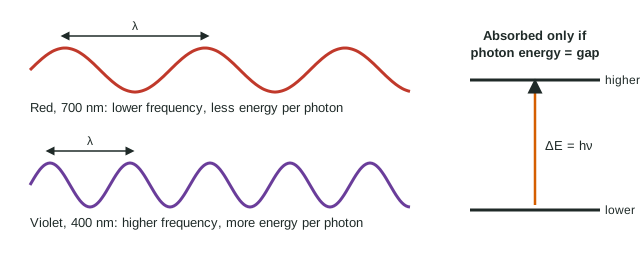
Light travels at c = λν, so wavelength and frequency are inversely related.
Part 1 · Hook
Why this matters
Part 2 · Before you start
What this builds on
Part 3 · Prerequisite check
Quick check before you start
1. Which carries more energy per photon?
- Ultraviolet
- Infrared
- Microwave
Show the answer
Shorter wavelengths carry more energy per photon.
- Correct: Ultraviolet:
- Infrared:
- Microwave:
2. What is 500 nm in meters?
- 5.00 × 10⁻⁷ m
- 5.00 × 10⁻⁹ m
- 5.00 × 10² m
Show the answer
500 × 10⁻⁹ m = 5.00 × 10⁻⁷ m.
- Correct: 5.00 × 10⁻⁷ m:
- 5.00 × 10⁻⁹ m:
- 5.00 × 10² m:
3. How many particles are in one mole?
- 6.022 × 10²³
- 6.626 × 10⁻³⁴
- 2.998 × 10⁸
Show the answer
Avogadro's number.
- Correct: 6.022 × 10²³:
- 6.626 × 10⁻³⁴:
- 2.998 × 10⁸:
Part 4 · See it
See it first
Part 5 · Step by step
How it works, step by step
- All light travels at c = 2.998 × 10⁸ m/sc = λν, so wavelength and frequency are inversely proportional
- Each photon carries energy E = hνshorter wavelength, higher frequency, more energy per photon: E = hc/λ
- Energy levels in atoms and molecules are quantizedonly photons whose energy matches a gap are absorbed or emitted
- Each element has its own set of gapseach emits its own set of wavelengths, a line spectrum
Part 6 · Key ideas
Key ideas
- c = λν with c = 2.998 × 10⁸ m/s; λ in meters (1 nm = 10⁻⁹ m).
- E = hν = hc/λ with h = 6.626 × 10⁻³⁴ J·s. This is one photon, in joules.
- Per mole: multiply by 6.022 × 10²³, then divide by 1000 for kJ/mol.
- A photon is absorbed or emitted only when its energy equals a gap between levels.
Part 7 · Misconception
A common mistake
The wrong idea: Brighter light has more energy per photon, so a bright enough lamp of any color can cause any transition.
What actually happens: Brightness is the number of photons. Energy per photon depends only on frequency (E = hν), so each photon must match the gap on its own.
Part 8 · Check yourself
Check yourself
Exam-style questions. Anything you miss goes into your review queue.
Data table
Emission lines of a gas discharge tube
A student views the light from a tube of hot hydrogen gas through a spectroscope and records four bright lines in the visible region.
| Line | Wavelength (nm) | Color |
|---|---|---|
| A | 656.3 | red |
| B | 486.1 | blue-green |
| C | 434.0 | blue-violet |
| D | 410.2 | violet |
1. What is the frequency of line A?
Type a number in s⁻¹.
Show the answer
λ = 656.3 nm = 6.563 × 10⁻⁷ m. ν = c/λ = (2.998 × 10⁸ m/s) / (6.563 × 10⁻⁷ m) = 4.56803 × 10¹⁴ s⁻¹, which is 4.568 × 10¹⁴ s⁻¹.
- Answer: 4.568 × 10¹⁴ s⁻¹
2. What is the energy of one photon of line A?
- 3.03 × 10⁻¹⁹ J
- 4.35 × 10⁻⁴⁰ J
- 1.82 × 10⁵ J/mol
- 3.03 × 10⁻²⁸ J
Show the answer
E = hc/λ = (6.626 × 10⁻³⁴ J·s)(2.998 × 10⁸ m/s) / (6.563 × 10⁻⁷ m) = 3.03 × 10⁻¹⁹ J.
- Correct: 3.03 × 10⁻¹⁹ J: Right: E = hc/λ with λ in meters.
- 4.35 × 10⁻⁴⁰ J: This is hλ. Energy is E = hν = hc/λ, which falls as λ rises.
- 1.82 × 10⁵ J/mol: This is the energy of a mole of photons; one photon is 6.022 × 10²³ times smaller.
- 3.03 × 10⁻²⁸ J: This used λ in nm. Convert first: 656.3 nm = 6.563 × 10⁻⁷ m.
3. Which line comes from the largest drop in energy between two levels?
- A, 656.3 nm
- B, 486.1 nm
- C, 434.0 nm
- D, 410.2 nm
Show the answer
E = hc/λ, so the shortest wavelength carries the most energy. Line D, at 410.2 nm, comes from the largest energy drop.
- A, 656.3 nm: Line A has the longest wavelength, so the smallest energy drop of the four.
- B, 486.1 nm: Line B, at 486.1 nm, is a longer wavelength than two of the other lines.
- C, 434.0 nm: Line C, at 434.0 nm, is longer than the 410.2 nm line.
- Correct: D, 410.2 nm: Right: shortest wavelength, most energy.
4. Why does hydrogen emit only these particular wavelengths rather than a continuous rainbow?
- Its electron energies are quantized, so only photons matching the gaps between levels are emitted.
- Its electrons can sit at any energy, but the spectroscope filters out the other wavelengths.
- Hydrogen atoms are too small to emit light of any other color than these four.
- Hot hydrogen gas reflects these four colors from the light in the room.
Show the answer
Electrons in an atom occupy fixed levels. A drop from one level to another emits a photon whose energy, and so wavelength, equals that gap exactly. A few gaps give a few lines.
- Correct: Its electron energies are quantized, so only photons matching the gaps between levels are emitted.: Right: fixed levels, fixed photon energies.
- Its electrons can sit at any energy, but the spectroscope filters out the other wavelengths.: A spectroscope spreads light out; it would show a continuous spectrum if one were emitted.
- Hydrogen atoms are too small to emit light of any other color than these four.: Atom size does not pick the colors; the gaps between levels do.
- Hot hydrogen gas reflects these four colors from the light in the room.: The light is emitted by the hot gas, not reflected.
5. When the wavelength of light is doubled, what happens to its frequency and to the energy of each photon?
- Both are halved.
- Both are doubled.
- Frequency halves; energy doubles.
- Frequency doubles; energy halves.
Show the answer
c = λν with c fixed, so doubling λ halves ν. E = hν, so the energy halves too.
- Correct: Both are halved.: Right: c fixed, E ∝ ν.
- Both are doubled.: Longer waves have lower frequency and less energy.
- Frequency halves; energy doubles.: E is proportional to ν, so they change together.
- Frequency doubles; energy halves.: Doubling λ lowers ν, not raises it.
6. Put the steps for finding the energy of one mole of photons from a wavelength in nm in order.
- Convert the wavelength from nm to m
- Calculate the frequency, ν = c/λ
- Calculate the energy of one photon, E = hν
- Multiply by Avogadro's number to get J/mol
- Convert J/mol to kJ/mol
Show the answer
Units first, then frequency, then energy per photon, then per mole, then kJ.
- Correct order: 1. Convert the wavelength from nm to m 2. Calculate the frequency, ν = c/λ 3. Calculate the energy of one photon, E = hν 4. Multiply by Avogadro's number to get J/mol 5. Convert J/mol to kJ/mol
Part 9 · Summary
Summary
Part 10 · Up next
What comes next
Part 11 · Connections