Significant Figures
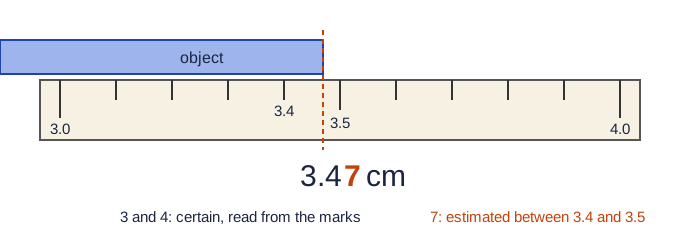
A measurement records every certain digit plus one estimated digit; these are its significant figures.
Part 1 · Hook
Why this matters
Part 2 · Before you start
What this builds on
Part 3 · Prerequisite check
Quick check before you start
1. Which is 0.00450 in scientific notation?
- 4.50 × 10⁻³
- 4.50 × 10³
- 45.0 × 10⁻⁴
- 4.5 × 10⁻²
Show the answer
Move the point 3 places right to get 4.50; a small number has a negative exponent.
- Correct: 4.50 × 10⁻³:
- 4.50 × 10³:
- 45.0 × 10⁻⁴:
- 4.5 × 10⁻²:
2. What is the density of an object with a mass of 20 g and a volume of 5 mL?
- 4 g/mL
- 0.25 g/mL
- 100 g/mL
- 25 g/mL
Show the answer
Density = mass ÷ volume = 20 g ÷ 5 mL = 4 g/mL.
- Correct: 4 g/mL:
- 0.25 g/mL:
- 100 g/mL:
- 25 g/mL:
Part 4 · See it
See it first
Part 5 · Step by step
How it works, step by step
- Every instrument can only be read so finelythe last recorded digit of a measurement is an estimate
- The significant figures are the certain digits plus that one estimated digitthey show how precise the measurement is
- A calculated answer cannot be more precise than the data it came fromit is rounded to match the least precise measurement
- Multiplying and adding spread uncertainty differentlyproducts keep the fewest significant figures, and sums keep the fewest decimal places
Part 6 · Key ideas
Key ideas
- Count significant figures: all nonzero digits; zeros between them; trailing zeros after a decimal point. Leading zeros never count. 0.004050 has four.
- Multiply or divide: keep the fewest significant figures. Add or subtract: keep the fewest decimal places.
- Exact numbers (counts, defined equalities like 1 kg = 1000 g) never limit an answer.
- Precision is how closely repeated readings agree; accuracy is how close they are to the true value. Round once, at the end.
Part 7 · Misconception
A common mistake
The wrong idea: Writing more digits makes an answer more accurate, so copy everything the calculator shows.
What actually happens: Extra digits claim a precision the measurements do not have. 23.45 g ÷ 12.0 mL is 1.95 g/mL, not 1.954166667 g/mL: the volume was only known to three significant figures.
Part 8 · Check yourself
Check yourself
Exam-style questions. Anything you miss goes into your review queue.
1. How many significant figures does 0.004050 g have?
- 7
- 3
- 4
- 2
Show the answer
Write it as 4.050 × 10⁻³ g: four significant figures. Leading zeros are placeholders; the captive zero and the trailing zero after the decimal point are measured.
- 7: This counts every digit, but leading zeros only place the decimal point.
- 3: The final zero comes after a decimal point, so it was measured and counts.
- Correct: 4: Right: leading zeros do not count; 4, 0, 5 and the trailing 0 after the decimal point do.
- 2: Zeros between nonzero digits (the 0 in 405) always count, and so does the trailing zero here.
2. Calculate 23.45 g ÷ 12.0 mL and report the density with the correct significant figures.
Type a number in g/mL.
Show the answer
23.45 ÷ 12.0 = 1.954… The least precise value, 12.0 mL, has three significant figures, so the answer is 1.95 g/mL.
- Answer: 1.95 g/mL
3. Add 12.52 g + 3.1 g + 0.247 g and report the total with the correct precision.
Type a number in g.
Show the answer
12.52 + 3.1 + 0.247 = 15.867. In addition the answer keeps the fewest decimal places: 3.1 has one, so the sum is 15.9 g.
- Answer: 15.9 g
4. A student measures 3 identical bolts as 2.157 g each and reports the total of the 3 bolts as 6.5 g "because 3 has one significant figure." What is wrong?
- The total should be rounded further, to 7 g, to match the one digit in 3
- Adding the three masses keeps two decimal places, so 6.47 g
- Multiplying a mass by a count of objects gives the wrong unit
- The 3 is an exact count, so it does not limit the answer: 6.471 g
Show the answer
Exact numbers, from counting or definitions such as 1 kg = 1000 g, never limit precision. 3 × 2.157 g = 6.471 g, four significant figures like the measurement.
- The total should be rounded further, to 7 g, to match the one digit in 3: This makes the same mistake more strongly: the count of 3 is exact.
- Adding the three masses keeps two decimal places, so 6.47 g: Adding 2.157 three times gives 6.471, which keeps three decimal places, not two.
- Multiplying a mass by a count of objects gives the wrong unit: The unit stays grams, and multiplying the mass of one by the number of identical bolts is exactly how to get the total.
- Correct: The 3 is an exact count, so it does not limit the answer: 6.471 g: Right: counted numbers are exact and have unlimited significant figures.
Data table
Three students weigh a 50.00 g standard mass
Three students each weigh the same certified 50.00 g mass four times on different balances.
| Student | Reading 1 (g) | Reading 2 (g) | Reading 3 (g) | Reading 4 (g) |
|---|---|---|---|---|
| Ana | 49.12 | 49.13 | 49.11 | 49.12 |
| Ben | 50.31 | 49.62 | 50.08 | 49.95 |
| Cai | 50.01 | 49.99 | 50.00 | 50.00 |
5. Which student's readings are precise but not accurate?
- Ben
- Cai
- Ana
- Cai, because readings that agree to 0.01 g are precise
Show the answer
Precision is how closely repeated readings agree; accuracy is how close they are to the true value. Ana is precise but off by about 0.88 g.
- Ben: Ben's readings spread over 0.69 g, so they are not precise; their average happens to land near 50.00 g.
- Cai: Cai's readings are both close together and close to 50.00 g: precise and accurate.
- Correct: Ana: Right: Ana's readings agree within 0.02 g, but all are about 0.88 g below the true 50.00 g.
- Cai, because readings that agree to 0.01 g are precise: Cai is precise, but also accurate: the readings sit right at 50.00 g.
6. Ana's results suggest which kind of error?
- A random error from the student reading the display inconsistently
- A significant-figures error from recording too many digits
- A systematic error, such as a balance that reads about 0.9 g low
- No error, since the readings are so close together
Show the answer
A consistent shift in one direction points to a systematic error, such as a balance that was not zeroed. Averaging more readings will not fix it.
- A random error from the student reading the display inconsistently: Random errors scatter readings in both directions; Ana's are tightly grouped.
- A significant-figures error from recording too many digits: Four-digit readings on a 0.01 g balance are recorded correctly.
- Correct: A systematic error, such as a balance that reads about 0.9 g low: Right: every reading is shifted the same way by about the same amount.
- No error, since the readings are so close together: Close agreement shows precision, not accuracy; the true mass is 50.00 g.
7. What is the average of Ben's four readings, reported to the correct precision?
Type a number in g.
Show the answer
(50.31 + 49.62 + 50.08 + 49.95) ÷ 4 = 199.96 ÷ 4 = 49.99 g. The sum keeps two decimal places; dividing by the exact count 4 keeps four significant figures.
- Answer: 49.99 g
8. Why does Cai's balance report readings to 0.01 g but not to 0.001 g?
- The standard mass has four significant figures, so the balance shows four
- A third decimal place would be zero for this mass, so it is left off
- Balances round to two decimal places to make averaging easier
- Its last digit is already estimated; a further digit would not be measured
Show the answer
Every measurement has an uncertainty in its last digit. Reporting more digits than the instrument resolves would claim a precision that was not measured.
- The standard mass has four significant figures, so the balance shows four: The display depends on the balance, not on the object being weighed.
- A third decimal place would be zero for this mass, so it is left off: The third decimal place is unknown, not zero; writing a zero would claim it was measured.
- Balances round to two decimal places to make averaging easier: The number of places reflects the balance's uncertainty, not convenience.
- Correct: Its last digit is already estimated; a further digit would not be measured: Right: a measurement keeps its certain digits plus one uncertain digit.
Part 9 · Summary
Summary
Part 10 · Up next
What comes next
Part 11 · Connections