Elemental Composition of Pure Substances
A pure compound has a fixed composition by mass.
Part 1 · Hook
Why this matters
Part 2 · Before you start
What this builds on
Part 3 · Prerequisite check
Quick check before you start
1. How many moles of oxygen atoms are in 8.00 g of oxygen atoms (16.00 g/mol)?
- 0.500 mol
- 128 mol
- 2.00 mol
- 0.0500 mol
Show the answer
8.00 g ÷ 16.00 g/mol = 0.500 mol.
- Correct: 0.500 mol:
- 128 mol:
- 2.00 mol:
- 0.0500 mol:
2. What is the molar mass of CO₂ (C 12.01, O 16.00)?
- 44.01 g/mol
- 28.01 g/mol
- 60.01 g/mol
- 40.01 g/mol
Show the answer
12.01 + 2(16.00) = 44.01 g/mol.
- Correct: 44.01 g/mol:
- 28.01 g/mol:
- 60.01 g/mol:
- 40.01 g/mol:
Part 4 · See it
See it first
Part 5 · Step by step
How it works, step by step
- A pure compound is always made of the same atoms in the same ratioit always has the same mass percent of each element (law of definite proportions)
- Atoms of different elements have different massesa mass ratio is not an atom ratio, so masses must be converted to moles
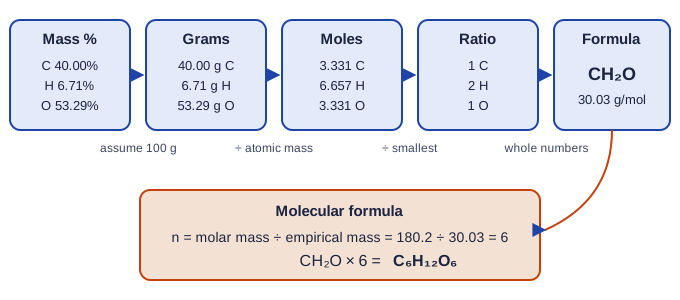
- Dividing every mole amount by the smallest gives the simplest ratiothat ratio, cleared to whole numbers, is the empirical formula
- Many molecules share one empirical formulathe molar mass is needed to find how many empirical units make one molecule
Part 6 · Key ideas
Key ideas
- A pure substance has a fixed composition (law of definite proportions): every sample of water is 11.2% H by mass.
- Mass percent of an element = (mass of the element in one formula ÷ molar mass) × 100.
- Empirical formula: assume 100 g, convert grams to moles, divide by the smallest, clear fractions (×2 for .5, ×3 for .33).
- Molecular formula = empirical formula × n, where n = molar mass ÷ empirical-formula mass.
Part 7 · Misconception
A common mistake
The wrong idea: Mass percents give the atom ratio directly, so a compound that is 75% X and 25% Y has three X atoms for each Y.
What actually happens: Different atoms have different masses, so a mass ratio is not an atom ratio. Convert each mass to moles first; only the ratio of moles gives the formula.
Part 8 · Check yourself
Check yourself
Exam-style questions. Anything you miss goes into your review queue.
Data table
Burning magnesium in three labs
Three lab groups heat different masses of pure magnesium in air until it has all turned into a white solid, magnesium oxide, and weigh the product.
| Group | Mass of Mg (g) | Mass of magnesium oxide (g) | Mass of O gained (g) |
|---|---|---|---|
| 1 | 1.216 | 2.016 | 0.800 |
| 2 | 3.040 | 5.040 | 2.000 |
| 3 | 0.7293 | 1.2093 | 0.4800 |
1. What is the mass percent of magnesium in Group 1's product?
Type a number in %.
Show the answer
Mass percent Mg = (1.216 g ÷ 2.016 g) × 100 = 60.32%.
- Answer: 60.32 %
2. Which conclusion do the three groups' results support?
- Magnesium oxide is about 60.3% magnesium by mass in each sample
- Larger samples of magnesium oxide contain a larger percent of magnesium
- Magnesium and oxygen combine in a 1 : 1 ratio by mass
- The groups made different compounds, since their product masses differ
Show the answer
All three products are 60.3% Mg by mass. A compound has the same composition by mass whatever the sample size.
- Correct: Magnesium oxide is about 60.3% magnesium by mass in each sample: Right: 60.32%, 60.32% and 60.31%: a fixed composition, the law of definite proportions.
- Larger samples of magnesium oxide contain a larger percent of magnesium: The masses differ, but the percent is the same in every group.
- Magnesium and oxygen combine in a 1 : 1 ratio by mass: Group 1 used 1.216 g Mg with 0.800 g O, a mass ratio of about 1.5 : 1, not 1 : 1.
- The groups made different compounds, since their product masses differ: Different amounts of one compound have different masses but the same composition.
3. Using Group 2's data, what is the empirical formula of magnesium oxide?
- Mg₃O₂
- MgO₂
- Mg₂O
- MgO
Show the answer
Formulas count atoms, so compare moles: 0.1251 mol Mg : 0.1250 mol O = 1 : 1, so MgO.
- Mg₃O₂: This uses the mass ratio, about 3 : 2, as if it were a ratio of atoms. Convert masses to moles first.
- MgO₂: This would need twice as many moles of O as Mg; the moles are equal.
- Mg₂O: This would need twice as many moles of Mg as O; the moles are equal.
- Correct: MgO: Right: 3.040/24.31 = 0.1251 mol Mg and 2.000/16.00 = 0.1250 mol O, a 1 : 1 ratio.
4. Based on the groups' results, what mass of magnesium is in 12.5 g of magnesium oxide?
Type a number and its unit.
Show the answer
Magnesium oxide is 60.32% Mg by mass: 12.5 g × 0.6032 = 7.54 g of Mg.
- Answer: 7.54 g
Data table
Analysis of a sweet-tasting compound
A lab analyzes a pure white solid that contains only carbon, hydrogen and oxygen. Its molar mass is found separately to be 180.2 g/mol.
| Element | Mass percent (%) | Atomic mass (amu) |
|---|---|---|
| C | 40.00 | 12.01 |
| H | 6.71 | 1.008 |
| O | 53.29 | 16.00 |
5. What is the empirical formula of the compound?
- C₄₀H₇O₅₃
- C₃H₇O₃
- C₆H₁₂O₆
- CH₂O
Show the answer
Assume 100 g: 40.00/12.01 = 3.331 mol C, 6.71/1.008 = 6.657 mol H, 53.29/16.00 = 3.331 mol O. Divide by 3.331: 1 : 1.999 : 1, so CH₂O.
- C₄₀H₇O₅₃: Percents are masses, not atom counts. Convert each to moles first.
- C₃H₇O₃: This rounds the moles in 100 g (3.33, 6.66, 3.33) instead of dividing by the smallest.
- C₆H₁₂O₆: That is the molecular formula; the empirical formula is the simplest ratio.
- Correct: CH₂O: Right: per 100 g, 3.331 mol C, 6.657 mol H, 3.331 mol O; dividing by 3.331 gives 1 : 2 : 1.
6. What is the molar mass of the empirical formula CH₂O (one C, two H and one O)?
Type a number and its unit.
Show the answer
12.01 + 2(1.008) + 16.00 = 30.03 g/mol.
- Answer: 30.03 g/mol
7. What is the molecular formula of the compound?
- CH₂O
- C₁₂H₂₄O₁₂
- C₆H₁₂O₆
- C₃H₆O₃
Show the answer
n = molar mass ÷ empirical-formula mass = 180.2 / 30.03 = 6. Multiply every subscript by 6: C₆H₁₂O₆.
- CH₂O: The empirical formula has a molar mass of 30.03, not 180.2.
- C₁₂H₂₄O₁₂: That is twelve CH₂O units, 360.3 g/mol, twice the molar mass measured.
- Correct: C₆H₁₂O₆: Right: 180.2 ÷ 30.03 = 6.00, so the molecule is six CH₂O units.
- C₃H₆O₃: This is three CH₂O units, with a molar mass of 90.08 g/mol.
Part 9 · Summary
Summary
Part 10 · Up next
What comes next
Part 11 · Connections