Logistic Models
A logistic model, dP/dt = kP(K − P) , has a rate jointly proportional to the quantity and to the room left.
Part 1 · Hook
Why this matters
Part 2 · Before you start
What this builds on
Part 3 · Prerequisite check
Quick check before you start
1. If , then as grows, (starting at a positive value)
- grows without bound
- levels off at 0.3
- decreases to 0
- stays the same
Show the answer
An exponential model grows without bound.
- Correct: grows without bound:
- levels off at 0.3:
- decreases to 0:
- stays the same:
2. What are the equilibrium solutions of ?
- and
- only
- and
Show the answer
The rate is 0 when or .
- Correct: and :
- only:
- :
- and :
Part 4 · See it
See it first
Part 5 · Step by step
How it works, step by step
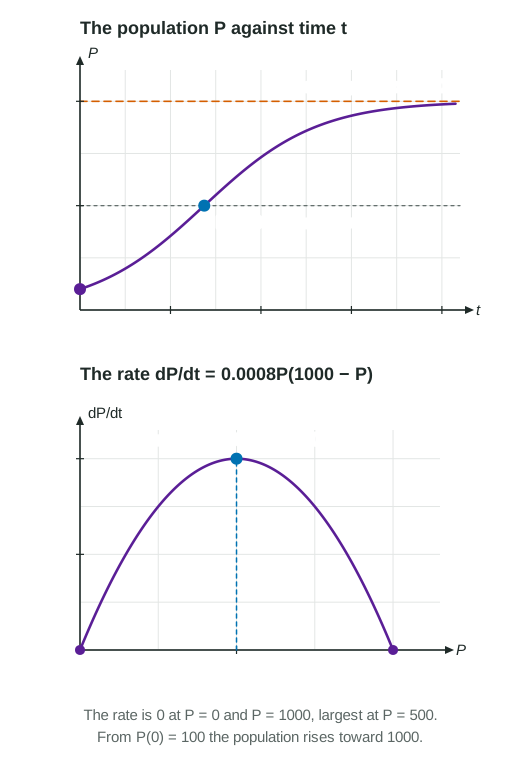
- The growth rate is jointly proportional to and to the room left, , a logistic differential equation
- When is small, : growth is nearly exponential
- As approaches , the factor approaches 0growth slows and levels off: , the carrying capacity
- The rate is a downward parabola in it is largest at , where the graph of has a point of inflection
Part 6 · Key ideas
Key ideas
- Logistic: or . The carrying capacity is the positive value of that makes the rate 0.
- For , increases toward ; for , decreases toward . Either way .
- Growth is fastest at : below it the graph of is concave up, above it concave down.
- Read these from the equation; no formula for is needed.
Part 7 · Misconception
A common mistake
The wrong idea: For
What actually happens: Near 1200 the factor is almost 0, so growth has nearly stopped. The rate is largest halfway, at .
Part 8 · Check yourself
Check yourself
Exam-style questions. Anything you miss goes into your review queue.
Table
Fish in a lake
| (years) | 0 | 1 | 2 | 3 | 4 | 6 | 8 |
|---|---|---|---|---|---|---|---|
| (fish) | 200 | 349 | 549 | 761 | 937 | 1125 | 1181 |
1. What is the carrying capacity of the lake for these fish?
No calculator. Type the exact value (a fraction, π, e or a root is fine), in fish.
Show the answer
when , and rises toward it: the carrying capacity is 1200 fish.
- Answer: 1200 fish
2. For what number of fish is the population growing fastest?
No calculator. Type the exact value (a fraction, π, e or a root is fine), in fish.
Show the answer
- Answer: 600 fish
3. Between which two times in the table is the population growing fastest?
- Between and
- Between and
- Between and
- Between and
Show the answer
Growth is fastest when , which happens between and . The table agrees: is the largest one-year change.
- Between and : Near the carrying capacity growth slows: rises only about 56 fish over these two years.
- Between and : At first the population is small, so growth is slow; it speeds up until .
- Between and : is already above 600 here, so the rate has started to fall: the jump is about 176, smaller than 212.
- Correct: Between and : Right: passes 600 between and ; the table also shows its largest jump there.
4. A population satisfies with . What is ?
No calculator. Type the exact value (a fraction, π, e or a root is fine).
Show the answer
at , the carrying capacity; a population starting at 20 rises toward it.
- Answer: 300
5. Which differential equation is a logistic model?
Show the answer
A logistic model has the form , or .
- : The rate grows with without limit; nothing slows it down.
- Correct: : Right: the rate is jointly proportional to and to .
- : The rate is proportional to alone: an exponential model, with no carrying capacity.
- : The rate is proportional to alone; it is largest at , not halfway.
6. In a school of 5000 students, the number who have heard a rumor satisfies
- The rumor spreads fastest when 5000 students have heard it, and approaches 5000
- The rumor spreads fastest when 2500 students have heard it, and approaches 2500
- The rumor spreads fastest at the start, when 100 students have heard it
- The rumor spreads fastest when 2500 students have heard it, and approaches 5000
Show the answer
is largest at , and since ,
- The rumor spreads fastest when 5000 students have heard it, and approaches 5000: At the rate is : the spreading has stopped.
- The rumor spreads fastest when 2500 students have heard it, and approaches 2500: 2500 is where the rate peaks; keeps growing past it, toward 5000.
- The rumor spreads fastest at the start, when 100 students have heard it: At few students are passing it on: the rate is , below the peak
. - Correct: The rumor spreads fastest when 2500 students have heard it, and approaches 5000: Right: the rate is largest at half the carrying capacity, and rises toward 5000.
Part 9 · Summary
Summary
Part 10 · Up next
What comes next
Part 11 · Connections