Membrane Permeability
The plasma membrane is selectively permeable.
Part 1 · Hook
Why this matters
In the late 1980s a team studying red blood cells found a protein whose job nobody knew. In 1992 they made frog oocytes, cells that let water in only slowly, build the protein, then moved them into a dilute solution. The ordinary oocytes barely swelled. The ones carrying the new protein swelled like balloons and burst within minutes. The protein was a dedicated doorway for water, now called an aquaporin, and its discovery won a Nobel Prize. It shows the central idea of this topic: what crosses a membrane, and how fast, depends on the bilayer and on the proteins in it.
Part 2 · Before you start
What this builds on
Part 3 · Prerequisite check
Quick check before you start
1. Which part of the plasma membrane forms its water-avoiding middle?
- The phospholipid heads
- The phospholipid tails
- The carbohydrate chains
Show the answer
The bilayer's two layers of hydrophobic fatty acid tails meet in the middle, where water is kept out.
- The phospholipid heads:
- Correct: The phospholipid tails:
- The carbohydrate chains:
2. Which kind of molecule is a sodium ion (Na⁺)?
- Nonpolar
- Charged
- A lipid
Show the answer
An ion carries a full electric charge, which makes it strongly attracted to water.
- Nonpolar:
- Correct: Charged:
- A lipid:
3. In diffusion, particles move:
- From lower to higher concentration, using ATP
- From higher to lower concentration, by their own motion
- Only when a membrane is present
Show the answer
Diffusion is the net spreading of particles down their concentration gradient, powered by their own random motion.
- From lower to higher concentration, using ATP:
- Correct: From higher to lower concentration, by their own motion:
- Only when a membrane is present:
Part 4 · See it
See it first
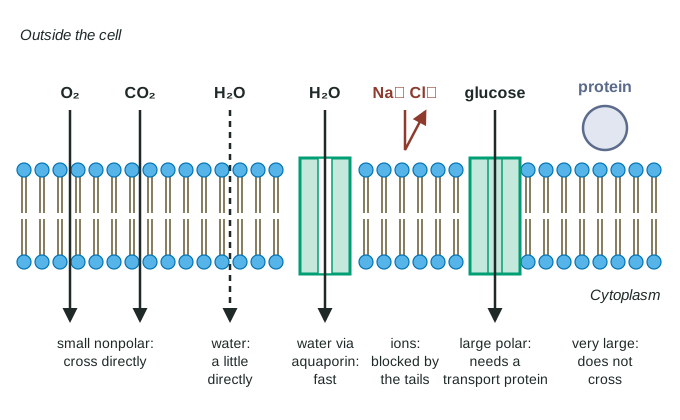
Part 5 · Step by step
How it works, step by step
- The middle of the bilayer is a layer of hydrophobic tails.Small nonpolar molecules such as O₂ and CO₂ dissolve in it and diffuse straight across: simple diffusion.
- Polar molecules are attracted to water and must leave it to enter the hydrophobic core.Small polar molecules such as water cross slowly, and large polar ones such as glucose hardly at all.
- Ions carry a full charge and hold a shell of water around them.The hydrophobic core keeps ions out almost entirely, even very small ones like Na⁺.
- The membrane carries transport proteins, such as aquaporins, that give particular substances a hydrophilic route across.Those substances cross far faster, so which proteins a cell makes decides much of what it lets in and out.
- When water moves into a plant, fungal or bacterial cell and it swells, its cell wall resists stretching.The wall pushes back on the cell and keeps it from bursting.
Part 6 · Key ideas
Key ideas
- A membrane is selectively permeable: it lets some substances through easily and holds others back. That lets a cell keep its insides different from its surroundings.
- Simple diffusion through the bilayer works for small nonpolar molecules (O₂, CO₂, N₂) and lipid-soluble ones such as steroid hormones. Charge matters more than size: tiny ions cross a bare bilayer more slowly than large uncharged sugars.
- Ions and large polar molecules cross at useful rates only through transport proteins. Water can slip through the bilayer slowly, but most water crosses through aquaporins.
- The cell wall (cellulose in plants, chitin in fungi, peptidoglycan in bacteria) lies outside the plasma membrane. It gives shape and protects the cell from bursting when water moves in, but it does not control which molecules enter.
Part 7 · Misconception
A common mistake
The wrong idea: The smaller a particle is, the more easily it crosses a membrane.
What actually happens: Charge and polarity matter more than size. A sodium ion (23 g/mol) is far lighter than glycerol (92 g/mol), yet it crosses a bare bilayer about a million times more slowly, because its charge keeps it out of the hydrophobic core.
Part 8 · Check yourself
Check yourself
Exam-style questions. Anything you miss goes into your review queue.
Data table
How fast substances cross a pure phospholipid bilayer
Researchers made artificial membranes of phospholipids only, with no proteins, and measured how fast each substance crossed them. The permeability is given to the nearest power of ten: each step up in the exponent means about ten times faster crossing.
| Substance | Molar mass (g/mol) | Polarity or charge | Approximate permeability (cm/s) |
|---|---|---|---|
| Carbon dioxide (CO₂) | 44 | Nonpolar | 10⁻¹ |
| Water (H₂O) | 18 | Polar, uncharged | 10⁻³ |
| Urea | 60 | Polar, uncharged | 10⁻⁶ |
| Glycerol | 92 | Polar, uncharged | 10⁻⁶ |
| Glucose | 180 | Polar, uncharged | 10⁻¹⁰ |
| Chloride ion (Cl⁻) | 35.5 | Charged | 10⁻¹¹ |
| Sodium ion (Na⁺) | 23 | Charged | 10⁻¹² |
1. Which statement best describes the pattern in the table?
- The smallest substances cross fastest, whatever their charge or polarity, and the largest cross slowest.
- Nonpolar CO₂ crosses fastest, uncharged polar molecules slower, ions slowest.
- Charged ions cross faster than uncharged polar molecules of a similar size.
- Molecules with a molar mass above 50 g/mol barely cross a bilayer, whatever their polarity.
Show the answer
Permeability falls from nonpolar (CO₂, 10⁻¹) through uncharged polar molecules (10⁻³ to 10⁻¹⁰, slower as they get bigger) to ions (10⁻¹¹ and 10⁻¹²).
- The smallest substances cross fastest, whatever their charge or polarity, and the largest cross slowest.: Sodium (23 g/mol) and chloride (35.5 g/mol) are small but the slowest of all, so charge matters more than size.
- Correct: Nonpolar CO₂ crosses fastest, uncharged polar molecules slower, ions slowest.: This ordering follows polarity and charge, with size mattering within the polar group.
- Charged ions cross faster than uncharged polar molecules of a similar size.: The ions (10⁻¹¹ and 10⁻¹²) are slower than water (10⁻³), a polar molecule of similar size.
- Molecules with a molar mass above 50 g/mol barely cross a bilayer, whatever their polarity.: Urea and glycerol (60 and 92 g/mol) cross at 10⁻⁶ cm/s, a million times faster than the ions.
2. A student claims that a molecule's size alone decides how fast it crosses a phospholipid bilayer. Which comparison from the table best refutes this claim?
- Glucose (180 g/mol) crosses about ten thousand times more slowly than glycerol (92 g/mol).
- Na⁺ (23 g/mol) crosses about 100 times slower than glucose (180 g/mol).
- Glycerol (92 g/mol) crosses about a thousand times more slowly than water (18 g/mol).
- Water crosses faster than urea, which is three times heavier.
Show the answer
Sodium is far smaller than glucose yet crosses about a hundred times more slowly (10⁻¹² against 10⁻¹⁰), so something besides size, its charge, controls crossing.
- Glucose (180 g/mol) crosses about ten thousand times more slowly than glycerol (92 g/mol).: Here too the larger molecule is slower, which fits the claim instead of refuting it.
- Correct: Na⁺ (23 g/mol) crosses about 100 times slower than glucose (180 g/mol).: A tiny ion crossing slower than a large sugar shows that size is not the only factor.
- Glycerol (92 g/mol) crosses about a thousand times more slowly than water (18 g/mol).: Here the larger molecule is slower, which fits the size claim rather than refuting it.
- Water crosses faster than urea, which is three times heavier.: The smaller molecule is faster here, which fits the claim.
3. Why do sodium and chloride ions cross the bilayer so slowly even though they are very small?
- Their charge keeps them out of the bilayer's hydrophobic core.
- They are too heavy to slip between the closely packed phospholipid heads on each surface.
- They bind tightly to the phospholipid tails and get stuck partway through the bilayer.
- They react with the phosphate heads and are turned into other molecules.
Show the answer
Ions carry a full charge and are surrounded by a shell of attracted water molecules. Leaving that water to enter the hydrophobic middle of the bilayer takes a lot of energy, so they almost never do.
- Correct: Their charge keeps them out of the bilayer's hydrophobic core.: Charge, not mass, is what keeps ions out of the hydrophobic core.
- They are too heavy to slip between the closely packed phospholipid heads on each surface.: Sodium (23 g/mol) is lighter than urea (60 g/mol) and glycerol (92 g/mol), which cross about a million times faster, so mass is not the reason.
- They bind tightly to the phospholipid tails and get stuck partway through the bilayer.: Charged ions are repelled by the nonpolar tails; they do not bind to them.
- They react with the phosphate heads and are turned into other molecules.: Ions are not chemically changed by the heads; they simply stay out of the core.
Graph
Frog oocytes with and without aquaporin
Frog oocytes are large cells whose plasma membranes let water through only slowly. Researchers injected some oocytes with mRNA coding for an aquaporin and others with the same volume of plain water. Three days later they moved each oocyte from a medium as concentrated as its own contents into a medium one-third as concentrated, so water tends to move into the cell, and measured its volume relative to the start. A third group got aquaporin mRNA and was then soaked in mercury chloride, which binds aquaporin. Oocytes with aquaporin and no mercury burst at about 3.5 minutes. Each point is the mean of 8 oocytes.
Water injected (control)Aquaporin mRNAAquaporin mRNA + mercury
Data table
| Time in dilute medium (min) | Water injected (control) | Aquaporin mRNA | Aquaporin mRNA + mercury |
|---|---|---|---|
| 0 | 1 | 1 | 1 |
| 1 | 1.01 | 1.12 | 1.03 |
| 2 | 1.02 | 1.24 | 1.06 |
| 3 | 1.03 | 1.36 | 1.09 |
| 4 | 1.04 | — | 1.12 |
| 5 | 1.05 | — | 1.15 |
4. Why did the researchers inject the control oocytes with plain water instead of leaving them uninjected?
- So that the mRNA is the only difference between the two groups.
- So that the control oocytes would swell about as fast as the oocytes that were given aquaporin mRNA.
- So that the control oocytes would make a small amount of aquaporin too.
- So that the control oocytes would start the experiment at a larger volume.
Show the answer
The injection could damage the membrane or add water. Giving the control the same injection, minus the mRNA, leaves the mRNA as the only difference between the groups.
- Correct: So that the mRNA is the only difference between the two groups.: Matching the injection isolates the mRNA as the one variable that differs.
- So that the control oocytes would swell about as fast as the oocytes that were given aquaporin mRNA.: The control is meant to show the normal, slow swelling, not to match the aquaporin group.
- So that the control oocytes would make a small amount of aquaporin too.: Plain water carries no mRNA, so the controls make no added aquaporin.
- So that the control oocytes would start the experiment at a larger volume.: The injected volume is tiny; starting sizes are matched, and volumes are given relative to the start.
5. Which explanation best accounts for the fast swelling of the aquaporin oocytes?
- The injected mRNA made the oocytes' contents much more concentrated, so much more water rushed in after the move.
- Ribosomes used the mRNA to make aquaporin, which entered the plasma membrane and let water in faster.
- The mRNA itself sat in the plasma membrane and formed holes for water.
- The mRNA broke down the phospholipids, so the bilayer let everything through.
Show the answer
mRNA is read by ribosomes to build a protein. The aquaporin made this way was sent to the plasma membrane, where it gave water a fast route through the bilayer.
- The injected mRNA made the oocytes' contents much more concentrated, so much more water rushed in after the move.: A small amount of mRNA barely changes how concentrated the contents are; the controls got the same volume of liquid and swelled slowly.
- Correct: Ribosomes used the mRNA to make aquaporin, which entered the plasma membrane and let water in faster.: This links the mRNA to a protein, the protein to the membrane, and the membrane to faster water entry.
- The mRNA itself sat in the plasma membrane and formed holes for water.: mRNA is read by ribosomes in the cytoplasm; it is not built into the membrane.
- The mRNA broke down the phospholipids, so the bilayer let everything through.: mRNA does not digest lipids, and mercury, which binds aquaporin, slowed the swelling, pointing to the protein.
Data table
Bacteria, penicillin and the cell wall
Penicillin stops bacteria from linking new peptidoglycan into their cell walls, so growing cells end up with weak walls. Students grew one species of bacterium for 2 hours in four conditions: a dilute medium (much less concentrated than the cells' contents) or the same medium with 0.5 M sucrose added (about as concentrated as the cells' contents), each with or without penicillin. They then counted intact cells as a percentage of those present at the start (mean ± SD, three cultures).
| Medium | Penicillin | Intact cells (% of starting number) | Shape of intact cells |
|---|---|---|---|
| Dilute | No | 99 ± 1 | Rod-shaped |
| Dilute | Yes | 12 ± 4 | Rod-shaped |
| Dilute + 0.5 M sucrose | No | 98 ± 2 | Rod-shaped |
| Dilute + 0.5 M sucrose | Yes | 91 ± 3 | Round |
6. Which explanation best accounts for the penicillin results?
- Water enters cells in dilute medium; weak walls fail to hold, so cells burst. Sucrose outside keeps water out.
- Penicillin dissolves the plasma membrane of the bacteria, and the sucrose in the medium repairs the damaged membrane.
- The sucrose feeds the cells, giving them the energy they need to break down the penicillin before it can act.
- In dilute medium penicillin enters cells faster and poisons their ribosomes.
Show the answer
A bacterium's contents are more concentrated than a dilute medium, so water moves in and the cell presses outward. The cell wall resists that push. With the wall weakened, cells in dilute medium burst; in a medium as concentrated as their contents, little water enters, so they survive but lose their rod shape.
- Correct: Water enters cells in dilute medium; weak walls fail to hold, so cells burst. Sucrose outside keeps water out.: This links the wall's job, resisting the outward push of entering water, to the four results.
- Penicillin dissolves the plasma membrane of the bacteria, and the sucrose in the medium repairs the damaged membrane.: Penicillin acts on the wall, not the membrane; the round, intact cells in sucrose show the membrane is fine.
- The sucrose feeds the cells, giving them the energy they need to break down the penicillin before it can act.: If sucrose let cells destroy penicillin, they would keep their rod shape; instead they turned round, showing the wall was still weakened.
- In dilute medium penicillin enters cells faster and poisons their ribosomes.: Penicillin targets wall building; the difference between media is about water entering, not about penicillin entering.
7. Which of these need a transport protein to cross a plasma membrane at a useful rate? Select all that apply.
- Potassium ions (K⁺)
- Oxygen (O₂)
- Glucose
- Carbon dioxide (CO₂)
- A steroid hormone such as estrogen
- Nitrogen gas (N₂)
Show the answer
Ions and large polar molecules such as glucose are kept out by the hydrophobic core. Small nonpolar molecules and lipid-soluble ones such as steroids dissolve through the bilayer by simple diffusion.
- Correct: Potassium ions (K⁺): As an ion, K⁺ is repelled by the hydrophobic core and needs a transport protein.
- Oxygen (O₂): O₂ is small and nonpolar, so it crosses the bilayer directly.
- Correct: Glucose: Glucose is large and polar, so it needs a transport protein to cross quickly.
- Carbon dioxide (CO₂): CO₂ is small and nonpolar and crosses the bilayer directly.
- A steroid hormone such as estrogen: Steroids are lipids, so they dissolve through the hydrophobic core without help.
- Nitrogen gas (N₂): N₂ is small and nonpolar and crosses the bilayer directly.
8. A drug blocks the aquaporins in a kidney cell's plasma membrane. Predict how each quantity changes.
| Variable | Change |
|---|---|
| Rate at which water crosses the plasma membrane | — |
| Rate at which oxygen crosses the plasma membrane | — |
| Rate at which carbon dioxide crosses the plasma membrane | — |
Show the answer
Aquaporins speed up water only. Small nonpolar gases cross through the bilayer itself, so blocking aquaporins slows water but leaves the gases unchanged.
- Rate at which water crosses the plasma membrane: decreases. Most water crosses through aquaporins; with them blocked, water can cross only slowly through the bilayer itself.
- Rate at which oxygen crosses the plasma membrane: no change. Oxygen is small and nonpolar and crosses directly through the bilayer, not through aquaporins, so blocking them does not change it.
- Rate at which carbon dioxide crosses the plasma membrane: no change. Carbon dioxide is also small and nonpolar and diffuses straight through the bilayer, so it is unaffected.
Part 9 · Summary
Summary
The plasma membrane is selectively permeable. Small nonpolar molecules diffuse straight through the hydrophobic core of the bilayer (simple diffusion). Polar molecules cross slowly, and ions hardly at all, unless the membrane carries transport proteins that give them a route; most water crosses through aquaporins. Outside the membrane, the cell walls of plants, fungi and bacteria give support and protect the cell from bursting when water moves in.
Part 10 · Up next