Meiosis and Genetic Diversity
Meiosis and fertilization make every offspring genetically new.
Part 1 · Hook
Why this matters
Brothers and sisters share both parents, yet unless they are identical twins they can look and act very differently. Each of your parents can make millions of different kinds of sperm or eggs, so the chance that two of their children inherit exactly the same chromosomes is effectively zero. The same divisions that create this variety can also go wrong: when a chromosome pair fails to separate, a gamete carries one chromosome too many or too few, as in most cases of Down syndrome. This topic shows where the variety comes from, and what happens when separation fails.
Part 2 · Before you start
What this builds on
Part 3 · Prerequisite check
Quick check before you start
1. In metaphase I of meiosis, the chromosomes line up
- as homologous pairs, side by side across the middle
- singly across the middle, as in mitosis
- as sister chromatids already separated at the poles
Show the answer
In meiosis I each homolog pairs with its partner, and the pairs line up across the middle; one homolog of each pair faces each pole.
- Correct: as homologous pairs, side by side across the middle:
- singly across the middle, as in mitosis:
- as sister chromatids already separated at the poles:
2. Homologous chromosomes carry
- the same genes, but possibly different alleles, one homolog from each parent
- identical DNA, copied in S phase
- different genes, one set from each parent
Show the answer
Homologs carry the same genes in the same order; the version (allele) at each gene may differ. Identical DNA describes sister chromatids.
- Correct: the same genes, but possibly different alleles, one homolog from each parent:
- identical DNA, copied in S phase:
- different genes, one set from each parent:
3. A human sperm cell normally has how many chromosomes?
- 23
- 46
- 92
Show the answer
Gametes are haploid: n = 23, one chromosome of each kind.
- Correct: 23:
- 46:
- 92:
Part 4 · See it
See it first
Part 5 · Step by step
How it works, step by step
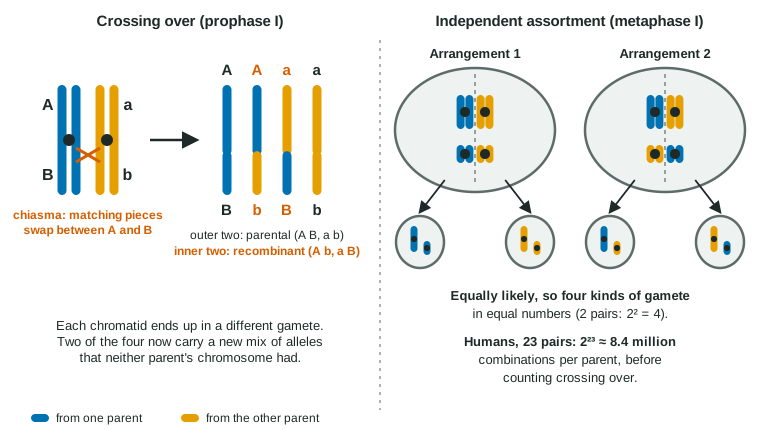
- In prophase I, paired homologs swap matching pieces between their chromatids (crossing over).Some chromatids now carry recombinant combinations of alleles, mixing the mother's and the father's versions on one chromosome.
- At metaphase I, each homologous pair lines up independently of the others, either way round.Each gamete receives a random mix of maternal and paternal chromosomes: 2ⁿ possible combinations, about 8.4 million in humans.
- Any one of a father's millions of different sperm can fuse with any one of a mother's different eggs (random fertilization).Each zygote is a new combination, about 70 trillion possibilities per couple before crossing over is counted, so siblings differ.
- Sometimes a homologous pair (meiosis I) or two sister chromatids (meiosis II) fail to separate: nondisjunction.Some gametes get an extra copy of that chromosome (n + 1) and some get none (n − 1).
- An n + 1 or n − 1 gamete is fertilized by a normal gamete.The zygote has three copies (trisomy) or one copy (monosomy) of that chromosome in every cell, which changes development; trisomy 21 causes Down syndrome.
Part 6 · Key ideas
Key ideas
- Crossing over in prophase I swaps pieces between homologs, making recombinant chromosomes with new combinations of alleles.
- Independent assortment: each homologous pair lines up at metaphase I independently, giving 2ⁿ chromosome combinations (2²³ ≈ 8.4 million in humans).
- Random fertilization multiplies the mother's and father's possibilities, so every offspring is new. Together these three make the genetic variation of sexual reproduction.
- Nondisjunction in meiosis I makes all four gametes abnormal (two n + 1, two n − 1); in meiosis II, two of the four (one n + 1, one n − 1).
- Fertilization of an abnormal gamete gives aneuploidy: trisomy (2n + 1) or monosomy (2n − 1). Examples: Down syndrome (trisomy 21), Turner syndrome (45,X), Klinefelter syndrome (47,XXY).
Part 7 · Misconception
A common mistake
The wrong idea: Gametes differ only because of crossing over; without it, every sperm from one man would be the same.
What actually happens: Independent assortment alone gives about 8.4 million chromosome combinations per person, because each of the 23 pairs lines up either way round at metaphase I. Crossing over adds even more by mixing alleles within chromosomes, and random fertilization multiplies the two parents' possibilities.
Part 8 · Check yourself
Check yourself
Exam-style questions. Anything you miss goes into your review queue.
Data table
Mother's age and births with trisomy 21
The table gives approximate rates of births with trisomy 21 (Down syndrome) by the mother's age at delivery, pooled from large population surveys. Family studies of DNA show that in about 90% of cases the extra chromosome 21 came from the egg, and that most of those egg errors happened in meiosis I. Human egg cells begin meiosis I before the mother herself is born and stay paused partway through prophase I, with homologs paired, until shortly before that egg is released, which can be 12 to 50 years later.
| Mother's age at delivery (years) | Births with trisomy 21 (per 10,000 births) |
|---|---|
| 20 | 6 |
| 25 | 8 |
| 30 | 11 |
| 35 | 26 |
| 40 | 91 |
| 45 | 333 |
1. How many times higher is the rate of births with trisomy 21 for mothers aged 45 than for mothers aged 25? Give a whole number.
Type a number in times.
Show the answer
333 ÷ 8 = 41.6, about 42 times higher.
- Answer: 42 times
2. Which hypothesis best explains both the age pattern and the finding that most extra chromosomes come from meiosis I in the egg?
- Links holding each paused homolog pair together weaken with time, so a pair more often goes to one pole.
- Eggs of older women copy chromosome 21 twice in S phase, so the egg enters meiosis I with an extra copy of it.
- Older mothers usually have older partners, whose sperm more often carry two copies of chromosome 21 after meiosis.
- In older mothers the embryo's body cells divide less accurately by mitosis, adding a chromosome 21 after fertilization.
Show the answer
Paired homologs are held together until anaphase I. An egg released at 45 has been paused with its homologs paired for about 45 years, so there is more time for those links to fail and for a pair to separate wrongly in meiosis I, which fits both observations.
- Correct: Links holding each paused homolog pair together weaken with time, so a pair more often goes to one pole.: A long pause in prophase I gives more time for the pair's links to fail, explaining both the age effect and the meiosis I origin.
- Eggs of older women copy chromosome 21 twice in S phase, so the egg enters meiosis I with an extra copy of it.: A copying error would not explain why the error appears in meiosis I separation, and copying happens only once before meiosis in eggs of any age.
- Older mothers usually have older partners, whose sperm more often carry two copies of chromosome 21 after meiosis.: The family studies show about 90% of extra chromosomes come from the egg, so a sperm explanation does not fit most cases.
- In older mothers the embryo's body cells divide less accurately by mitosis, adding a chromosome 21 after fertilization.: An error after fertilization would not put the extra chromosome in the egg's meiosis I, which is where the DNA evidence places most cases.
Model
Tracing an extra chromosome 21
The karyotype is from child A. To find where the extra chromosome came from, researchers read a stretch of DNA close to the centromere of chromosome 21. This stretch comes in many slightly different types, numbered here; each copy of chromosome 21 carries one type. Crossing over almost never happens this close to the centromere. They tested child A and the parents, and also a child with the same karyotype from another family, child B.
| Person | Types found |
|---|---|
| Child A's father | 1 and 2 |
| Child A's mother | 3 and 4 |
| Child A | 1, 3 and 4 |
| Child B's father | 5 and 6 |
| Child B's mother | 7 and 8 |
| Child B | 5, 6 and 8 |
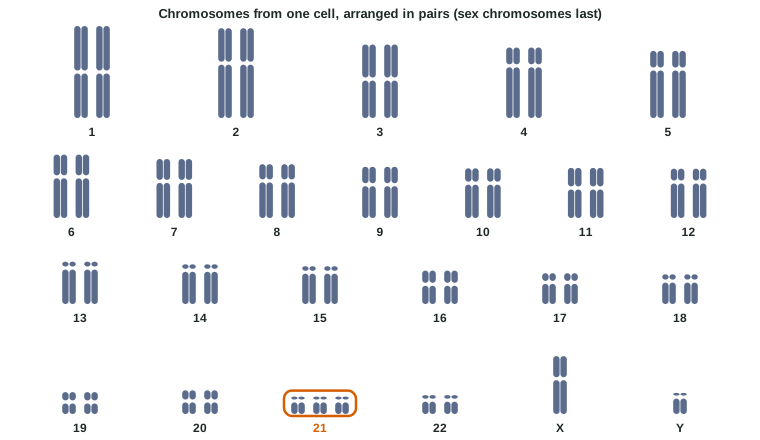
3. Which gamete that formed child A was abnormal, and how many chromosomes did it carry?
- The egg, with 24 chromosomes
- The sperm, with 24 chromosomes
- The egg, with 22 chromosomes
- Neither; both carried 23, and a chromosome 21 was copied after fertilization
Show the answer
Child A has one type from the father (1) and two from the mother (3 and 4). So the sperm carried one chromosome 21 (23 in all) and the egg carried two (24 in all).
- Correct: The egg, with 24 chromosomes: Two of child A's three chromosome 21s match the mother's types, so the egg carried the extra one: 23 + 1 = 24.
- The sperm, with 24 chromosomes: Only one type from the father (1) is present, so the sperm carried a normal single chromosome 21.
- The egg, with 22 chromosomes: An egg with 22 chromosomes would give 45 in the child, not 47.
- Neither; both carried 23, and a chromosome 21 was copied after fertilization: An extra copy made after fertilization would duplicate one of the child's two types, not add the mother's second type.
4. In which division did the error that produced child A most likely occur?
- Meiosis I in the mother, because the egg carried both of her different chromosome 21s
- Meiosis II in the mother, because the egg carried both of her different chromosome 21s
- Meiosis I in the father, because the child carries one of his two types
- Mitosis in the early embryo, because the child has three copies in each cell
Show the answer
The egg carried types 3 and 4: one copy of each of the mother's two homologs. Homologs separate in meiosis I, so they ended up together because that division failed. An error in meiosis II would put two identical sister chromatids (3 and 3, or 4 and 4) in the egg.
- Correct: Meiosis I in the mother, because the egg carried both of her different chromosome 21s: Two different maternal types in one egg means the homologs did not separate: a meiosis I error.
- Meiosis II in the mother, because the egg carried both of her different chromosome 21s: Sister chromatids are identical near the centromere, so a meiosis II error gives two copies of one type, not 3 and 4.
- Meiosis I in the father, because the child carries one of his two types: One paternal type is the normal contribution of a sperm; the extra copy is maternal.
- Mitosis in the early embryo, because the child has three copies in each cell: A mitosis error in the embryo would duplicate one of the child's existing copies and usually affect only some cells; it would not add the mother's second type.
5. A fruit fly has 2n = 8. Ignoring crossing over, how many different combinations of chromosomes can its gametes receive by independent assortment? Give a whole number.
Type a number in combinations.
Show the answer
2n = 8 means n = 4 homologous pairs. Each pair can line up two ways, independently: 2⁴ = 16 combinations.
- Answer: 16 combinations
6. Select the process that can put alleles from both of a parent's homologs onto one chromosome in a gamete.
- Crossing over in prophase I
- Independent assortment at metaphase I
- Random fertilization
- Separation of sister chromatids in anaphase II
- Copying of DNA in S phase
Show the answer
Only crossing over moves pieces between homologs, making a recombinant chromosome that carries some alleles from each.
- Correct: Crossing over in prophase I: Crossing over swaps matching pieces between a maternal and a paternal chromatid.
- Independent assortment at metaphase I: Independent assortment shuffles whole chromosomes; each chromosome stays maternal or paternal.
- Random fertilization: Fertilization combines two gametes' chromosomes but does not change any one chromosome.
- Separation of sister chromatids in anaphase II: Sister chromatids separate without exchanging anything.
- Copying of DNA in S phase: Copying makes identical sister chromatids; it does not mix the homologs.
7. In a cell with 2n = 8, one homologous pair fails to separate in meiosis I; meiosis II is normal. How many chromosomes do the four gametes have?
- 5, 5, 3 and 3
- 5, 3, 4 and 4
- 4, 4, 4 and 4
- 5, 5, 4 and 4
Show the answer
Normally each gamete gets 4. After meiosis I, one cell has 5 chromosomes (both homologs of the faulty pair) and the other 3. Meiosis II splits each normally: 5, 5, 3, 3.
- Correct: 5, 5, 3 and 3: Both cells after meiosis I are abnormal (5 and 3), and meiosis II passes that to all four gametes.
- 5, 3, 4 and 4: One n + 1, one n − 1 and two normal gametes is the result of an error in meiosis II.
- 4, 4, 4 and 4: Four normal gametes would mean no nondisjunction at all.
- 5, 5, 4 and 4: Chromosomes are not created: the four gametes share 16 in total (5 + 5 + 3 + 3), while 5, 5, 4, 4 adds up to 18.
8. A boy has 47 chromosomes with XXY (Klinefelter syndrome). DNA tests show one X came from his mother and the other X and the Y came from his father. In which division did the error happen?
- Meiosis I in the father: the X and Y, which pair in meiosis I, went into the same sperm.
- Meiosis II in the father: the two X chromatids failed to separate, giving an XX sperm.
- Meiosis I in the mother: her two X chromosomes failed to separate and went into one egg.
- Meiosis II in the mother: her X chromatids went into the same egg.
Show the answer
The sperm carried both an X and a Y. In a man, X and Y pair through their short matching region and separate in meiosis I; if they fail to separate, one sperm gets both. A meiosis II error would give XX or YY sperm, never XY.
- Correct: Meiosis I in the father: the X and Y, which pair in meiosis I, went into the same sperm.: X plus Y in one sperm means the X-Y pair stayed together: a meiosis I error.
- Meiosis II in the father: the two X chromatids failed to separate, giving an XX sperm.: A meiosis II error in the father gives a sperm with two identical X or two Y chromosomes, not X with Y.
- Meiosis I in the mother: her two X chromosomes failed to separate and went into one egg.: Only one X came from the mother, so her egg was normal.
- Meiosis II in the mother: her X chromatids went into the same egg.: The mother contributed a single X, so her meiosis worked normally.
Part 9 · Summary
Summary
Meiosis and fertilization make every offspring genetically new. In prophase I, crossing over swaps pieces between homologs and makes recombinant chromosomes. At metaphase I, each homologous pair lines up independently, so gametes get random mixes of maternal and paternal chromosomes (2ⁿ combinations). Random fertilization then joins any sperm with any egg. When chromosomes fail to separate (nondisjunction), gametes carry an extra or a missing chromosome: an error in meiosis I affects all four gametes, an error in meiosis II two of them. Fertilization of such a gamete gives trisomy or monosomy, as in Down syndrome (trisomy 21), Turner syndrome (45,X) and Klinefelter syndrome (47,XXY).
Part 10 · Up next
What comes next
Part 11 · Connections