Facilitated Diffusion
Ions and polar molecules need transport proteins to cross the hydrophobic bilayer.
Part 1 · Hook
Why this matters
A puffer fish carries a poison so strong that a few milligrams can kill an adult. It does not damage any organ. It simply plugs one kind of protein tunnel in the membranes of nerve cells, so sodium ions can no longer rush in, and the nerves fall silent. Your cells depend on thousands of these tunnels and on the pumps that keep ions lined up on the right side of the membrane.
Part 2 · Before you start
What this builds on
Part 3 · Prerequisite check
Quick check before you start
1. Why can a sodium ion (Na⁺) not slip directly through a phospholipid bilayer?
- Its charge is repelled by the hydrophobic middle of the bilayer.
- It is too large to fit between the phospholipids.
- It reacts with the phosphate heads and is destroyed.
- It is pulled out of the membrane by cholesterol.
Show the answer
Ions are charged, and the fatty-acid tails in the middle of the bilayer are nonpolar, so ions cannot dissolve in it. Size is not the problem: Na⁺ is smaller than an O₂ molecule, which crosses easily.
- Correct: Its charge is repelled by the hydrophobic middle of the bilayer.:
- It is too large to fit between the phospholipids.:
- It reacts with the phosphate heads and is destroyed.:
- It is pulled out of the membrane by cholesterol.:
2. Which describes passive transport?
- Movement down a concentration gradient with no energy input from the cell.
- Movement against a concentration gradient using ATP.
- Movement of large particles inside vesicles.
- Movement that happens only through the lipid bilayer.
Show the answer
Passive transport runs on the gradient itself: substances spread from where they are crowded to where they are scarce, and the cell spends no ATP.
- Correct: Movement down a concentration gradient with no energy input from the cell.:
- Movement against a concentration gradient using ATP.:
- Movement of large particles inside vesicles.:
- Movement that happens only through the lipid bilayer.:
Part 4 · See it
See it first
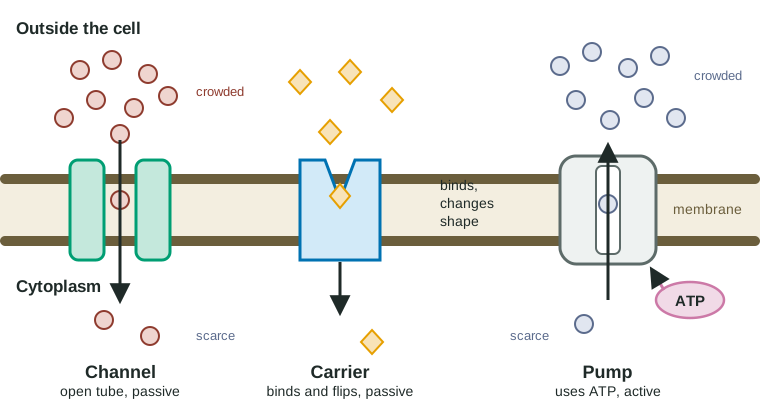
Part 5 · Step by step
How it works, step by step
- The middle of the lipid bilayer is hydrophobic.Ions and polar molecules such as glucose cannot dissolve in it, so they barely cross the membrane on their own.
- A channel protein forms a water-filled tunnel, sized and lined to fit one kind of ion (or water, for aquaporins).That ion streams through, from the side where it is crowded to the side where it is scarce, with no ATP spent: facilitated diffusion.
- Many channels are gated: they open only when a signaling molecule binds or when the membrane voltage changes.The cell controls when ions flow, so an ion rush can serve as a signal.
- A carrier protein binds a specific molecule, changes shape, and releases it on the other side, a few molecules at a time.Uptake speeds up as the outside concentration rises, until every carrier is busy; then the rate levels off at a ceiling.
- The sodium-potassium pump uses one ATP to move three Na⁺ out and two K⁺ in, against both gradients.Na⁺ stays crowded outside and K⁺ crowded inside, and slightly more positive charge leaves than enters.
- With those gradients in place, K⁺ leaks out through open potassium channels and leaves negative charges behind.The inside of the cell is negative (a membrane potential, about −70 mV in a resting nerve cell): an electrochemical gradient that stores energy for later work.
Part 6 · Key ideas
Key ideas
- Facilitated diffusion is still diffusion: the substance moves down its gradient and no ATP is spent. The protein only provides a path through the bilayer.
- Channels are tunnels (fast, millions of ions per second). Carriers bind and change shape (slower, and they max out when every carrier is busy). Pumps spend ATP to push substances against their gradient.
- An ion feels two pushes: its concentration difference and the charge difference across the membrane. Together they make its electrochemical gradient. For Na⁺ entering a cell, both push inward.
- A gradient is stored energy. The pump spends ATP to build the Na⁺ and K⁺ gradients; nerve signals, and other transport you will meet in topic 2.8, spend that stored energy.
Part 7 · Misconception
A common mistake
The wrong idea: Any transport that uses a protein must use energy, so facilitated diffusion is a kind of active transport.
What actually happens: The protein only gives the substance a path. Whether energy is needed depends on direction: down the gradient is passive (channels and most carriers), against it needs energy (pumps).
Part 8 · Check yourself
Check yourself
Exam-style questions. Anything you miss goes into your review queue.
Graph
Uptake of two substances by red blood cells
Researchers suspended equal numbers of red blood cells in solutions containing different starting concentrations of either glucose or substance X, a small molecule. Neither substance was present inside the cells at the start. They measured how fast each substance entered the cells during the first minute. Each point is the mean of four trials; the variation between trials was less than 5%.
GlucoseSubstance X
Data table
| Concentration outside the cells (mM) | Glucose | Substance X |
|---|---|---|
| 0 | 0 | 0 |
| 2 | 6 | 1 |
| 4 | 9 | 2 |
| 6 | 10.8 | 3 |
| 8 | 12 | 4 |
| 10 | 12.9 | 5 |
| 15 | 14.2 | 7.5 |
| 20 | 15 | 10 |
1. Which statement best describes the glucose data?
- Uptake rate rises steeply at low concentrations, then by less and less as concentration grows.
- Uptake rate climbs by the same amount with each additional 2 mM of glucose, across the whole range tested.
- Uptake rate rises slowly at first and then faster once the concentration passes about 10 mM.
- Uptake rate peaks near 10 mM and then falls as more glucose is added outside the cells.
Show the answer
Glucose uptake gains 6.0 nmol/min over the first 2 mM but only 0.8 nmol/min over the last 5 mM: the curve flattens toward a ceiling.
- Correct: Uptake rate rises steeply at low concentrations, then by less and less as concentration grows.: Correct: the first 2 mM add 6.0 nmol/min, while going from 15 to 20 mM adds only 0.8 nmol/min.
- Uptake rate climbs by the same amount with each additional 2 mM of glucose, across the whole range tested.: That describes substance X, whose rate climbs 1.0 nmol/min for every 2 mM. Glucose gains less with each step.
- Uptake rate rises slowly at first and then faster once the concentration passes about 10 mM.: The pattern is the reverse: the steep part is at low concentrations and the curve flattens at high ones.
- Uptake rate peaks near 10 mM and then falls as more glucose is added outside the cells.: The rate never falls; it keeps creeping up, from 12.9 at 10 mM to 15.0 at 20 mM.
2. Which explanation best accounts for the difference between the two curves?
- Glucose uses a limited number of carrier proteins that all become occupied; X diffuses through the bilayer itself.
- Glucose is pumped in using ATP, and the cells run short of ATP at high glucose levels, while X needs no energy.
- Glucose is too large to fit through the bilayer at high concentrations, while X fits through at any concentration.
- Glucose molecules attract one another at high concentrations and slow down, while X molecules stay evenly spread out.
Show the answer
A curve that levels off is the signature of a fixed number of transport proteins: once every carrier is busy, adding more glucose cannot speed transport. A straight line means rate tracks the gradient, as in simple diffusion through the bilayer.
- Correct: Glucose uses a limited number of carrier proteins that all become occupied; X diffuses through the bilayer itself.: Correct: a fixed number of carriers caps the rate, while diffusion through the bilayer has no such cap and stays proportional to the gradient.
- Glucose is pumped in using ATP, and the cells run short of ATP at high glucose levels, while X needs no energy.: Nothing was inside the cells at the start, so glucose was moving down its gradient: no pump is needed. Glucose enters red blood cells by facilitated diffusion.
- Glucose is too large to fit through the bilayer at high concentrations, while X fits through at any concentration.: Size does not change with concentration. A molecule either can or cannot cross the bilayer; glucose cannot at any concentration and needs a carrier throughout.
- Glucose molecules attract one another at high concentrations and slow down, while X molecules stay evenly spread out.: Glucose molecules dissolve and move independently in water; the leveling off comes from the limited number of carriers, not from clumping.
3. Calculate the percent increase in the glucose uptake rate when the outside concentration doubles from 10 mM to 20 mM. Round to the nearest whole percent.
Type a number in %.
Show the answer
Percent change = (new − old) ÷ old × 100 = (15.0 − 12.9) ÷ 12.9 × 100 ≈ 16%. Doubling the concentration raised the rate by only about a sixth, because nearly every carrier was already busy at 10 mM. For substance X the same doubling raises the rate by 100%.
- Answer: 16 %
4. The experiment is repeated with cells treated with a drug that permanently blocks half of their glucose carriers. Which prediction is most consistent with the explanation of the curves?
- The glucose curve levels off at about half its original height; the X curve does not change.
- The glucose curve keeps its original ceiling but takes twice the concentration to reach it; the X curve does not change.
- Both curves level off at about half their original heights, because the membrane has fewer open routes.
- The glucose curve becomes a straight line like X, because the remaining carriers are no longer crowded.
Show the answer
The ceiling of the glucose curve is set by how many carriers there are. Halve the carriers and the top rate halves. X does not use the carriers, so its line is unchanged.
- Correct: The glucose curve levels off at about half its original height; the X curve does not change.: Correct: with half the carriers, the most glucose they can move per minute is about half as much, and X's route through the bilayer is untouched.
- The glucose curve keeps its original ceiling but takes twice the concentration to reach it; the X curve does not change.: Blocking carriers lowers the ceiling. A shift to higher concentration with the same ceiling would come from something competing with glucose for the same carriers, not from losing carriers.
- Both curves level off at about half their original heights, because the membrane has fewer open routes.: X crosses the lipid bilayer directly, so blocking glucose carriers has no effect on it.
- The glucose curve becomes a straight line like X, because the remaining carriers are no longer crowded.: Fewer carriers fill up sooner, not later; the glucose curve still levels off, just at a lower rate.
5. A student proposes that substance X also uses a carrier, one with so many copies that it never fills up in this range. Which new result would best support the student's idea?
- Adding a large amount of a molecule shaped like X to the solution slows the uptake of X.
- Repeating the experiment at 25 °C instead of 37 °C slows the uptake of X by a small amount.
- The uptake of X at 20 mM is twice its uptake at 10 mM, just as in the original data.
- Cells given extra glucose take up X at the same rate as cells given no glucose.
Show the answer
Carriers are specific: they bind molecules of a particular shape. If a look-alike molecule slows X's uptake, the two are competing for the same binding sites, which a bilayer route would not show.
- Correct: Adding a large amount of a molecule shaped like X to the solution slows the uptake of X.: Correct: competition for a binding site is evidence for a specific transport protein, because diffusion through the bilayer has no site to compete for.
- Repeating the experiment at 25 °C instead of 37 °C slows the uptake of X by a small amount.: Lower temperature slows nearly all movement of molecules, including simple diffusion, so it cannot tell the two routes apart.
- The uptake of X at 20 mM is twice its uptake at 10 mM, just as in the original data.: This repeats the original pattern, which is exactly what simple diffusion predicts; it adds no evidence for a carrier.
- Cells given extra glucose take up X at the same rate as cells given no glucose.: This shows only that X does not share the glucose carrier. X could still diffuse through the bilayer or use some other carrier.
6. Which feature separates a carrier protein from a channel protein?
- A carrier binds the substance and changes shape to move it across the membrane.
- A carrier moves its substance from low concentration to high concentration.
- A carrier uses ATP each time it moves a molecule across the membrane.
- A carrier lets any small molecule through, while a channel is specific.
Show the answer
A channel is an open tunnel the substance passes through. A carrier grips the substance, changes shape and lets it go on the other side.
- Correct: A carrier binds the substance and changes shape to move it across the membrane.: Correct: binding plus a change of shape is what makes a protein a carrier.
- A carrier moves its substance from low concentration to high concentration.: Carriers in facilitated diffusion move substances down their gradient, from high to low, just as channels do.
- A carrier uses ATP each time it moves a molecule across the membrane.: Carriers in facilitated diffusion use no ATP; the gradient drives the movement. A protein that spends ATP is a pump.
- A carrier lets any small molecule through, while a channel is specific.: Both are specific. A carrier binds only molecules that fit its binding site; a channel's size and charged lining admit only certain ions.
7. Inside a resting animal cell the membrane potential is −70 mV and Na⁺ is far more concentrated outside. Which statement correctly describes the electrochemical gradient for Na⁺?
- Both the concentration difference and the negative inside pull Na⁺ into the cell.
- The concentration difference pulls Na⁺ in, but the negative inside pushes it back out.
- The two forces cancel each other, which is why Na⁺ needs a pump to enter the cell.
- Na⁺ feels no electrical push, because charge affects negatively charged ions but not positive ones.
Show the answer
Na⁺ is crowded outside, so diffusion favors entry. It is also positive, and opposite charges attract, so the negative inside draws it in too. Both parts of the gradient point inward, which is why Na⁺ rushes in when a channel opens.
- Correct: Both the concentration difference and the negative inside pull Na⁺ into the cell.: Correct: concentration and charge both favor Na⁺ entering, a steep inward electrochemical gradient.
- The concentration difference pulls Na⁺ in, but the negative inside pushes it back out.: A negative inside attracts a positive ion; it pulls Na⁺ in, it does not push it out.
- The two forces cancel each other, which is why Na⁺ needs a pump to enter the cell.: The forces add rather than cancel, and Na⁺ enters through channels without a pump. The pump moves Na⁺ out.
- Na⁺ feels no electrical push, because charge affects negatively charged ions but not positive ones.: Charge acts on every ion: a positive ion is drawn toward negative regions and a negative ion toward positive ones.
Part 9 · Summary
Summary
Ions and polar molecules need transport proteins to cross the hydrophobic bilayer. Channels form tunnels, often gated so the cell controls when they open; carriers bind and change shape, so their uptake rate levels off once every carrier is busy. Both are facilitated diffusion: passive, down the gradient. Pumps such as the sodium-potassium pump spend ATP to move ions against their gradients (3 Na⁺ out, 2 K⁺ in). The resulting electrochemical gradients, including a negative membrane potential, store energy the cell uses later.
Part 10 · Up next
What comes next
Part 11 · Connections