B cells and antibodies
1Why this matters
Priya, 24, steps on a rusty nail while gardening. At urgent care, her records show her last tetanus shot was twelve years ago, so she gets a booster. Her neighbor, who has never been vaccinated, gets the same wound and is given both a first tetanus vaccine and an injection of tetanus antibodies. Why does one person need borrowed antibodies and the other not? The answer lies in how B cells make antibodies, and in what the first exposure leaves behind.
2What this builds on
3Quick check before you start
1. What does an antibody bind?
- Any foreign molecule it meets
- One particular antigen shape
- Only peptides held in MHC proteins
Show the answer
Each antibody's arm tips fit one antigen's shape, the way a key fits one lock. Binding peptides held in MHC is how T cell receptors work, not antibodies.
- Any foreign molecule it meets:
- Correct: One particular antigen shape:
- Only peptides held in MHC proteins:
2. Which T cell recognizes antigen in MHC class II and directs other immune cells with cytokines?
- Cytotoxic T cell
- Regulatory T cell
- Helper T cell
Show the answer
Helper T cells carry CD4, recognize antigen in MHC class II, and coordinate other cells, including B cells, with cytokines and surface contact.
- Cytotoxic T cell:
- Regulatory T cell:
- Correct: Helper T cell:
3. What does the complement system do when it is activated on a bacterium's surface?
- It coats the bacterium for phagocytes and can punch holes in its membrane
- It makes the bacterium divide faster
- It presents the bacterium's peptides to T cells
Show the answer
Activated complement proteins coat microbes (opsonization), attract phagocytes and build the membrane attack complex, which makes holes in the microbe's membrane.
- Correct: It coats the bacterium for phagocytes and can punch holes in its membrane:
- It makes the bacterium divide faster:
- It presents the bacterium's peptides to T cells:
4Anatomy
With labels hidden, select a box to reveal its label.
5How it works, step by step
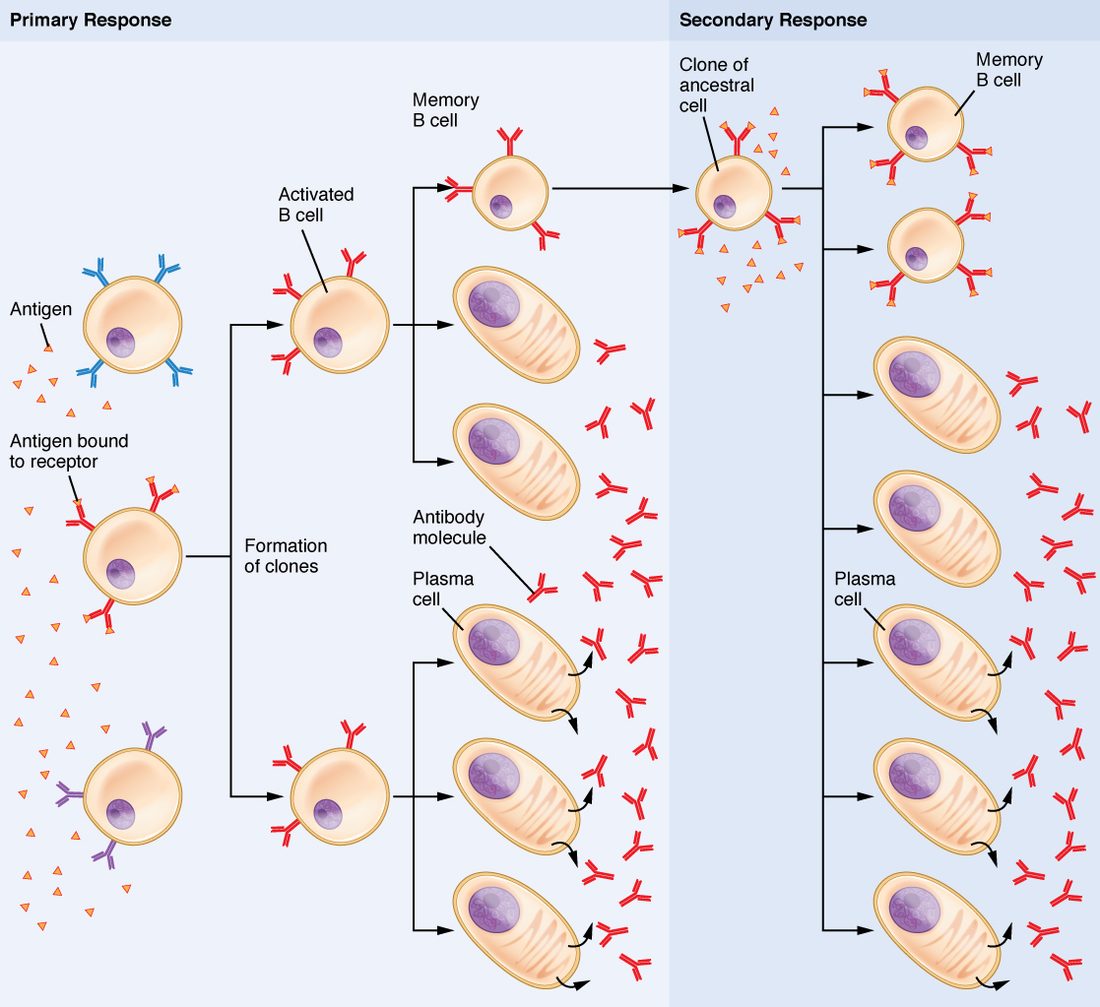
- A protein antigen binds the B cell receptors of a naïve B cell that fits it, and the B cell takes it in and displays its peptides on MHC class II.A helper T cell that recognizes the same antigen binds the B cell and releases cytokines onto it.
- Helper T cell contact and cytokines activate the B cell.It divides into a clone, and many of its daughters switch from IgM to another class, such as IgG.
- Daughter cells differentiate.Plasma cells release thousands of antibody molecules per second, and memory B cells remain.
- IgG binds the microbe's antigens with its variable regions, leaving its Fc regions facing out.Phagocytes bind the Fc regions and engulf the coated microbe, and complement is activated on its surface.
- The same antigen appears again months or years later.Memory B cells respond within days, making far more IgG than the first time: the secondary response.
6Core concepts
7A common mistake
The wrong idea: Antibodies kill microbes by themselves.
What actually happens: An antibody only binds. It blocks toxins and viruses from attaching to your cells (neutralization) and clumps microbes together (agglutination), but the killing is done by others that its Fc region calls in: complement, phagocytes that engulf antibody-coated microbes, and natural killer cells. That is why the class, which sets the Fc region, matters as much as what the antibody binds.
8Check yourself
Anything you miss goes into your review queue.
1. The second peak on the graph rises sooner and climbs far higher than the first. What best explains the difference?
- The antigen was given in a larger dose the second time
- Memory B cells left by the first exposure responded
- Antibodies from the first response were still binding the antigen
- A different antigen was given the second time
Show the answer
The first exposure left memory B cells that outnumber the original naïve cells, respond with less stimulation, and already make switched, better-fitting antibody. When the same antigen returns, they produce plasma cells within days.
- The antigen was given in a larger dose the second time: The graph gives no reason to think the dose changed, and the same pattern appears with identical vaccine doses. Memory, not dose, explains it.
- Correct: Memory B cells left by the first exposure responded: Correct. Memory B cells make the secondary response faster and larger.
- Antibodies from the first response were still binding the antigen: Leftover antibody would, if anything, clear some antigen and blunt the response. The rise comes from new plasma cells.
- A different antigen was given the second time: A different antigen would bring a new primary response, with the same lag and low peak as the first. Memory is specific.
2. IgG coats a bacterium, and a macrophage then engulfs it. Which part of the antibody does the macrophage's receptor protein bind?
- The light chains
- The antigen-binding sites
- The variable region of the heavy chains
- The Fc region
Show the answer
When IgG binds a microbe with its arm tips, its Fc region points outward. Phagocytes carry Fc receptor proteins that bind that stem, so coated microbes are engulfed far more readily. This is opsonization.
- The light chains: Light chains form part of the arms, which are busy gripping the bacterium. They do not bind Fc receptor proteins.
- The antigen-binding sites: The antigen-binding sites are attached to the bacterium, so they are not free to bind the macrophage.
- The variable region of the heavy chains: The variable regions sit at the arm tips, on the bacterium. Receptor proteins on phagocytes bind the constant stem.
- Correct: The Fc region: Correct. Fc receptor proteins bind the Fc region.
3. A woman who had a tetanus vaccine series as a child gets a booster dose twenty years later. Predict each variable after the booster, compared with her very first dose.
| Variable | Change |
|---|---|
| Days until antibody rises in the blood | — |
| Peak antibody level | — |
| Share of the antibody that is IgG | — |
| How tightly the antibody binds the toxin | — |
| Number of memory B cells afterward | — |
Show the answer
A second exposure to the same antigen recalls memory B cells. The response starts sooner, goes higher, is mainly IgG, fits better and leaves more memory cells. That is why boosters work.
- Days until antibody rises in the blood: down. Memory B cells need less stimulation and are more numerous than the naïve cells were, so plasma cells appear within 1–3 days instead of 5–10.
- Peak antibody level: up. Many memory B cells each form a clone of plasma cells, so far more antibody is made, often 10 to 100 times more.
- Share of the antibody that is IgG: up. Memory B cells have already switched class, so the response is mostly IgG, with little of the IgM that starts a primary response.
- How tightly the antibody binds the toxin: up. Memory cells come from B cells selected for better-fitting antibody during the first responses (affinity maturation).
- Number of memory B cells afterward: up. Each secondary response makes new memory cells as well as plasma cells, so the pool grows.
4. Select every example of passive immunity.
- Antivenom given after a snakebite
- A measles vaccine
- IgG crossing from a mother into her fetus
- Recovering from chickenpox
- IgA a baby swallows in breast milk
- Anti-D injected into an Rh-negative mother
Show the answer
Passive immunity is protection by antibody someone else made. Antivenom, maternal IgG, IgA in breast milk and injected anti-D are all borrowed antibody. A vaccine and recovery from infection make your own immune system respond: active immunity.
- Correct: Antivenom given after a snakebite: Correct. Antivenom is antibody made in another animal: artificial passive immunity.
- A measles vaccine: A vaccine makes your own B and T cells respond and leave memory: artificial active immunity.
- Correct: IgG crossing from a mother into her fetus: Correct. Maternal IgG is natural passive immunity.
- Recovering from chickenpox: Recovering from an infection is natural active immunity; your own cells made the antibodies and memory cells.
- Correct: IgA a baby swallows in breast milk: Correct. IgA in milk is natural passive immunity for the baby's gut.
- Correct: Anti-D injected into an Rh-negative mother: Correct. Injected anti-D is borrowed antibody: artificial passive immunity.
5. An 18-month-old responds poorly to a vaccine made of a bacterium's capsule sugar alone, but well to one in which the sugar is attached to a protein. Why does the protein help?
- The protein makes the sugar a larger target for IgM
- Protein antigens do not need B cells at all
- The protein stops the sugar from being broken down before B cells can reach it
- Helper T cells that recognize the protein can help B cells that recognize the sugar
Show the answer
Capsule sugars are T cell-independent antigens: they give weak, mostly IgM responses with little memory, and poor ones in young children. A B cell that binds the sugar takes in the whole conjugate and displays peptides from the attached protein on MHC class II. Helper T cells that recognize those peptides then help it expand, switch class and form memory. This is a conjugate vaccine.
- The protein makes the sugar a larger target for IgM: Size alone does not help. The gain comes from helper T cells, which can then drive class switching and memory.
- Protein antigens do not need B cells at all: Protein antigens do need B cells to make antibody. What they add is peptides for helper T cells.
- The protein stops the sugar from being broken down before B cells can reach it: The sugar's lifetime is not the problem. Without T cell help, B cells make a weak response however long the antigen lasts.
- Correct: Helper T cells that recognize the protein can help B cells that recognize the sugar: Correct. Linking the sugar to a protein turns the response into a T cell-dependent one.
6. Complete the sequence: IgG binds antigens on a bacterium → ____ → the phagocyte engulfs the bacterium readily.
- The IgG molecules punch holes in the bacterium
- Fc receptor proteins on a phagocyte bind the IgG stems
- The bacterium displays its peptides on MHC class I
- IgG enters the bacterium and blocks the enzymes it needs to divide
Show the answer
This is opsonization. Bound IgG leaves its Fc regions facing out, and phagocytes grab them with Fc receptor proteins, which strongly speeds engulfment.
- The IgG molecules punch holes in the bacterium: Antibodies do not make holes. The membrane attack complex of complement does.
- Correct: Fc receptor proteins on a phagocyte bind the IgG stems: Correct. Fc receptor proteins link the phagocyte to the coated bacterium.
- The bacterium displays its peptides on MHC class I: Bacteria do not have MHC proteins; MHC is found on your own cells.
- IgG enters the bacterium and blocks the enzymes it needs to divide: Antibodies act from outside, on surface antigens. They do not enter bacteria.
7. A hiker bitten by a rattlesnake recovers after antivenom. A year later he is bitten again. Will the first antivenom still protect him?
- Yes, because the antivenom left memory B cells
- Yes, because antivenom antibodies last for decades
- No, because antivenom is broken down and leaves no memory
- No, because the first dose made him permanently immune to the snake's venom
Show the answer
Antivenom is passive immunity: antibodies made in another animal. They work at once but are broken down within days to weeks, and because his own B cells did not make them, no memory cells formed.
- Yes, because the antivenom left memory B cells: Memory B cells come only from your own immune response. Borrowed antibodies do not create them.
- Yes, because antivenom antibodies last for decades: Borrowed antibodies last days to a few months, not decades.
- Correct: No, because antivenom is broken down and leaves no memory: Correct. Passive immunity is immediate but temporary.
- No, because the first dose made him permanently immune to the snake's venom: The answer contradicts itself: if he were immune, he would be protected. Antivenom does not make you immune.
9Summary
B cells bind whole antigens with their B cell receptors. For T cell-dependent (protein) antigens, a helper T cell that recognizes the same antigen activates the B cell, which expands, switches class and becomes plasma cells and memory B cells; T cell-independent antigens such as capsule sugars give mostly IgM and little memory. An antibody (immunoglobulin) has two heavy and two light chains: the variable regions at the arm tips form two identical antigen-binding sites, and the constant regions, including the Fc stem, set the class. IgG is the main blood antibody and the only class that crosses to the fetus; IgA protects mucous membranes; IgM comes first and is best at agglutination and complement; IgE arms mast cells; IgD sits on naïve B cells. Antibodies neutralize, agglutinate, opsonize, activate complement and direct killer cells. Secondary responses are faster, larger and mostly IgG. Active immunity (infection or a vaccine) leaves memory; passive immunity (borrowed antibody) is immediate but brief.