Inverse Functions
An inverse function undoes a function: f⁻¹(b) = a exactly when f(a) = b .
Part 1 · Hook
Why this matters
Part 2 · Before you start
What this builds on
Part 3 · Prerequisite check
Quick check before you start
1. Let and . What is ?
Show the answer
, so .
- Correct: :
- :
- :
- :
2. Solve for .
Show the answer
Add , then divide by .
- Correct: :
- :
- :
- :
Part 4 · See it
See it first
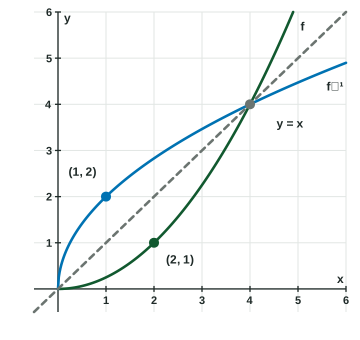
Part 5 · Step by step
How it works, step by step
- sends the input to the output sends back to : the point becomes
- Swap every input and outputthe graph reflects across the line , and the domain and range trade places
- Two inputs share an output, such as the inverse would need two outputs, so is not invertible
- Restrict the domain to a piece where only increases or only decreasesthat piece has an inverse
- Compose a function with its inverse and : the identity function
Part 6 · Key ideas
Key ideas
- means . The names the inverse function; is not .
- A function is invertible when each output comes from exactly one input (it is one-to-one).
- Justify with specific values: ", so has no inverse", never a bare rule name.
- To find a formula, swap and in and solve for .
- The domain of is the range of , and the range of is the domain of .
Part 7 · Misconception
A common mistake
The wrong idea: means , so the inverse of is .
What actually happens: undoes : it adds the back, so . Check with composition:
Part 8 · Check yourself
Check yourself
Exam-style questions. Anything you miss goes into your review queue.
Table
Values of and
| 0 | 1 | 2 | 3 | 4 | 5 | |
|---|---|---|---|---|---|---|
| -3 | -1 | 2 | 5 | 7 | 12 | |
| 4 | 1 | 0 | 1 | 4 | 9 |
1. The function is invertible. Using the table, what is ?
Show the answer
is the input of whose output is . The table has , so .
- Correct: : , so the inverse sends back to .
- : This is . The inverse runs the other way: from the output back to an input.
- : This is . The in names the inverse function, not a reciprocal.
- : This is . is an input of , not the reciprocal of .
2. Which statement correctly decides whether is invertible, using values from the table?
- No: and , so two inputs share the output
- Yes: each input of has exactly one output
- No: , and an output of has no inverse
- Yes: is the largest output in the table
Show the answer
An invertible function gives each output for one input. , so would have to be both and : has no inverse.
- Correct: No: and , so two inputs share the output : Two inputs, and , share the output , named with values: this earns the point.
- Yes: each input of has exactly one output: That makes a function. To be invertible, each output must also come from one input.
- No: , and an output of has no inverse: An output of is no problem; comes from one input.
- Yes: is the largest output in the table: A largest output says nothing about repeated outputs; does.
3. Using the table, which value can be an input of ?
Show the answer
The inputs of are the outputs of : . Of these choices, only is one of them.
- Correct: : is an output of , so .
- : is an input of , but no input of gives the output in the table.
- : is an input of ; it is not an output of , so is not in the table.
- : is an input of ; , so is not an output in the table.
Graph
The graph of
4. Use the graph to find .
Show the answer
is the input of whose output is . The graph passes through , so .
- Correct: : , so the inverse sends back to .
- : This is , the forward direction.
- : is the output we start from; the answer is the input that produces it.
- : ; that point does not have output .
5. Which point is on the graph of ?
Show the answer
is on the graph of , so is on the graph of : the coordinates trade places.
- Correct: : , so .
- : This point is on the graph of itself.
- : This point is on ; its swapped partner is on the inverse.
- : , so the point is , not .
6. Let . Write .
Type an expression for .
Show the answer
subtracts , then divides by . Undo in reverse order: multiply by , then add . So .
- Answer:
7. Let , defined for every real number. Which statement shows that has no inverse?
- and
- and
- is a function, so each input has one output
- is a negative output
Show the answer
Two different inputs, and , give the same output , so an inverse could not decide which input to return.
- Correct: and : Two inputs with one shared output: specific values that prove it.
- and : Different inputs with different outputs show nothing about repeats.
- is a function, so each input has one output: That is true of every function; it does not decide invertibility.
- is a negative output: A negative output is allowed; repeated outputs are what matter.
Part 9 · Summary
Summary
Part 10 · Up next
What comes next
Part 11 · Connections