
The question
Name: ______________________ Date: ____________ A weight on a spring (6 points)
Graph
Height of a weight on a spring
A weight hangs from a spring above a floor. The weight is pulled and released, and then it bobs up and down with a frequency of 0.5 cycle per second. The bottom of the weight is 60 centimeters above the floor at its highest and 40 centimeters above the floor at its lowest. At time seconds, the weight is at its highest. The sinusoidal function models the height of the bottom of the weight above the floor, in centimeters, at time . The graph of for one cycle is shown with its axes unscaled. The points , , , and are on the graph: and are highest points, is a lowest point, and and are on the midline.
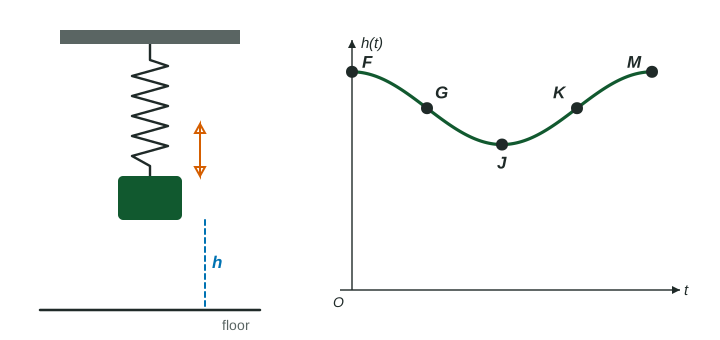
(A) Find the coordinates of the points , , , and . [2 points]
(B) The function is given by
, where , , and are constants. Find values of , , and . [2 points] (C(i)) Is increasing or decreasing on the interval ? Give a reason for your answer in the context of the problem. [1 point]
(C(ii)) Is the graph of concave up or concave down on the interval , and is the rate of change of increasing or decreasing there? Explain your reasoning. [1 point]