Units, Prefixes and Significant Figures
Work in SI units (m, kg, s).
Part 1 · Hook
Why this matters
Part 2 · See it
See it first
Part 3 · Step by step
How it works, step by step
- A number is reported without a unitnobody can tell how big the quantity is, so a value is always a number times a unit
- Every quantity is converted to SI base units (m, kg, s) before you calculatethe units of the answer come out in SI too, with no hidden factors of 100 or 1000
- You multiply by a fraction equal to 1, such as (1 m / 100 cm)the value does not change, but the unwanted unit cancels like a number
- A measured value is known only to a few digitsa calculated result keeps the precision of the least precise data, rounded once at the end
Part 4 · Key ideas
Key ideas
- Physics 1 works in SI units: the meter (m), kilogram (kg) and second (s), and units built from them such as m/s.
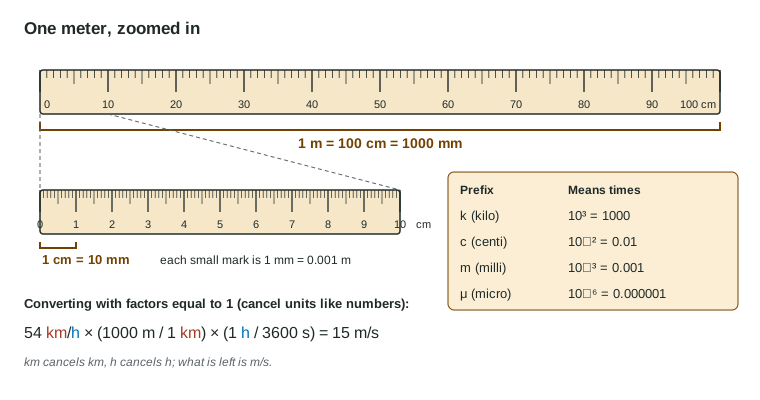
- A prefix is a power of ten: kilo = 10³, centi = 10⁻², milli = 10⁻³, micro = 10⁻⁶. So 1 km = 1000 m, 1 cm = 0.01 m, 1 g = 0.001 kg.
- To convert, multiply by a fraction equal to 1 with the unit you want on top and the unit you are removing on the bottom. Check that the units cancel.
- Areas need the factor twice: 1 m² = 100 cm × 100 cm = 10 000 cm².
- Significant figures: multiplying or dividing, keep the fewest significant figures of the data; adding or subtracting, the fewest decimal places. Round once, at the end.
Part 5 · Misconception
A common mistake
The wrong idea: To change 72 km/h into m/s, multiply by 3.6, because there are 3600 seconds in an hour and 1000 meters in a kilometer.
What actually happens: Write the factors and let the units cancel: 72 km/h × (1000 m / 1 km) × (1 h / 3600 s) = 20 m/s. The number gets smaller, because a meter per second is a faster speed than a kilometer per hour.
Part 6 · Check yourself
Check yourself
Exam-style questions. Anything you miss goes into your review queue.
1. A toy car rolls 45 cm across a table. How far is that in meters?
Type a number in m.
Show the answer
1 m = 100 cm, so 45 cm × (1 m / 100 cm) = 0.45 m.
- Answer: 0.45 m
2. A cyclist rides at 27 km/h. What is her speed in m/s?
Type a number in m/s.
Show the answer
27 km/h × (1000 m / 1 km) × (1 h / 3600 s) = 27 000 m / 3600 s = 7.5 m/s.
- Answer: 7.5 m/s
3. A student records a length as 0.00620 m. How many significant figures does it have?
- 6
- 5
- 3
- 2
Show the answer
Leading zeros never count; the trailing zero after the decimal point does. 0.00620 = 6.20 × 10⁻³, three significant figures.
- 6: This counts every digit, but the zeros in front of the 6 only show where the decimal point is.
- 5: This counts the zeros after the decimal point, which only place the 6.
- Correct: 3: Right: the leading zeros only place the decimal point; 6, 2 and the final 0 count.
- 2: The final zero comes after a nonzero digit and after the decimal point, so it was measured and counts.
4. A sprinter runs 100.0 m in 12.47 s. A calculator shows 100.0 ÷ 12.47 = 8.019246191. How should the speed be reported?
- 8.019 m/s
- 8.0 m/s
- 8.019246191 m/s
- 8 m/s
Show the answer
Multiplying or dividing: keep as many significant figures as the least precise value. 100.0 m and 12.47 s each have four, so 8.019 m/s.
- Correct: 8.019 m/s: Right: both measurements have four significant figures, so the result keeps four.
- 8.0 m/s: Two figures throws away precision the measurements had; both data values have four.
- 8.019246191 m/s: A calculator does not know how precise the data are; extra digits claim precision nobody measured.
- 8 m/s: One figure throws away most of the precision of four-figure data.
5. A tabletop measures 1.2 m by 0.80 m. What is its area in square centimeters (cm²)?
Type a number in cm^2.
Show the answer
Area = 1.2 m × 0.80 m = 0.96 m². Each meter is 100 cm, and a square meter is 100 cm × 100 cm = 10 000 cm², so 0.96 m² = 9600 cm² (two significant figures).
- Answer: 9.6 × 103 cm^2
6. A quantity is found by dividing a value in m/s by a value in s. What unit does the result have?
- m
- m/s²
- m·s
- s/m
Show the answer
Units cancel and combine like numbers: (m/s) ÷ s = m/s².
- m: That would come from multiplying m/s by s, not dividing.
- Correct: m/s²: Right: (m/s) ÷ s = m/(s·s) = m/s², read "meters per second squared".
- m·s: Dividing by seconds puts another s in the denominator, not the numerator.
- s/m: This flips the whole unit; only one more second goes below the line.
Part 7 · Summary
Summary
Part 8 · Up next
What comes next
Part 9 · Connections