Scarcity
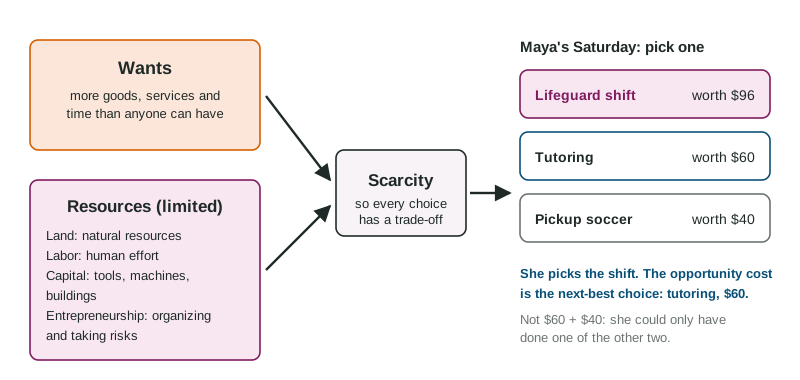
Scarcity means resources are limited while wants are not, so every choice involves a trade-off.
Part 1 · Hook
Why this matters
Part 2 · Prerequisite check
Quick check before you start
1. A table lists three jobs worth $900, $650 and $400. Which is worth the most?
- The $900 job
- The $650 job
- The $400 job
- They are worth the same
Show the answer
Compare the values directly: 900 is the largest.
- Correct: The $900 job:
- The $650 job:
- The $400 job:
- They are worth the same:
2. On a graph, the horizontal axis
- runs left to right
- runs up the side
- is always labeled Price
- shows the slope
Show the answer
The horizontal axis runs along the bottom.
- Correct: runs left to right:
- runs up the side:
- is always labeled Price:
- shows the slope:
Part 3 · See it
See it first
Part 4 · Step by step
How it works, step by step
- Wants are unlimited and resources are limitedthere is scarcity: not every want can be met
- Scarcity means you cannot have everythingevery choice is a trade-off: getting one thing means giving up another
- You pick the best option and give up the restthe value of the next-best option you gave up is the opportunity cost
- You compare each option with its opportunity costyou can tell whether a choice is worth what it gives up
Part 5 · Key ideas
Key ideas
- Scarcity: limited resources and unlimited wants. It affects rich and poor people, firms and governments alike.
- The factors of production (resources) are land (natural resources), labor (human effort), capital (tools, machines, buildings) and entrepreneurship (organizing and risk taking). Money is not capital in this sense.
- Most resources are scarce, but some are not used up when used: an idea or a piece of knowledge can be shared by everyone at once.
- Every choice is a trade-off. Its opportunity cost is the value of the next-best alternative given up: one option, not all of them added together.
Part 6 · Misconception
A common mistake
The wrong idea: The opportunity cost of Maya's lifeguard shift is $100: the $60 of tutoring plus the $40 of soccer she gave up.
What actually happens: She could have done only one of the other two, so the opportunity cost is the single next-best choice: tutoring, worth $60.
Part 7 · Check yourself
Check yourself
Exam-style questions. Anything you miss goes into your review queue.
1. What does scarcity mean in economics?
- A good has run out in stores
- People with low incomes face it, but others do not
- Resources are limited while wants are unlimited
- Prices are higher than people would like
Show the answer
Scarcity is the gap between limited resources and unlimited wants. It is always present, not just when shelves are empty.
- A good has run out in stores: A store running out is a stock-out at one moment; scarcity never goes away.
- People with low incomes face it, but others do not: Rich people, firms and governments face scarcity too, at least of time.
- Correct: Resources are limited while wants are unlimited: Right: limited resources, unlimited wants.
- Prices are higher than people would like: High prices can follow from scarcity, but they are not what it means.
2. Which of these is capital, as a factor of production?
- Cash in the bakery's bank account
- The baker's skill at decorating cakes
- The farmland the wheat grows on
- An oven in a bakery
Show the answer
Capital means goods made to produce other goods: tools, machines and buildings. An oven qualifies.
- Cash in the bakery's bank account: Money buys capital but is not itself a factor of production.
- The baker's skill at decorating cakes: Effort and skill are labor.
- The farmland the wheat grows on: Farmland is a natural resource, so it is land.
- Correct: An oven in a bakery: Right: a machine used to make bread.
3. A free concert is held on a weeknight. For a student who would otherwise work a $50 shift, what is the opportunity cost of going?
- Zero, because the ticket is free
- The $50 shift she gives up
- The price other people pay for concerts
- The cost of the band's equipment
Show the answer
The ticket price is zero, but going means giving up her next-best use of the evening: a shift worth $50.
- Zero, because the ticket is free: A free ticket still costs the time, and the time had another use.
- Correct: The $50 shift she gives up: Right: the next-best use of her time.
- The price other people pay for concerts: Other people's prices are not what she gives up.
- The cost of the band's equipment: The band's costs are not a choice she makes.
Data
Harbor Lane Print Shop's Saturday
| Job | Worth to the shop ($) |
|---|---|
| Wedding invitations | 900 |
| Store banners | 650 |
| Cafe menus | 400 |
4. The shop chooses the wedding invitations. What is the opportunity cost of that choice, in dollars?
Type a number ($). A four-function calculator is allowed, as on the exam.
Show the answer
The next-best job is the banners, worth $650. Only one other job could have been printed, so the opportunity cost is dollars.
- Answer: 650 $
Scenario
Juniper Ridge Bike Co. starts up
Ana Ruiz quits her job and puts her savings into a bike repair company, Juniper Ridge Bike Co. She rents a lot beside a river and uses its water to wash bikes. She hires two mechanics, buys wrenches, a repair stand and a delivery van, and spends her evenings deciding which repairs to offer and what to charge. (An invented company.)
5. Which factor of production are the wrenches, the repair stand and the delivery van?
- Land
- Labor
- Capital
- Entrepreneurship
Show the answer
Tools, machines and vehicles made to produce other goods and services are capital.
- Land: Land means natural resources such as the lot and the river water.
- Labor: Labor is the mechanics' effort.
- Correct: Capital: Right: tools and machines are capital.
- Entrepreneurship: Entrepreneurship is Ana's organizing and risk taking.
Part 8 · Summary
Summary
Part 9 · Up next
What comes next
Part 10 · Connections