Comparative Advantage and Trade
Absolute advantage is making more of a good with the same resources; comparative advantage is making it at a lower opportunity cost.
Part 1 · Hook
Why this matters
Part 2 · Before you start
What this builds on
Part 3 · Prerequisite check
Quick check before you start
1. A straight-line PPC means the opportunity cost
- stays the same for each extra unit
- rises with each extra unit
- falls with each extra unit
- is zero
Show the answer
A straight line has one slope.
- Correct: stays the same for each extra unit:
- rises with each extra unit:
- falls with each extra unit:
- is zero:
2. A tailor can make 30 shirts or 10 jackets. One jacket costs
- 3 shirts
- 10 shirts
- 1/3 of a shirt
- 30 shirts
Show the answer
30 shirts given up / 10 jackets gained.
- Correct: 3 shirts:
- 10 shirts:
- 1/3 of a shirt:
- 30 shirts:
3. A point outside a producer's PPC is
- a combination it cannot make alone with its current resources
- an efficient combination
- a combination with idle resources
- its best choice
Show the answer
Outside the curve is unattainable by its own production.
- Correct: a combination it cannot make alone with its current resources:
- an efficient combination:
- a combination with idle resources:
- its best choice:
Part 4 · See it
See it first
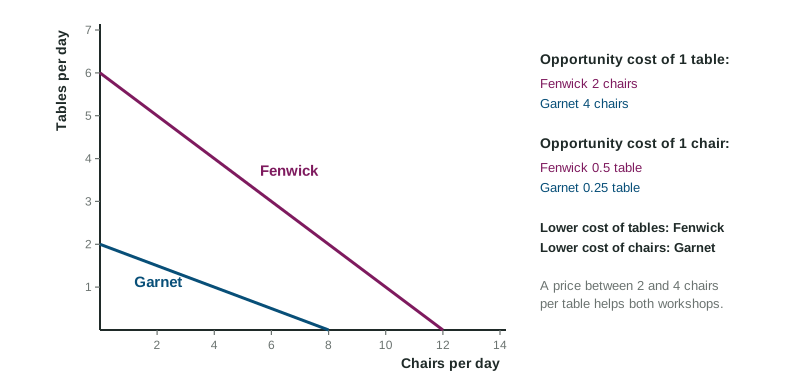
Part 5 · Step by step
How it works, step by step
- Two producers have different opportunity costs for the same goodeach has a comparative advantage in the good it gives up less to make
- Each producer specializes in its comparative-advantage goodtogether they make more in total than when each makes some of both
- They trade at a price between their two opportunity costseach gets the other good for less than it would cost to make itself
- Both pay less than their own opportunity costboth can consume a combination outside their own PPC
Part 6 · Key ideas
Key ideas
- Absolute advantage: producing more of a good with the same resources (or using fewer resources for the same output).
- Comparative advantage: producing a good at a lower opportunity cost. Each producer has a comparative advantage in something, unless their costs are equal.
- Output table: opportunity cost of X = Y given up ÷ X gained. Input table (hours per unit): opportunity cost of X = hours for X ÷ hours for Y.
- Specialization by comparative advantage plus trade lets both producers consume beyond their own PPCs.
- Mutually beneficial terms of trade lie between the two producers' opportunity costs.
Part 7 · Misconception
A common mistake
The wrong idea: Fenwick makes more chairs and more tables than Garnet, so Fenwick has the comparative advantage in both and gains nothing by trading.
What actually happens: That is absolute advantage. A table costs Fenwick 2 chairs but Garnet 4, while a chair costs Fenwick half a table but Garnet only a quarter. Fenwick has the comparative advantage in tables, Garnet in chairs, and both gain from trading.
Part 8 · Check yourself
Check yourself
Exam-style questions. Anything you miss goes into your review queue.
1. A producer has a comparative advantage in a good when it can make that good
- in a larger amount than another producer
- with more workers than the other producer uses
- at a lower opportunity cost
- at a higher price than another producer
Show the answer
Comparative advantage is about opportunity cost: what you give up to make one more unit.
- in a larger amount than another producer: Making more with the same resources is absolute advantage.
- with more workers than the other producer uses: Using more workers says nothing about what each unit costs in other goods.
- Correct: at a lower opportunity cost: Right: lower opportunity cost.
- at a higher price than another producer: Price is not how either advantage is defined.
Data
Output tables for two workshops
| Workshop | Chairs per day | Tables per day |
|---|---|---|
| Fenwick | 12 | 6 |
| Garnet | 8 | 2 |
2. What is Fenwick's opportunity cost of one table, in chairs?
Type a number (chairs). A four-function calculator is allowed, as on the exam.
Show the answer
Fenwick gives up 12 chairs to make 6 tables: chairs per table.
- Answer: 2 chairs
3. Which workshop has the comparative advantage in tables, and why?
- Garnet: a table costs it 4 chairs, Fenwick 2
- Fenwick: it makes 6 tables to Garnet's 2
- Neither: Fenwick is better at both goods
- Fenwick: a table costs it 2 chairs, Garnet 4
Show the answer
Compare opportunity costs of a table: 2 chairs for Fenwick, 4 for Garnet. The lower cost wins.
- Garnet: a table costs it 4 chairs, Fenwick 2: The comparative advantage goes to the LOWER cost, which is Fenwick's.
- Fenwick: it makes 6 tables to Garnet's 2: That compares amounts, which is absolute advantage.
- Neither: Fenwick is better at both goods: Being better at both is absolute advantage; costs still differ, so each has a comparative advantage.
- Correct: Fenwick: a table costs it 2 chairs, Garnet 4: Right: 2 chairs is less than 4.
Data
Hours of labor needed in two countries
| Country | Hours for 1 bushel of rice | Hours for 1 bolt of cloth |
|---|---|---|
| Corvania | 2 | 4 |
| Lumeria | 3 | 9 |
4. Which country has the comparative advantage in rice?
- Corvania: it needs fewer hours for rice
- Corvania: 1/2 bolt per bushel, to Lumeria's 1/3
- Lumeria: it needs more hours for rice
- Lumeria: 1/3 bolt per bushel, to Corvania's 1/2
Show the answer
Opportunity cost of a bushel of rice: Corvania 2 ÷ 4 = 1/2 bolt, Lumeria 3 ÷ 9 = 1/3 bolt. Lumeria's is lower.
- Corvania: it needs fewer hours for rice: Fewer hours is absolute advantage, not comparative.
- Corvania: 1/2 bolt per bushel, to Lumeria's 1/3: The comparative advantage goes to the LOWER cost, Lumeria's 1/3.
- Lumeria: it needs more hours for rice: Needing more hours is not why; its lower opportunity cost is.
- Correct: Lumeria: 1/3 bolt per bushel, to Corvania's 1/2: Right: 1/3 is less than 1/2.
5. Fenwick can make 12 chairs or 6 tables a day, or any mix on a straight line between them. Label the axes and the curve of its production possibilities graph.
Work on the graph (it needs JavaScript), then check.
Show the answer
Chairs go on the horizontal axis and Tables on the vertical axis, as drawn, and the straight line is Fenwick's PPC.
- Key: see the explanation
Part 9 · Summary
Summary
Part 10 · Up next
What comes next
Part 11 · Connections