The question
Name: ______________________ Date: ____________ Two languages in one country: patterns and forces (7 points)
Map
Languages spoken at home by province of Country A
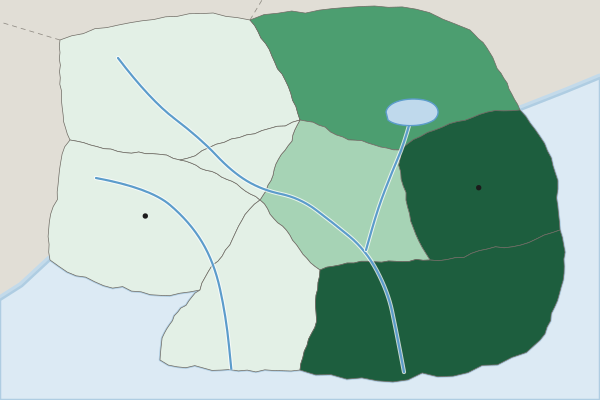
People who speak Language B at home (percent, invented; most others speak Language A)
- Under 10%
- 10% to 49%
- 50% to 89%
- 90% or more
(A) Identify Identify the scale of analysis of the data shown on the map. [1 point]
Identify means: Give the information asked for: a word or short phrase can earn the point, with no reasons needed.
(B) Describe Describe the pattern of Language B shown on the map. [1 point]
Describe means: Give the relevant characteristics: what it is like, where and how much. A name alone earns nothing.
(C) Explain Explain how Language B can act as a centripetal force within the eastern provinces. [1 point]
Explain means: Say how or why, with every link of the chain: a cause, then because or so, then its effect, tied to the place or data asked about.
(D) Explain Explain how the language difference shown on the map can act as a centrifugal force for Country A as a whole. [1 point]
Explain means: Say how or why, with every link of the chain: a cause, then because or so, then its effect, tied to the place or data asked about.
(E) Explain Explain how speakers of Language B could use placemaking to build a sense of place in the Eastern Plains. [1 point]
Explain means: Say how or why, with every link of the chain: a cause, then because or so, then its effect, tied to the place or data asked about.
(F) Explain Explain how making both Language A and Language B official languages could act as a centripetal force for Country A. [1 point]
Explain means: Say how or why, with every link of the chain: a cause, then because or so, then its effect, tied to the place or data asked about.
(G) Explain the degree Explain the degree to which the language pattern on the map could lead to devolution in Country A. [1 point]
Explain the degree means: State the degree first (to a high, moderate or low degree), then explain why with evidence.