The Tragedy of the Commons
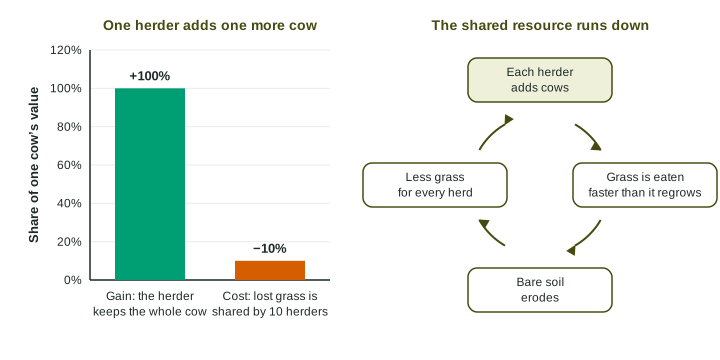
A shared resource that no one controls is overused because each user gains in full from taking more while the cost is spread over everyone.
Part 1 · Hook
Why this matters
Part 2 · Prerequisite check
Quick check before you start
1. What is carrying capacity?
- The largest population an environment can support over time
- The fastest rate a population can grow
- The number of species in an ecosystem
- The total biomass of the producers
Show the answer
Carrying capacity is the largest population the resources of an environment can support for a long time.
- Correct: The largest population an environment can support over time:
- The fastest rate a population can grow:
- The number of species in an ecosystem:
- The total biomass of the producers:
2. Fish caught for food from the ocean are an example of which ecosystem service?
- A provisioning service
- A regulating service
- A cultural service
- A supporting service
Show the answer
Provisioning services are the goods people take from ecosystems: food, water, wood and fiber.
- Correct: A provisioning service:
- A regulating service:
- A cultural service:
- A supporting service:
Part 3 · See it
See it first
Part 4 · Step by step
How it works, step by step
- A resource is open to everyone and owned by no oneno single user has a reason to protect it
- Each user keeps the full gain from taking more while the cost is sharedevery user takes more
- Total use rises above what the resource can renewthe resource shrinks, so each user gets less
- Rules that limit or assign use (permits, quotas, fees, community agreements)use falls back to what the resource can renew
Part 5 · Key ideas
Key ideas
- A common resource is shared, hard to fence off, and used up as it is used: open pastures, ocean fisheries, aquifers, the air.
- The tragedy of the commons is not about bad people. Each user acts sensibly for themselves; together they run the resource down.
- The gain from taking more goes to one user; the cost is split among all users. That gap is the cause.
- Fixes change the rewards: limits set by law (permits, quotas, seasons), fees for use, private or assigned rights, or community rules with monitoring and penalties.
Part 6 · Misconception
A common mistake
The wrong idea: The tragedy of the commons happens because users do not know they are harming the resource.
What actually happens: Users can know the resource is shrinking and still take more, because each one keeps the whole gain from taking more but pays only a small share of the loss. Rules that change those rewards fix it; information alone often does not.
Part 7 · Check yourself
Check yourself
Exam-style questions. Anything you miss goes into your review queue.
1. Which feature makes a resource a common resource that can suffer the tragedy of the commons?
- It is shared by many users and hard to keep anyone from using
- It is owned by one family that sells what it produces
- It is renewed faster than anyone could use it up
- It is made in a factory and sold to many users
Show the answer
A common resource is shared and hard to fence off, and taking it leaves less for others. That is the setting the tragedy needs.
- Correct: It is shared by many users and hard to keep anyone from using: Right: shared use with no easy way to exclude users is what lets each user take too much.
- It is owned by one family that sells what it produces: An owner bears the whole cost of overuse, so the owner has a reason to protect it.
- It is renewed faster than anyone could use it up: A resource renewed faster than any possible use cannot be run down.
- It is made in a factory and sold to many users: A product sold in a market has a price and an owner at every step.
2. Twenty herders share one pasture equally. One herder adds a cow, and the grass that cow eats is lost to the whole pasture. What percent of that cost does the herder who added the cow bear?
Type a number, then its unit (%). Scale words (2.5 million) and powers of ten (2.5 × 10^6) are read.
Show the answer
The cost is split 20 ways: . The herder keeps 100% of the new cow but pays only 5% of its cost.
- Answer: 5 %
3. A pasture has a carrying capacity of 120 cows and now holds 120. Each of its 12 herders adds 3 cows. Write the setup for the percent by which the new herd is larger than the carrying capacity, then give the answer.
Type the setup as on the exam, with brackets and units, then the answer.
Show the answer
The new herd is cows, so the percent change is
- Setup: ; answer 30 %
Data
Boats and catch on a shared lake
| Year | Boats | Total catch (metric tons) | Catch per boat (metric tons) |
|---|---|---|---|
| 2000 | 20 | 900 | 45 |
| 2005 | 30 | 1,200 | 40 |
| 2010 | 45 | 1,350 | 30 |
| 2015 | 60 | 1,200 | 20 |
| 2020 | 70 | 840 | 12 |
4. Which statement best describes the trend in catch per boat from 2000 to 2020?
- It fell every five years, from 45 to 12 metric tons per boat
- It rose until 2010, then fell, following the number of boats
- It stayed near 40 metric tons per boat while total catch fell
- It rose steadily as more boats joined the fishery each year
Show the answer
Catch per boat fell at every step: 45, 40, 30, 20, 12 metric tons.
- Correct: It fell every five years, from 45 to 12 metric tons per boat: Right: the column falls at every five-year step.
- It rose until 2010, then fell, following the number of boats: That describes total catch, which peaked in 2010; catch per boat fell throughout.
- It stayed near 40 metric tons per boat while total catch fell: Catch per boat fell far below 40 after 2005.
- It rose steadily as more boats joined the fishery each year: Boats rose, but catch per boat fell.
5. Write the setup for the percent change in catch per boat from 2000 to 2020, then give the answer. (A decrease is a negative percent change.)
Type the setup as on the exam, with brackets and units, then the answer.
Show the answer
Percent change = (new - old) / old × 100:
- Setup: ; answer -73.3 %
6. Total catch was the same in 2005 and 2015 (1,200 metric tons). What does the rest of the table suggest about the lake in 2015 compared with 2005?
- Twice as many boats were needed for the same catch, a sign the fish stock had shrunk
- The fish stock had grown, since the same catch was taken in both years by the fleet
- Fishing pressure was lower in 2015, since each boat caught less fish than before
- The lake was healthy in both years, since the total catch did not change
Show the answer
In 2005, 30 boats caught 1,200 metric tons; in 2015, 60 boats were needed. Effort doubled for the same catch, so each boat found fewer fish.
- Correct: Twice as many boats were needed for the same catch, a sign the fish stock had shrunk: Right: the same catch took twice the effort, which points to fewer fish in the lake.
- The fish stock had grown, since the same catch was taken in both years by the fleet: A growing stock would give more catch per boat, not less.
- Fishing pressure was lower in 2015, since each boat caught less fish than before: Pressure was higher: 60 boats fished instead of 30.
- The lake was healthy in both years, since the total catch did not change: Equal totals hide the doubled effort; catch per boat halved.
7. Which management step fits this lake best and addresses the cause of the decline shown in the table?
- Issue a limited number of fishing permits so the fleet stays near 30 boats
- Build a second boat ramp on the far shore so that boats can reach the whole lake more easily
- Stock the lake with fish once and then leave fishing unrestricted
- Lend money to the fishers so they can buy larger and faster boats
Show the answer
The table shows catch per boat falling as boats were added. Limiting permits caps the fleet, the cause of the decline.
- Correct: Issue a limited number of fishing permits so the fleet stays near 30 boats: Right: a cap on boats limits total effort, the driver of the falling catch.
- Build a second boat ramp on the far shore so that boats can reach the whole lake more easily: Easier access adds effort and speeds the decline.
- Stock the lake with fish once and then leave fishing unrestricted: One-time stocking does nothing about unlimited fishing, which would take the new fish too.
- Lend money to the fishers so they can buy larger and faster boats: Bigger boats raise each boat's catch and the total pressure on the fish.
Part 8 · Summary
Summary
Part 9 · Up next
What comes next
Part 10 · Connections