Carrying Capacity
Carrying capacity is the largest population an environment can support over time.
Part 1 · Hook
Why this matters
Part 2 · Before you start
What this builds on
Part 3 · Prerequisite check
Quick check before you start
1. An r-selected species is hit by a flood that kills most of its population. What usually happens next?
- It rebounds quickly, because survivors reproduce early and often
- It recovers over many decades
- It cannot recover
- It switches to K-selection
Show the answer
High biotic potential lets r-selected species rebound fast.
- Correct: It rebounds quickly, because survivors reproduce early and often:
- It recovers over many decades:
- It cannot recover:
- It switches to K-selection:
2. A population in a zone of physiological stress for food shortage will usually do what?
- Shrink, because individuals reproduce and survive less
- Grow faster than before
- Stay exactly the same
- Move into its optimal range automatically
Show the answer
Stressed individuals reproduce and survive less, so the population declines.
- Correct: Shrink, because individuals reproduce and survive less:
- Grow faster than before:
- Stay exactly the same:
- Move into its optimal range automatically:
Part 4 · See it
See it first
Part 5 · Step by step
How it works, step by step
- A population has plenty of food, water and spacebirths outnumber deaths and the population grows
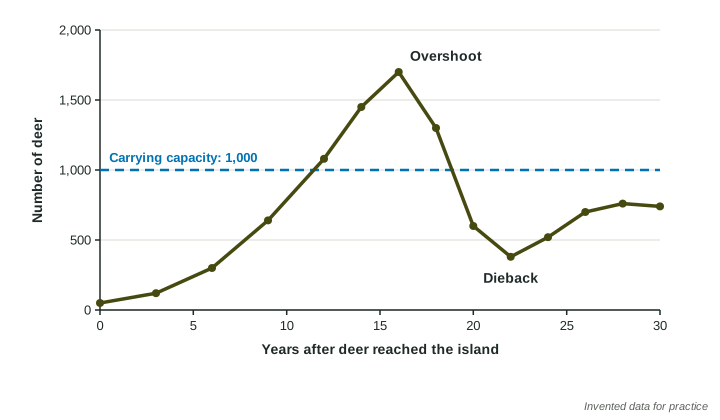
- The population grows larger than its environment can support over time (overshoot)individuals use resources faster than they are replaced, for example eating plants faster than they regrow
- Resources run short and are damagedstarvation, disease and fewer births make the population crash (dieback)
- The damaged resources recover slowlythe carrying capacity can stay lower than before for many years
Part 6 · Key ideas
Key ideas
- Carrying capacity (K) is the largest population of a species that an environment can support over time, given its food, water, space and other resources.
- When a population grows past its carrying capacity, it is in overshoot: it uses resources faster than they are replaced.
- Overshoot leads to dieback: a sharp drop in population as individuals starve, sicken or fail to reproduce.
- Overshoot can damage the resources themselves (plants eaten down to bare ground, soil washed away), so carrying capacity can be lower after a dieback than before.
Part 7 · Misconception
A common mistake
The wrong idea: Carrying capacity is a fixed number that a population can never go above.
What actually happens: A population can go above carrying capacity for a while (overshoot), but it cannot stay there. Carrying capacity can also change when the environment changes, for example after a drought or after plants are grazed down.
Part 8 · Check yourself
Check yourself
Exam-style questions. Anything you miss goes into your review queue.
Model or diagram
A deer herd on an island
1. According to the figure, in about which year did the herd first rise above its carrying capacity?
- Year 12
- Year 6
- Year 16
- Year 20
Show the answer
Find where the herd line first rises above the dashed carrying capacity line.
- Correct: Year 12: Right: the herd was 640 in year 9 and 1,080 in year 12, crossing the 1,000 line between them.
- Year 6: In year 6 the herd was 300, well below 1,000.
- Year 16: Year 16 is the peak, after the herd had already passed 1,000.
- Year 20: By year 20 the herd had fallen to 600, below 1,000.
2. Write the setup for the percent change in the herd from its peak of 1,700 in year 16 to 380 in year 22, then give the answer, rounded to the nearest whole percent.
Type the setup as on the exam, with brackets and units, then the answer.
Show the answer
Start at the peak:
- Setup: ; answer -78 %
3. After the dieback, the herd levels off near 750, below the original carrying capacity of 1,000. Which explanation fits best?
- The deer that survived were too old to have young
- Heavy grazing hurt the plants, lowering K
- Carrying capacity rises after a dieback
- Deer prefer to keep their herd smaller after a crash
Show the answer
Overshoot can lower carrying capacity by damaging the resources.
- The deer that survived were too old to have young: The herd grows from 380 to about 750, so the deer are reproducing.
- Correct: Heavy grazing hurt the plants, lowering K: Right: overshoot damaged the resources, so the island now supports fewer deer.
- Carrying capacity rises after a dieback: The herd levels off lower than before, not higher.
- Deer prefer to keep their herd smaller after a crash: Population size is set by resources, not by preference.
4. Which management action would most likely have prevented the overshoot shown in the figure?
- Adding more deer to the island in year 10
- Removing the island’s food plants to slow growth
- Removing some deer once the herd neared 1,000
- Waiting until year 20 to count the deer again
Show the answer
Keeping a population at or below carrying capacity prevents overshoot and dieback.
- Adding more deer to the island in year 10: More deer would make the overshoot worse.
- Removing the island’s food plants to slow growth: Removing food lowers carrying capacity and causes starvation.
- Correct: Removing some deer once the herd neared 1,000: Right: keeping the herd near the carrying capacity avoids damage to the plants and the crash.
- Waiting until year 20 to count the deer again: By year 20 the dieback had already happened.
Passage
The reindeer of St. Matthew Island
In 1944, 29 reindeer were released on St. Matthew Island, a remote island in the Bering Sea with no wolves or other large predators. The island’s lichens, the reindeer’s main winter food, had built up over centuries into thick mats. By 1963 the herd had grown to about 6,000 animals, and biologists found the lichen mats grazed down and trampled over much of the island. During the severe winter of 1963 to 1964, most of the reindeer starved. A survey in 1966 found 42 animals, and the herd later died out. Lichens grow only a few millimeters a year, so the island’s winter food would take decades to recover.
Invented passage for practice, summarizing published accounts of the St. Matthew Island reindeer, studied by the biologist David Klein (US Fish and Wildlife Service and University of Alaska).
5. Which assumption is the passage making when it calls the 6,000 reindeer an overshoot?
- The island could not supply that much lichen year after year
- The reindeer would have kept growing without the hard winter
- The first 29 reindeer were already too many for the island
- Reindeer herds tend to crash after about 20 years
Show the answer
Overshoot means resources are being used faster than they are replaced.
- Correct: The island could not supply that much lichen year after year: Right: overshoot means using food faster than it grows back, which the grazed-down lichen shows.
- The reindeer would have kept growing without the hard winter: The passage does not assume unlimited growth; it describes damaged food.
- The first 29 reindeer were already too many for the island: The herd grew for years, so 29 was well below carrying capacity.
- Reindeer herds tend to crash after about 20 years: The passage is about this island’s food supply, not a fixed time span.
6. Which statement best defines carrying capacity?
- The largest number of offspring one female can have
- The number of different species an area can hold
- The largest population an environment can support over time
- The total mass of food in an ecosystem at one time
Show the answer
Carrying capacity: the largest population supportable over time.
- The largest number of offspring one female can have: That is about reproduction, not the environment.
- The number of different species an area can hold: That is species richness.
- Correct: The largest population an environment can support over time: Right: it is set by food, water, space and other resources.
- The total mass of food in an ecosystem at one time: Carrying capacity is a number of individuals, not a mass of food.
7. A wildlife refuge feeds a deer herd extra hay every winter for 20 years, and the herd grows to twice its earlier size. The feeding then stops. Which outcome is most likely?
- A dieback, as the herd is far above the natural carrying capacity
- No change, because the deer are used to the area
- Faster growth, because the deer are well fed
- The herd stays at its new size for good
Show the answer
Remove an added resource and carrying capacity drops back.
- Correct: A dieback, as the herd is far above the natural carrying capacity: Right: hay raised the carrying capacity; without it the herd is in overshoot.
- No change, because the deer are used to the area: Being used to an area does not provide food.
- Faster growth, because the deer are well fed: Once the extra food stops, there is less food per deer, not more.
- The herd stays at its new size for good: The natural food supply cannot support twice the earlier herd.
Part 9 · Summary
Summary
Part 10 · Up next
What comes next
Part 11 · Connections