Structure of Water and Hydrogen Bonding
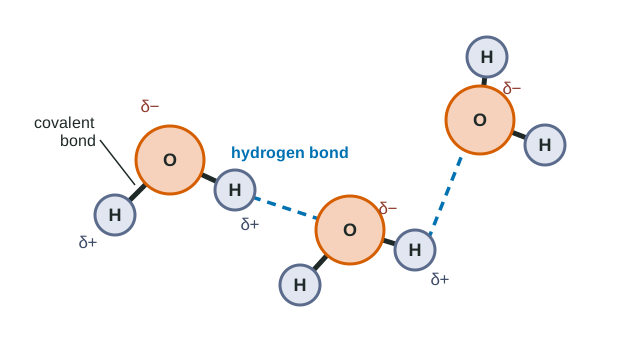
Oxygen pulls shared electrons harder than hydrogen, and the water molecule is bent, so water is polar: a δ− oxygen end and δ+ hydrogen ends.
Part 1 · Hook
Why this matters
A marathon runner on a hot afternoon can lose close to a liter of sweat an hour, yet her body temperature climbs only a degree or two. A pond beside the course stays cool while the asphalt gets too hot to touch, and a 30-meter tree lifts water from its roots to its top leaves with no moving parts. All three come from one small fact: water molecules are sticky. They pull on each other, and on anything else with an electric charge.
Part 2 · See it
See it first
Part 3 · Step by step
How it works, step by step
- Oxygen is more electronegative than hydrogen: it pulls the electrons they share toward itself.The shared electrons spend more time near oxygen, so the oxygen end of a water molecule carries a partial negative charge (δ−) and each hydrogen a partial positive charge (δ+).
- The molecule is bent, so both δ+ hydrogens sit on one side and the δ− oxygen on the other.The charges do not cancel out: water is a polar molecule with a negative end and a positive end.
- Opposite partial charges on neighboring molecules attract each other.The δ+ hydrogen of one molecule is drawn to the δ− oxygen of another, forming a hydrogen bond; each water molecule can hold up to four.
- Hydrogen bonds keep breaking and re-forming between millions of neighboring molecules.Water clings to itself (cohesion, surface tension) and to charged or polar surfaces (adhesion), and it takes extra energy to speed its molecules up or pull them into the air.
- Absorbed heat first goes into breaking hydrogen bonds, and a molecule must break all of its hydrogen bonds to escape as vapor.Water warms slowly (high specific heat) and evaporating water carries away a large amount of heat (high heat of vaporization), which steadies temperatures in bodies, lakes and coasts.
- The same partial charges surround ions and other polar molecules.Salts and polar substances dissolve in water, which is why most of the chemistry of a cell takes place in water.
Part 4 · Key ideas
Key ideas
- A covalent bond joins atoms inside one molecule by sharing electrons. A hydrogen bond is a weaker attraction between a δ+ hydrogen and a δ− atom such as oxygen or nitrogen, usually on a different molecule.
- Cohesion is water attracting water; adhesion is water attracting a different polar or charged surface. Water climbs a narrow tube when adhesion pulls it up the walls and cohesion drags the rest of the column along.
- Specific heat is about changing temperature; heat of vaporization is about changing from liquid to gas. Hydrogen bonds make both unusually high for water, so water warms slowly and evaporation cools strongly.
- A polar or charged substance is hydrophilic and dissolves in water. A nonpolar one, such as oil, is hydrophobic: water molecules bond to each other instead and push it aside.
- pH measures hydrogen ion concentration on a scale where each whole step is a tenfold change. A buffer takes up or releases hydrogen ions, so the pH of a solution changes much less when acid or base is added.
Part 5 · Misconception
A common mistake
The wrong idea: A hydrogen bond is the bond that holds the two hydrogen atoms onto the oxygen inside a water molecule.
What actually happens: Those are covalent bonds, made by sharing electrons, and they are about twenty times stronger. A hydrogen bond is the weaker attraction between the δ+ hydrogen of one molecule and the δ− oxygen of a different molecule. When water boils, hydrogen bonds break but the covalent bonds do not: steam is still H2O.
Part 6 · Check yourself
Check yourself
Exam-style questions. Anything you miss goes into your review queue.
1. A crystal of table salt (NaCl) dissolves in water. Which description of the water molecules closest to the ions is correct?
- Oxygen atoms face the sodium ions, and hydrogen atoms face the chloride ions.
- Hydrogen atoms face the sodium ions, and oxygen atoms face the chloride ions.
- Water molecules form covalent bonds with the ions, sharing electrons with them.
- Water molecules point in random directions, because the ions carry full charges rather than partial ones.
Show the answer
Opposite charges attract. Water's δ− oxygen end turns toward a cation such as Na+, and its δ+ hydrogen end turns toward an anion such as Cl−. These shells of water pull the ions out of the crystal.
- Correct: Oxygen atoms face the sodium ions, and hydrogen atoms face the chloride ions.: Correct. The δ− oxygen is attracted to the positive Na+; the δ+ hydrogens are attracted to the negative Cl−.
- Hydrogen atoms face the sodium ions, and oxygen atoms face the chloride ions.: This reverses the charges. Hydrogens carry δ+ and would be repelled by positive Na+.
- Water molecules form covalent bonds with the ions, sharing electrons with them.: The ions are surrounded and held by attractions between charges; no electrons are shared and the ions stay as ions.
- Water molecules point in random directions, because the ions carry full charges rather than partial ones.: Full charges attract water's partial charges even more strongly, so the nearest water molecules are lined up, not random.
2. A student draws a hydrogen bond as a dashed line between a hydrogen atom of one water molecule and a hydrogen atom of a neighboring water molecule. What is wrong with the drawing?
- Nothing; any two hydrogen atoms on neighboring molecules can form a hydrogen bond.
- The line should be solid, because hydrogen bonds are as strong as covalent bonds.
- Both hydrogens carry a partial positive charge and repel; a hydrogen bond links a δ+ hydrogen to a δ− oxygen.
- Hydrogen bonds form inside one water molecule, so the dashed line should join each hydrogen to its own oxygen atom.
Show the answer
A hydrogen bond needs opposite partial charges: a δ+ hydrogen (bonded to O or N) and a δ− atom such as oxygen on another molecule. Like charges, H to H, repel.
- Nothing; any two hydrogen atoms on neighboring molecules can form a hydrogen bond.: Two δ+ hydrogens carry the same partial charge, so they repel rather than attract.
- The line should be solid, because hydrogen bonds are as strong as covalent bonds.: Hydrogen bonds are much weaker than covalent bonds, which is why they are drawn dashed.
- Correct: Both hydrogens carry a partial positive charge and repel; a hydrogen bond links a δ+ hydrogen to a δ− oxygen.: Correct. The attraction is between opposite partial charges, so a hydrogen bond runs from the hydrogen of one molecule to the oxygen of another.
- Hydrogen bonds form inside one water molecule, so the dashed line should join each hydrogen to its own oxygen atom.: The bond between a hydrogen and its own oxygen is covalent. Hydrogen bonds link different molecules.
3. On a hot, dry afternoon a plant closes most of its stomata. Predict how each value changes over the next hour compared with when the stomata were open.
| Variable | Change |
|---|---|
| Rate at which water moves up the xylem | — |
| Temperature of the leaves | — |
| Strength of each hydrogen bond between water molecules in the xylem | — |
Show the answer
Closing stomata cuts transpiration. That removes the evaporation pull that lifts water through the xylem and the evaporative cooling that keeps leaves near air temperature. Water's hydrogen bonds themselves are unchanged.
- Rate at which water moves up the xylem: decreases. Transpiration provides the pull. With the stomata closed, less water evaporates from the leaves, so less water is drawn up the cohesive column.
- Temperature of the leaves: increases. Less evaporation means less evaporative cooling, so the sun-warmed leaves heat up.
- Strength of each hydrogen bond between water molecules in the xylem: no change. The strength of a hydrogen bond depends on water's polarity, which closing the stomata does not change; only the number of molecules being pulled up changes.
Graph
Cooling by evaporation
Four identical thermometers were wrapped in identical cotton cloths. One cloth was left dry; the others were soaked with 2.0 g of water, methanol or acetone. A fan blew room air (22 °C, 40% humidity) over all four, and each temperature was read every minute. When the cloths were weighed at 8 minutes, the acetone and methanol cloths were dry (acetone by about 3 minutes, methanol by about 5); the water cloth still held 1.1 g of water.
Dry clothWaterMethanolAcetone
Data table
| Time (min) | Dry cloth | Water | Methanol | Acetone |
|---|---|---|---|---|
| 0 | 22 | 22 | 22 | 22 |
| 1 | 22 | 19.8 | 15.5 | 12 |
| 2 | 22 | 18.1 | 12.4 | 8.2 |
| 3 | 22 | 17 | 11 | 7.4 |
| 4 | 22 | 16.4 | 10.8 | 9.5 |
| 5 | 22 | 16.1 | 11.6 | 13.8 |
| 6 | 22 | 16 | 13.5 | 17.6 |
| 7 | 22 | 16 | 16.2 | 19.9 |
| 8 | 22 | 16 | 18.6 | 21 |
4. Which description of the graph is accurate?
- Acetone produced the largest, fastest drop, but its thermometer was also the first to warm back up.
- Water produced the largest drop in temperature, because it has the highest heat of vaporization of the three.
- The three liquids cooled their thermometers by about the same amount, but at different speeds.
- Methanol cooled its thermometer for longer than water did.
Show the answer
Read each curve for its lowest point and for when it starts to rise. Acetone has the deepest minimum (7.4 °C at 3 minutes) and is the first to turn upward, as its cloth dries at about 3 minutes.
- Correct: Acetone produced the largest, fastest drop, but its thermometer was also the first to warm back up.: Correct. Acetone fell to 7.4 °C by minute 3, below every other liquid, then rose from minute 4 as the cloth dried.
- Water produced the largest drop in temperature, because it has the highest heat of vaporization of the three.: Water's lowest reading was 16.0 °C, the smallest drop of the three liquids. A high heat per gram does not guarantee the biggest drop.
- The three liquids cooled their thermometers by about the same amount, but at different speeds.: The lowest readings differ a lot: about 7 °C for acetone, 11 °C for methanol and 16 °C for water.
- Methanol cooled its thermometer for longer than water did.: By minute 8 the methanol thermometer was back up to 18.6 °C, while the water thermometer was still at 16.0 °C.
5. Acetone has the lowest heat of vaporization of the three liquids, yet it produced the largest temperature drop. Which explanation best accounts for this?
- Acetone has a lower specific heat than water, so the cloth soaked in acetone held less heat to begin with and cooled sooner.
- With no hydrogen bonds to break, acetone evaporated so fast that it removed more heat per minute, though less per gram.
- Acetone molecules absorb heat as they form hydrogen bonds with the cotton of the cloth.
- Acetone removed more total heat than water did over the 8 minutes.
Show the answer
The temperature drop depends on how fast heat is removed. That equals the heat per gram times the grams evaporating each minute. Acetone's weak attractions let it evaporate many times faster, so its cooling rate was highest even though each gram carried less heat.
- Acetone has a lower specific heat than water, so the cloth soaked in acetone held less heat to begin with and cooled sooner.: All the cloths started at 22 °C. Specific heat affects how much a substance's temperature changes per joule; it does not explain why evaporation cooled the thermometer more.
- Correct: With no hydrogen bonds to break, acetone evaporated so fast that it removed more heat per minute, though less per gram.: Correct. Cooling rate = grams evaporated per minute × heat per gram. Acetone's 2.0 g was gone in about 3 minutes; water had lost only 0.9 g in 8 minutes. The much faster evaporation outweighs the smaller heat per gram.
- Acetone molecules absorb heat as they form hydrogen bonds with the cotton of the cloth.: Acetone has no H on O or N, so it does not donate hydrogen bonds, and forming bonds releases energy rather than absorbing it.
- Acetone removed more total heat than water did over the 8 minutes.: It removed less: 2.0 g × 500 J/g = 1,000 J, versus 0.9 g × 2,260 J/g ≈ 2,030 J for the water. It removed its smaller total in a much shorter time.
6. Use the heats of vaporization from the table of four liquids (methanol 1,100 J/g; acetone 500 J/g). By the time each cloth was dry, how many more joules had evaporation of the methanol removed than evaporation of the acetone? Round to the nearest whole joule.
Type a number in J.
Show the answer
Each cloth held 2.0 g. Methanol: 2.0 g × 1,100 J/g = 2,200 J. Acetone: 2.0 g × 500 J/g = 1,000 J. Difference: 2,200 − 1,000 = 1,200 J. Acetone gave the deepest drop but removed less heat overall.
- Answer: 1200 J
7. Why did the student include a thermometer wrapped in a dry cloth?
- To show that a dry cotton cloth absorbs heat from the thermometer bulb as the fan blows room air across it.
- To measure how fast water vapor from the other cloths spread through the room.
- To provide a fourth liquid for comparison with water, methanol and acetone.
- To show the effect of the fan and cloth alone, so extra cooling of the wet thermometers can be credited to evaporation.
Show the answer
A comparison setup that matches the others in every way but one lets you credit a difference to that one factor. Here the one factor is the evaporating liquid; the dry cloth stayed at room temperature, so the drops in the other three are due to evaporation.
- To show that a dry cotton cloth absorbs heat from the thermometer bulb as the fan blows room air across it.: The dry cloth's reading stayed at 22 °C, so the cloth and fan cause no cooling; that is what the dry cloth was there to check, not something it was expected to show.
- To measure how fast water vapor from the other cloths spread through the room.: A thermometer reads temperature, not the amount of vapor in the air.
- To provide a fourth liquid for comparison with water, methanol and acetone.: The dry cloth holds no liquid; its job is to show what happens with everything the same except evaporation.
- Correct: To show the effect of the fan and cloth alone, so extra cooling of the wet thermometers can be credited to evaporation.: Correct. The dry setup is identical except that nothing evaporates. Its steady 22 °C shows that the cooling of the other three comes from evaporation.
8. The experiment is repeated with the same 22 °C air but at 90% humidity, so water evaporates much more slowly. Predict how each value for the water-soaked thermometer would change compared with the original run.
| Variable | Change |
|---|---|
| Lowest temperature the water thermometer reaches | — |
| Time until the water cloth is dry | — |
| Heat removed per gram of water that does evaporate | — |
Show the answer
Humidity slows the rate of evaporation, not the energy each gram takes. Less evaporation per minute means less cooling per minute (a higher lowest temperature) and a cloth that stays wet longer; the heat per gram is unchanged.
- Lowest temperature the water thermometer reaches: increases. Slower evaporation removes heat more slowly, so the thermometer cools less and its lowest reading is higher (closer to 22 °C).
- Time until the water cloth is dry: increases. Fewer grams evaporate each minute, so the 2.0 g of water lasts longer.
- Heat removed per gram of water that does evaporate: no change. The heat of vaporization is a property of water: each gram that evaporates still has to break the same hydrogen bonds, whatever the humidity.
Part 7 · Summary
Summary
Oxygen pulls shared electrons harder than hydrogen, and the water molecule is bent, so water is polar: a δ− oxygen end and δ+ hydrogen ends. Opposite partial charges on neighboring molecules attract, forming hydrogen bonds. Those bonds explain cohesion and surface tension, adhesion and capillary action, water's high specific heat and high heat of vaporization, why ice floats, and why water dissolves ions and polar molecules but not oil. Water also splits into a few hydrogen and hydroxide ions; pH measures the hydrogen ions, and buffers keep pH steady.
Part 8 · Up next
What comes next
Part 9 · Connections