Blood types and transfusion
1Why this matters
Mr. Adams, 45, arrives after a car crash, bleeding heavily. There is no time to find out his blood type, so the trauma team starts O-negative red cells at once. Twenty minutes later the lab reports that he is A positive, and the team switches to A-positive units. Why is O negative safe for a stranger, and why switch as soon as the type is known? The answers lie in the antigens on red cells and the antibodies in plasma.
2What this builds on
3Quick check before you start
1. What is the glycocalyx?
- The layer of sugar chains on a cell's outer surface
- The protein skeleton just under the membrane
- The fluid inside the nucleus
Show the answer
The glycocalyx is the coat of sugar chains attached to membrane proteins and lipids on the outer surface. It carries a cell's identity markers.
- Correct: The layer of sugar chains on a cell's outer surface:
- The protein skeleton just under the membrane:
- The fluid inside the nucleus:
2. What does an antibody bind?
- Any foreign cell it meets
- One specific antigen
- Oxygen
Show the answer
Each antibody's binding sites fit one antigen's shape, the way a key fits one lock.
- Any foreign cell it meets:
- Correct: One specific antigen:
- Oxygen:
3. When many red cells are destroyed at once, which pigment builds up and can cause jaundice?
- Bilirubin
- Ferritin
- Erythropoietin
Show the answer
Heme from destroyed red cells is converted to bilirubin. If the liver cannot clear it fast enough, it builds up and yellows the skin and eyes.
- Correct: Bilirubin:
- Ferritin:
- Erythropoietin:
4Anatomy
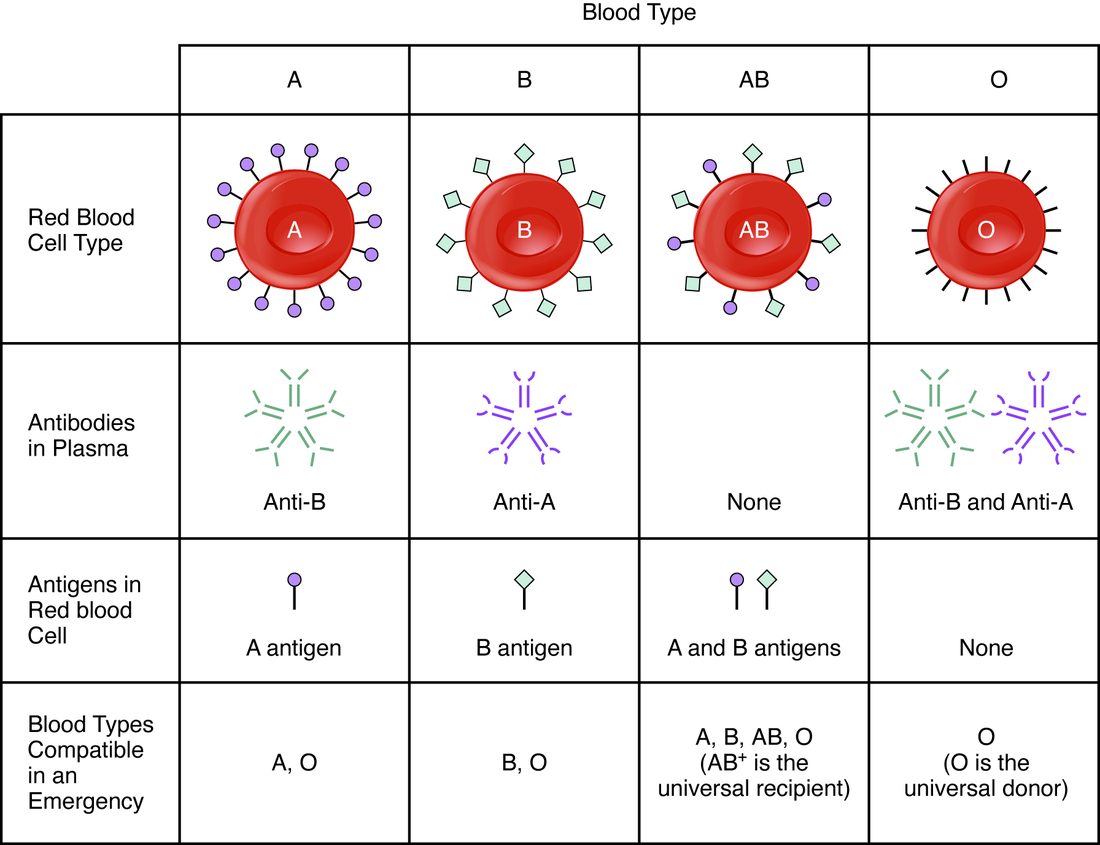
With labels hidden, select a box to reveal its label.
5How it works, step by step
- Type B red cells are transfused by mistake into a type A patient, whose plasma holds anti-B.Anti-B antibodies bind the B antigens on the donor cells within seconds.
- Each antibody has several binding sites and binds antigens on two or more cells.The donor cells are cross-linked into clumps: agglutination.
- Antibodies bound to the cells switch on plasma proteins that punch holes in their membranes.The donor cells burst (hemolysis) and release hemoglobin into the plasma.
- Free hemoglobin and chemical signals from the attack flood the blood.Fever, chills, back pain, dark urine and falling blood pressure follow, and the kidneys can fail: a transfusion reaction.
6Core concepts
7A common mistake
The wrong idea: An Rh-negative person has anti-D antibodies from birth, just as a type A person has anti-B.
What actually happens: Anti-A and anti-B appear in infancy without any exposure to other blood. Anti-D does not: an Rh-negative person makes it only after meeting Rh-positive red cells, through a transfusion or a pregnancy. That is why a first Rh-mismatched transfusion usually causes no immediate reaction, why a first Rh-positive baby is usually unharmed, and why the injection of anti-D after delivery, which stops the mother making her own, works.
8Check yourself
Anything you miss goes into your review queue.
1. A typing test shows agglutination in the anti-A and anti-B wells and none in the anti-D well. What is the blood type?
- O positive
- AB negative
- AB positive
- O negative
Show the answer
Clumping with anti-A and anti-B means the red cells carry both A and B antigens: type AB. No clumping with anti-D means no D antigen: Rh negative.
- O positive: Type O cells carry neither A nor B, so they would not clump with anti-A or anti-B.
- Correct: AB negative: Correct. A and B present, D absent.
- AB positive: An Rh-positive sample would clump in the anti-D well too.
- O negative: Type O cells would stay smooth in all three wells if Rh negative.
2. A patient is O positive. Which red cells can she safely receive?
- O negative and O positive only
- O positive only
- Any Rh-positive type
- O, A and B, as long as they are Rh positive
Show the answer
Her plasma holds anti-A and anti-B, so she can receive only red cells with neither antigen: type O. As an Rh-positive person she makes no anti-D, so either Rh-positive or Rh-negative O cells are safe.
- Correct: O negative and O positive only: Correct. Only type O cells, of either Rh type.
- O positive only: O negative is also safe: it lacks the D antigen, which she already has.
- Any Rh-positive type: A, B and AB red cells would meet her anti-A or anti-B.
- O, A and B, as long as they are Rh positive: Her anti-A and anti-B would attack A and B red cells whatever their Rh type.
3. A type A patient is mistakenly given a unit of type B red cells. Predict the change in each variable over the first hour, compared with before the transfusion.
| Variable | Change |
|---|---|
| Agglutination of the donor red cells | — |
| Free hemoglobin in the plasma | — |
| Hemoglobin in the urine | — |
| Body temperature | — |
| Blood pressure | — |
Show the answer
An ABO-incompatible transfusion sets off an immediate antibody attack on the donor cells. Agglutination and hemolysis release hemoglobin into the plasma and urine, and the reaction causes fever and a fall in blood pressure. The transfusion must be stopped at once.
- Agglutination of the donor red cells: up. The patient's anti-B binds the B antigens on the donor cells and cross-links them into clumps.
- Free hemoglobin in the plasma: up. Antibodies on the donor cells trigger plasma proteins that burst them, releasing hemoglobin into the plasma.
- Hemoglobin in the urine: up. Free hemoglobin in the plasma is small enough to be filtered by the kidneys and spills into the urine, darkening it.
- Body temperature: up. Chemical signals released during the antibody attack cause fever and chills.
- Blood pressure: down. Signals released in the reaction widen blood vessels, so pressure falls and shock can follow.
4. An Rh-negative man who has never had a transfusion is given Rh-positive, ABO-matched red cells in an emergency. What is most likely to happen?
- An immediate, severe transfusion reaction
- Nothing now, but he may make anti-D for next time
- He becomes Rh positive permanently
- Nothing now or later: Rh does not matter in men
Show the answer
He has no anti-D yet, so the donor cells are not attacked at once. Over the next weeks his immune system may make anti-D against the D antigen he has met. A later Rh-positive transfusion could then trigger a reaction.
- An immediate, severe transfusion reaction: An immediate reaction needs antibodies already present. Anti-D forms only after exposure.
- Correct: Nothing now, but he may make anti-D for next time: Correct. The first exposure sensitizes; the danger comes later.
- He becomes Rh positive permanently: Transfused cells live about 120 days at most; his own red cells stay Rh negative.
- Nothing now or later: Rh does not matter in men: Rh matters for any future transfusion. In men there is no pregnancy risk, which is why O-positive blood is often used for men in emergencies.
5. An Rh-negative woman had an Rh-positive first baby three years ago and received no treatment. She is now pregnant with a second Rh-positive fetus, which becomes severely anemic before birth. What is the cause?
- The fetus has inherited an enzyme defect from its father
- The fetus's own antibodies attack its red cells
- Her anti-A antibodies cross to the fetus
- Anti-D from her first delivery destroys its red cells
Show the answer
Fetal red cells entered her blood at the first delivery, and she made anti-D. That kind of antibody crosses from mother to fetus. In this Rh-positive fetus, it binds and destroys red cells: hemolytic disease of the newborn.
- The fetus has inherited an enzyme defect from its father: The history of a first Rh-positive baby without treatment points to maternal anti-D, not an inherited enzyme defect.
- The fetus's own antibodies attack its red cells: A fetus does not attack its own antigens; the antibodies come from the mother.
- Her anti-A antibodies cross to the fetus: The problem here is Rh, not ABO, and most anti-A cannot cross to the fetus.
- Correct: Anti-D from her first delivery destroys its red cells: Correct. Maternal anti-D from the first pregnancy.
6. An Rh-negative woman has just delivered an Rh-positive baby. Why is she given an injection of anti-D immune globulin within 72 hours?
- To give her newborn baby a supply of antibodies against infection
- To clear fetal Rh-positive cells before she reacts to them
- To turn her red cells Rh positive
- To destroy any anti-D she already has
Show the answer
The injected anti-D clears the fetal Rh-positive cells that entered her blood at delivery before her immune system responds to them, so she never starts making her own anti-D. The injected antibody is gone within months and does not harm later pregnancies.
- To give her newborn baby a supply of antibodies against infection: The injection is for the mother, and it does not protect the baby against infection.
- Correct: To clear fetal Rh-positive cells before she reacts to them: Correct. It prevents her from becoming sensitized.
- To turn her red cells Rh positive: Nothing changes her own red cells' Rh type.
- To destroy any anti-D she already has: Anti-D cannot destroy anti-D. Once she has made her own, the injection no longer helps.
7. A student says that when mismatched blood agglutinates, it is clotting. What is the key difference?
- Agglutination needs platelets; clotting does not
- Agglutination happens outside the body; clotting happens inside it
- Antibodies clump cells in agglutination; fibrin forms a clot
- There is no difference: they are two names for one and the same process
Show the answer
Agglutination is an immune process: antibodies bind antigens on several cells and cross-link them into clumps. Coagulation is thrombin converting fibrinogen into fibrin threads. They can happen together in a severe transfusion reaction, but they are different processes.
- Agglutination needs platelets; clotting does not: Platelets are central to clotting, not to agglutination.
- Agglutination happens outside the body; clotting happens inside it: Agglutination happens inside the vessels in a transfusion reaction as well as in a typing test.
- Correct: Antibodies clump cells in agglutination; fibrin forms a clot: Correct. Different molecules, different mechanisms.
- There is no difference: they are two names for one and the same process: They involve different molecules and are triggered differently.
9Summary
Red cells carry blood group antigens in their glycocalyx. In the ABO system, the A and B antigens are sugars added to the H antigen: type A has A, type B has B, type AB has both, type O has neither. From infancy, plasma holds antibodies against the ABO antigens the cells lack. Agglutination is antibodies cross-linking red cells into clumps, often followed by hemolysis; typing tests read it with anti-A, anti-B and anti-D. The Rh factor is the D antigen; Rh-negative people make anti-D only after exposure to Rh-positive cells. Donor red cells must not carry an antigen the recipient has, or will make, antibodies against: O negative is the universal donor and AB positive the universal recipient for red cells, and a crossmatch confirms each unit. An ABO-incompatible transfusion causes a transfusion reaction: agglutination, hemolysis, fever, dark urine, low blood pressure and kidney damage. In hemolytic disease of the newborn, an Rh-negative mother sensitized by a first Rh-positive baby makes anti-D that crosses to a later Rh-positive fetus and destroys its red cells; anti-D immune globulin prevents it.