Speciation
By the biological species concept, a species is a group of populations whose members can interbreed and produce fertile offspring; for fossils and asexual organisms, body form (the morphological species concept) is used instead.
Part 1 · Hook
Why this matters
Before European settlers planted apple trees in North America, a small fly laid its eggs only in the fruit of hawthorn trees. In the 1800s some flies began using apples. Apples ripen weeks earlier than hawthorns, and the flies mate on the fruit they grew up in, so apple flies and hawthorn flies now meet less and less, even on trees growing side by side. Their gene pools have begun to diverge in under 200 years. Biologists are watching what may be one species becoming two.
Part 2 · Before you start
What this builds on
Part 3 · Prerequisite check
Quick check before you start
1. Gene flow between two populations tends to
- make their allele frequencies more alike
- make their allele frequencies more different
- have no effect on their allele frequencies
Show the answer
Moving alleles back and forth mixes the gene pools, which keeps the populations similar.
- Correct: make their allele frequencies more alike:
- make their allele frequencies more different:
- have no effect on their allele frequencies:
2. A plant with four complete sets of chromosomes (4n) is described as
- polyploid
- haploid
- trisomic
Show the answer
Polyploidy means more than two complete sets of chromosomes; trisomy is one extra chromosome.
- Correct: polyploid:
- haploid:
- trisomic:
3. On a phylogenetic tree, what does a node represent?
- A common ancestor whose population split into two lines
- A species alive today
- The most evolved species on the tree
Show the answer
At a node one ancestral population split into lines that then evolved separately; this topic is about how such splits happen.
- Correct: A common ancestor whose population split into two lines:
- A species alive today:
- The most evolved species on the tree:
Part 4 · See it
See it first
Part 5 · Step by step
How it works, step by step
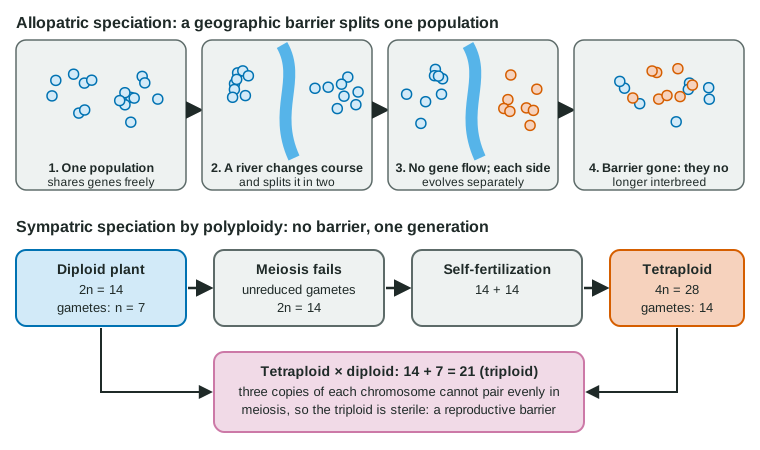
- A geographic barrier, such as a river changing course, divides one population into two.Gene flow between the two parts stops.
- Without gene flow, each part has its own new mutations, its own genetic drift and its own selective pressures.Allele frequencies in the two gene pools change in different directions.
- Some of the differences that build up affect reproduction: mating songs, breeding times, the fit of reproductive parts, or how well hybrid genes work together.Reproductive barriers arise, prezygotic ones that block mating or fertilization and postzygotic ones that make hybrids die or be sterile.
- When the barrier disappears and the populations meet again, they no longer produce fertile offspring together.They are now separate species, reproductively isolated by the biological species concept: allopatric speciation.
- Barriers can also arise without any geographic separation, for example when a plant's chromosomes double and its offspring cannot breed with the parents' population.A new species forms in the same place (sympatric speciation), sometimes in one generation.
Part 6 · Key ideas
Key ideas
- Biological species concept: a species is a group that can interbreed and produce fertile offspring. Speciation happens when populations become reproductively isolated.
- Prezygotic barriers stop mating or fertilization: habitat, temporal, behavioral, mechanical, gametic. Postzygotic barriers act on hybrids: inviability, sterility, breakdown.
- Allopatric speciation starts with a geographic barrier; sympatric speciation happens in one place, often by polyploidy in plants.
- Speciation can be gradual or come in bursts (punctuated equilibrium). Adaptive radiation: many species from one ancestor fill open niches. These patterns are macroevolution.
Part 7 · Misconception
A common mistake
The wrong idea: Two populations that look different must be different species, and two that look alike must be one species.
What actually happens: By the biological species concept, what matters is whether they can interbreed and produce fertile offspring. Very different-looking dogs are one species; some birds and frogs that look identical are separate species with different songs or calls.
Part 8 · Check yourself
Check yourself
Exam-style questions. Anything you miss goes into your review queue.
Data table
Crosses among three populations of a stream fish
Three populations of a small fish were sampled. Populations L and M share the same streams in one valley; population K lives in a separate river system 300 km away. In the lab, researchers placed 100 pairs (one female, one male) for each cross in tanks and recorded whether they spawned, how many eggs were fertilized and hatched, and whether the offspring grown to adulthood were fertile.
| Cross | Pairs that spawned (%) | Eggs fertilized (%) | Fertilized eggs that hatched (%) | Adult offspring that were fertile (%) |
|---|---|---|---|---|
| K × K | 92 | 95 | 90 | 98 |
| L × L | 90 | 94 | 91 | 97 |
| M × M | 89 | 96 | 89 | 99 |
| K × L | 88 | 93 | 88 | 96 |
| K × M | 85 | 91 | 87 | 3 |
| L × M | 10 | 93 | 88 | 2 |
1. Which kind of reproductive barrier do the data show between populations K and M?
- Hybrid sterility: offspring form and develop, but few adults are fertile
- Behavioral isolation: few K and M pairs spawn when placed together
- Gametic isolation: sperm from one population rarely fertilize eggs of the other
- Hybrid inviability: most fertilized K × M eggs fail to hatch
Show the answer
K × M pairs spawn (85%), fertilize (91%) and hatch (87%) about as well as the controls, but only 3% of the adult offspring are fertile: a postzygotic barrier, hybrid sterility.
- Correct: Hybrid sterility: offspring form and develop, but few adults are fertile: Correct: the barrier appears only at the fertility stage.
- Behavioral isolation: few K and M pairs spawn when placed together: 85% of K × M pairs spawned, close to the 89-92% of the controls.
- Gametic isolation: sperm from one population rarely fertilize eggs of the other: 91% of K × M eggs were fertilized, about the same as in the controls.
- Hybrid inviability: most fertilized K × M eggs fail to hatch: 87% of fertilized K × M eggs hatched, close to the controls.
2. Using the biological species concept, how many species do populations K, L and M represent?
- One
- Two
- Three
- Unknown, since crosses do not test species
Show the answer
K and L interbreed and produce fertile offspring (96%), so by the biological species concept they are one species. M produces almost no fertile offspring with either, so it is a second species.
- One: M is reproductively isolated from K and L: its hybrids are nearly all sterile.
- Correct: Two: Correct: K with L is one species; M is another.
- Three: K and L produce fertile offspring, so they are not separate species, even though they live 300 km apart.
- Unknown, since crosses do not test species: The biological species concept is defined by interbreeding and fertile offspring, which is exactly what crosses test.
3. L and M rarely spawn together, but K and M spawn readily. Which explanation best accounts for this difference?
- Where L and M meet, selection against sterile hybrids favored fish that avoid the other population
- Population K lives far from M, so its fish do not yet recognize M fish as mates and avoid them
- L fish are less fertile than K fish, so they spawn less with any partner, whether L or M
- K and M belong to one species, while L and M belong to two different species
Show the answer
In the shared streams, a L fish that spawned with M left mostly sterile offspring, so fish that avoided M left more fertile offspring. Over generations this strengthened a prezygotic barrier there (reinforcement). K never met M, so no such selection acted on K.
- Correct: Where L and M meet, selection against sterile hybrids favored fish that avoid the other population: Correct: selection against hybrids where the two meet strengthens prezygotic isolation.
- Population K lives far from M, so its fish do not yet recognize M fish as mates and avoid them: K fish do spawn with M readily, so not recognizing M is the opposite of what the data show.
- L fish are less fertile than K fish, so they spawn less with any partner, whether L or M: L × L pairs spawn at 90%, so L fish are not reluctant to spawn in general.
- K and M belong to one species, while L and M belong to two different species: K × M hybrids are 97% sterile, so K and M are different species too.
Model
A tetraploid wildflower
A wildflower species is diploid, with 2n = 14. In one plant, a failure of meiosis produced gametes with 14 chromosomes, and self-fertilization of that plant produced tetraploid offspring (4n = 28). The tetraploids grow among the diploids in the same meadow, flower at the same time and are visited by the same bees. Researchers then made the crosses below.
| Cross | Seeds formed per flower | Offspring | Offspring that produced viable seed (%) |
|---|---|---|---|
| Diploid × diploid | 22 | Diploid | 96 |
| Tetraploid × tetraploid | 18 | Tetraploid | 91 |
| Diploid × tetraploid | 15 | Triploid | 2 |
4. Which claim is best supported by the model?
- The tetraploids are a new species that arose in a single generation without geographic separation
- The tetraploids are the same species as the diploids, since they share a meadow and pollinators
- The tetraploids became a new species through many generations of natural selection in a separate area
- The tetraploids are a new species because they look different, whether or not they interbreed
Show the answer
Tetraploids breed among themselves (91% fertile offspring) but their hybrids with diploids are sterile (2%), so they are reproductively isolated: a new species by the biological species concept, formed in one step in the same place, which is sympatric speciation.
- Correct: The tetraploids are a new species that arose in a single generation without geographic separation: Correct: instant reproductive isolation in the same meadow.
- The tetraploids are the same species as the diploids, since they share a meadow and pollinators: Sharing a place does not make them one species; their hybrids are nearly all sterile.
- The tetraploids became a new species through many generations of natural selection in a separate area: The isolation arose in one generation, from one meiosis failure, in the same meadow.
- The tetraploids are a new species because they look different, whether or not they interbreed: The species status here rests on reproductive isolation shown by the crosses, not on appearance.
5. Put the steps of allopatric speciation in order.
- A population is split by a geographic barrier, such as a new river channel
- Gene flow between the two parts stops
- Mutation, drift and different selective pressures change allele frequencies differently on each side
- Differences build up that prevent interbreeding
- When the barrier disappears, the two populations no longer produce fertile offspring together
Show the answer
Separation stops gene flow; without it, each side evolves on its own; the differences that accumulate include reproductive barriers, so the populations stay separate species even when they meet again.
- Correct order: 1. A population is split by a geographic barrier, such as a new river channel 2. Gene flow between the two parts stops 3. Mutation, drift and different selective pressures change allele frequencies differently on each side 4. Differences build up that prevent interbreeding 5. When the barrier disappears, the two populations no longer produce fertile offspring together
6. Sea urchins of two species release eggs and sperm into the same water. A sperm protein must bind a matching receptor on the egg's surface before fusion. Researchers mix eggs of species 1 with sperm of species 2. Predict the result and the barrier.
- Few eggs are fertilized, because the sperm protein binds the foreign egg receptor poorly: gametic isolation
- Many eggs are fertilized but the embryos die early, because the sperm protein is foreign: hybrid inviability
- Many eggs are fertilized and the hybrids grow normally, because the gametes share the same water
- Few eggs are fertilized, because the two species release gametes at different times: temporal isolation
Show the answer
In the lab the gametes are mixed directly, so timing and habitat play no part. If the binding proteins do not match, sperm cannot fuse with eggs: gametic isolation, a prezygotic barrier.
- Correct: Few eggs are fertilized, because the sperm protein binds the foreign egg receptor poorly: gametic isolation: Correct: mismatched binding proteins block fertilization.
- Many eggs are fertilized but the embryos die early, because the sperm protein is foreign: hybrid inviability: If binding fails, no zygote forms, so there are no embryos to die.
- Many eggs are fertilized and the hybrids grow normally, because the gametes share the same water: Sharing water does not overcome a mismatch between the sperm protein and the egg receptor.
- Few eggs are fertilized, because the two species release gametes at different times: temporal isolation: Researchers mixed the gametes themselves, so release timing cannot be the barrier here.
7. Select the two examples of prezygotic barriers.
- Two frog species call with different songs, and females approach only their own species' call
- Two flowering plants open their flowers in different months
- A horse and a donkey produce a mule that is sterile
- Two salamander species mate, but most hybrid embryos stop developing
- Hybrids of two cotton species are fertile, but their offspring are weak
Show the answer
Prezygotic barriers act before a zygote forms. Different songs (behavioral) and different flowering months (temporal) keep mating from happening at all.
- Correct: Two frog species call with different songs, and females approach only their own species' call: Behavioral isolation: no mating, no zygote.
- Correct: Two flowering plants open their flowers in different months: Temporal isolation: no pollination between them.
- A horse and a donkey produce a mule that is sterile: Hybrid sterility acts after a zygote forms (postzygotic).
- Two salamander species mate, but most hybrid embryos stop developing: Hybrid inviability is postzygotic.
- Hybrids of two cotton species are fertile, but their offspring are weak: Hybrid breakdown is postzygotic.
Part 9 · Summary
Summary
By the biological species concept, a species is a group of populations whose members can interbreed and produce fertile offspring; for fossils and asexual organisms, body form (the morphological species concept) is used instead. Speciation happens when populations become reproductively isolated. Prezygotic barriers prevent mating or fertilization: habitat, temporal, behavioral, mechanical and gametic isolation. Postzygotic barriers act after a hybrid zygote forms: hybrid inviability, hybrid sterility and hybrid breakdown. In allopatric speciation a geographic barrier stops gene flow, and mutation, drift and different selective pressures drive the separated gene pools apart until barriers evolve. In sympatric speciation isolation arises in one place, as when polyploidy makes a plant's offspring unable to breed with the parent population. Where related populations meet in a hybrid zone, selection against unfit hybrids can strengthen barriers (reinforcement). Speciation may be gradual or happen in bursts separated by long stasis (punctuated equilibrium), and an adaptive radiation produces many species that fill open niches.
Part 10 · Up next
What comes next
Part 11 · Connections