Variations in Populations
Genetic variation lets populations survive change.
Part 1 · Hook
Why this matters
Until the 1950s, the banana in every grocery store was a variety called the Gros Michel. Each plant was grown from a cutting of another, so every one was a clone. When a soil fungus that could infect it spread through Central America, there were no plants with alleles to resist it, and the variety was wiped out of export farming. Its replacement, the Cavendish, is also grown as clones, and a new strain of the same fungus is now spreading through Cavendish farms worldwide.
Part 2 · Before you start
What this builds on
Part 3 · Prerequisite check
Quick check before you start
1. In a population with q = 0.1 for a recessive allele, what fraction of individuals are heterozygous?
- 2pq = 0.18
- q² = 0.01
- p² = 0.81
Show the answer
p = 0.9, so heterozygotes are 2 × 0.9 × 0.1 = 0.18.
- Correct: 2pq = 0.18:
- q² = 0.01:
- p² = 0.81:
2. Why does a small, isolated population tend to lose genetic variation?
- Genetic drift and inbreeding remove alleles by chance and make individuals more alike
- Small populations mutate less, so no new alleles appear
- Natural selection is stronger in small populations
Show the answer
Chance losses are larger in small populations, and mating among relatives raises homozygosity.
- Correct: Genetic drift and inbreeding remove alleles by chance and make individuals more alike:
- Small populations mutate less, so no new alleles appear:
- Natural selection is stronger in small populations:
3. Sickle cell disease is caused by
- a missense mutation that puts valine in place of glutamic acid in a hemoglobin chain
- an extra copy of chromosome 11
- a deletion of the whole hemoglobin gene
Show the answer
One base change alters one amino acid, and the hemoglobin forms fibers when oxygen is low.
- Correct: a missense mutation that puts valine in place of glutamic acid in a hemoglobin chain:
- an extra copy of chromosome 11:
- a deletion of the whole hemoglobin gene:
Part 4 · See it
See it first
Part 5 · Step by step
How it works, step by step
- A population carries many different alleles, produced by mutation and reshuffled by sexual reproduction.Individuals differ in how they respond to stresses, including diseases and environmental changes the population has never met.
- A new disease or environmental change arrives.Individuals whose alleles happen to give disease resistance or tolerance survive and reproduce, while others die.
- The survivors pass those alleles on.The population persists and adapts, because natural selection had variation to act on.
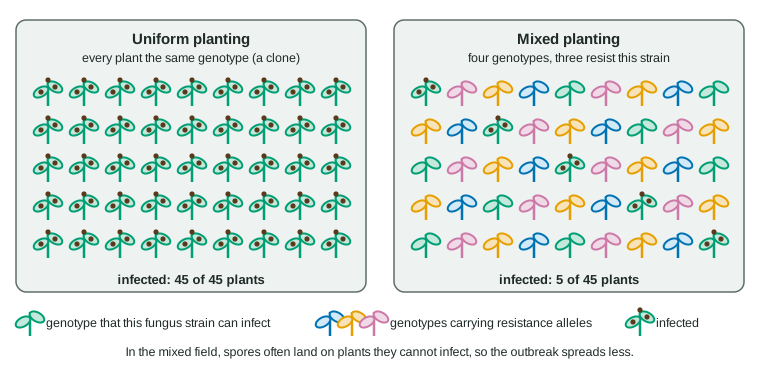
- A population with little variation, such as a crop of clones or a small inbred population, has few different alleles.It is unlikely to include any individuals that can survive the new stress, so it is vulnerable to being wiped out.
- Where heterozygotes have the highest fitness, as sickle-cell carriers do where malaria is common,selection keeps both alleles in the population, preserving variation even though one homozygote is harmed.
Part 6 · Key ideas
Key ideas
- Genetic variation makes it more likely that some individuals survive a new disease or environmental change; selection then acts on them.
- Population vulnerability: small, inbred or clonal populations have few alleles, so one stress can wipe them out. A monoculture of identical plants is the extreme case.
- Disease resistance alleles usually exist before the disease arrives. Variation in molecules, such as enzyme forms suited to different temperatures, helps populations fit their surroundings.
- Heterozygote advantage keeps alleles common: sickle-cell carriers resist malaria, so both alleles persist where malaria is common.
Part 7 · Misconception
A common mistake
The wrong idea: When a disease arrives, the population develops resistance to it because it needs to.
What actually happens: Resistance cannot be produced on demand. A population survives only if some members already carry alleles that let them resist; the more genetic variation it has, the more likely that is.
Part 8 · Check yourself
Check yourself
Exam-style questions. Anything you miss goes into your review queue.
Data table
Rice fields during a blast fungus outbreak
In a year when rice blast fungus spread through a farming region, researchers compared three kinds of fields. Some fields grew only variety H, a high-value variety the local strain of the fungus can infect. Some grew only variety R, which carries an allele that resists the local strain. Mixed fields grew one row of H for every four rows of R. Twelve fields of each kind were scored at harvest.
| Planting | Variety H plants infected (%) | Variety R plants infected (%) | Grain yield (tonnes per hectare) | Yield ± 2 SE |
|---|---|---|---|---|
| H alone | 58 | — | 4.1 | 0.4 |
| R alone | — | 4 | 6.0 | 0.3 |
| Mixed, 1 row H : 4 rows R | 9 | 3 | 6.4 | 0.3 |
1. Which statement best describes the infection data?
- Variety H was infected far less often among rows of R than when grown alone
- Variety R was infected more often when grown with variety H than when grown alone
- Variety H was infected about as often in mixed fields as in fields of H alone
- Variety R lost its resistance when grown in the same field as variety H
Show the answer
Variety H plants were 58% infected when grown alone but 9% in mixed fields. R stayed near 3-4% either way.
- Correct: Variety H was infected far less often among rows of R than when grown alone: Correct: 58% alone versus 9% in mixtures.
- Variety R was infected more often when grown with variety H than when grown alone: R was 4% infected alone and 3% in mixtures, about the same.
- Variety H was infected about as often in mixed fields as in fields of H alone: H infection fell from 58% to 9%, a large drop.
- Variety R lost its resistance when grown in the same field as variety H: R's infection stayed low in mixed fields, so it kept its resistance.
2. Which explanation best accounts for variety H being infected less in the mixed fields?
- Spores from infected H plants mostly land on R plants they cannot infect, so spread slows
- Variety R plants release a chemical that kills the fungus, which protects the other plants in the field
- Variety H plants grown next to variety R take up R's resistance allele through their roots
- Mixed fields were planted later in the season, after the outbreak had already ended
Show the answer
In a uniform field, every neighbor is a host, so the fungus spreads plant to plant. In the mixture, susceptible plants are spaced apart by resistant ones, so many spores are wasted and the outbreak grows more slowly.
- Correct: Spores from infected H plants mostly land on R plants they cannot infect, so spread slows: Correct: resistant neighbors break the chain of spread.
- Variety R plants release a chemical that kills the fungus, which protects the other plants in the field: The stem describes a resistance allele, not a chemical; and R's own infection data do not suggest one.
- Variety H plants grown next to variety R take up R's resistance allele through their roots: Alleles are not passed between neighboring plants through their roots.
- Mixed fields were planted later in the season, after the outbreak had already ended: Nothing in the setup says planting dates differed; the fields were compared in the same outbreak year.
3. The next year a new strain of the fungus appears that can infect variety R but not variety H. Predict which planting suffers the greatest loss.
- Fields of R alone, because every plant is a host for the new strain
- Mixed fields, because they contain two varieties the fungus can attack
- Fields of H alone, because H was the variety most infected the year before
- The three kinds equally, because the new strain spreads by the same kind of spores
Show the answer
A field of one genotype has no individuals that resist the new strain, so it can spread through the whole field. Mixed fields keep some H plants the new strain cannot infect, and H-alone fields resist it.
- Correct: Fields of R alone, because every plant is a host for the new strain: Correct: a uniform field of a now-susceptible genotype is the most vulnerable.
- Mixed fields, because they contain two varieties the fungus can attack: The new strain cannot infect H, so mixed fields keep some unaffected plants and spaced-out hosts.
- Fields of H alone, because H was the variety most infected the year before: Last year's strain is not this year's; the new strain cannot infect H.
- The three kinds equally, because the new strain spreads by the same kind of spores: The strain can infect only one of the two varieties, so plantings differ in how many hosts they offer.
Data table
A small, isolated wild cat population before and after new arrivals
Roads, farms and towns cut a population of wild cats off from all others. By the early 1990s about 26 adults remained. In 1995, eight females from a larger population of the same species in another region were released into the area, and many bred there. Researchers tested cats for genetic variation and examined kittens for inherited defects.
| Years | Adults (approximate) | Heterozygosity (share of tested genes with two different alleles) | Kittens with a heart defect (%) | Kittens with a kinked tail (%) |
|---|---|---|---|---|
| 1990-1994 | 26 | 0.16 | 21 | 88 |
| 2000-2004 | 62 | 0.27 | 7 | 31 |
| 2010-2014 | 120 | 0.29 | 4 | 18 |
4. Which explanation best accounts for the high rate of inherited defects in 1990-1994?
- In a small, isolated population relatives mate, so more kittens get two copies of a harmful recessive allele
- Small populations make new harmful mutations much faster, so their kittens carried many more new mutations
- Low heterozygosity means kittens inherited fewer genes, so some body structures could not form
- The defects were caused by the roads and farms themselves, through stress on the pregnant females
Show the answer
With few mates available, cats were often related, so kittens more often received the same recessive allele from both parents (inbreeding). Recessive defects then appear, and heterozygosity falls.
- Correct: In a small, isolated population relatives mate, so more kittens get two copies of a harmful recessive allele: Correct: inbreeding exposes harmful recessive alleles.
- Small populations make new harmful mutations much faster, so their kittens carried many more new mutations: Mutation rate per gene does not depend on population size; the issue is how alleles are combined.
- Low heterozygosity means kittens inherited fewer genes, so some body structures could not form: Every kitten has the same set of genes; low heterozygosity means fewer different alleles, not fewer genes.
- The defects were caused by the roads and farms themselves, through stress on the pregnant females: The defects are inherited and fell after new alleles arrived, which stress would not explain.
5. A new virus that kills wild cats reaches the area. Predict how the population would have fared if the virus had arrived in 1990-1994 instead of 2010-2014.
- Worse in 1990-1994: fewer, more similar cats made resistance alleles less likely
- Better in 1990-1994: with fewer cats, the virus would have had fewer hosts and would have died out
- The same in both periods, because a new virus is equally deadly to cats of any genotype
- Better in 1990-1994, because inbred cats have stronger immune systems from mating with relatives
Show the answer
Surviving a new disease depends on some individuals carrying alleles that resist it. A small population with low heterozygosity has fewer different alleles, so the chance that some cats resist is lower, and one outbreak could wipe it out.
- Correct: Worse in 1990-1994: fewer, more similar cats made resistance alleles less likely: Correct: low variation makes a population vulnerable.
- Better in 1990-1994: with fewer cats, the virus would have had fewer hosts and would have died out: A small population can still pass a virus among its members, and losing cats matters more when there are few.
- The same in both periods, because a new virus is equally deadly to cats of any genotype: Cats differ genetically in how they respond to infection; that variation is what the period comparison is about.
- Better in 1990-1994, because inbred cats have stronger immune systems from mating with relatives: Inbreeding lowers variation, including in immune genes; it does not strengthen immunity.
Graph
Survival by hemoglobin genotype in two regions
The graph shows modeled survival to adulthood, without modern medical care, for children of three hemoglobin genotypes in a region where malaria is common and in a region where it is rare. The values are based on field studies and rounded. HbA is the normal allele; HbS is the sickle-cell allele.
Malaria commonMalaria rare
Data table
| Genotype | Malaria common | Malaria rare |
|---|---|---|
| HbA HbA | 80 | 97 |
| HbA HbS | 92 | 97 |
| HbS HbS | 18 | 22 |
6. HbS HbS children rarely survive to adulthood, yet the HbS allele stays common where malaria is common. Which explanation fits the graph?
- Carriers, who hold most HbS alleles, survive better than either homozygote, so both alleles stay
- New HbS mutations arise each generation fast enough to replace the alleles lost in HbS HbS children
- Malaria causes the HbA allele to change into the HbS allele in people who are infected
- The HbS allele is dominant, so it spreads whether or not it helps the people who carry it
Show the answer
Heterozygote advantage: selection removes HbS in HbS HbS children and HbA through malaria deaths of HbA HbA children. Carriers, with the highest survival, pass on both alleles, so both persist (balancing selection).
- Correct: Carriers, who hold most HbS alleles, survive better than either homozygote, so both alleles stay: Correct: the heterozygote has the highest fitness where malaria is common.
- New HbS mutations arise each generation fast enough to replace the alleles lost in HbS HbS children: New mutations to HbS are far too rare to keep the allele at such high frequencies.
- Malaria causes the HbA allele to change into the HbS allele in people who are infected: Infections do not change a person's alleles; mutations are random.
- The HbS allele is dominant, so it spreads whether or not it helps the people who carry it: Dominance does not make an allele spread; in fact the disease is recessive.
7. Nearly every export banana is a Cavendish, grown from cuttings of a few original plants. A fungal disease that kills Cavendish plants has spread to many countries. Why is the crop so vulnerable?
- The plants are clones, so a strain that can infect one plant can infect nearly all of them
- Bananas grown from cuttings mutate faster than bananas grown from seed, so they lose resistance quickly
- Fungi infect plants grown from cuttings more easily than plants of any kind grown from seed
- The Cavendish was bred for flavor, and flavor genes make plants more attractive to fungi
Show the answer
Plants grown from cuttings are genetically identical. With no variation, there are no plants carrying resistance alleles to survive, so one pathogen strain threatens the whole crop. An earlier variety, the Gros Michel, was lost the same way in the 1950s.
- Correct: The plants are clones, so a strain that can infect one plant can infect nearly all of them: Correct: a monoculture of clones has no variation for resistance.
- Bananas grown from cuttings mutate faster than bananas grown from seed, so they lose resistance quickly: Propagating by cuttings does not raise the mutation rate; it prevents new combinations of alleles.
- Fungi infect plants grown from cuttings more easily than plants of any kind grown from seed: The problem is that the plants are identical, not that they came from cuttings as such.
- The Cavendish was bred for flavor, and flavor genes make plants more attractive to fungi: Nothing links flavor genes to fungal infection; the risk comes from uniformity.
Part 9 · Summary
Summary
Genetic variation lets populations survive change. When a new disease or environmental stress arrives, individuals whose alleles happen to give disease resistance or tolerance survive and reproduce, and natural selection acts through them. Populations with little variation, because they are small, inbred or reproduce as clones, are vulnerable: few or none of their members may carry useful alleles. Monocultures of genetically uniform crops show this most clearly, from the Irish potato famine to the loss of the Gros Michel banana; mixed plantings slow outbreaks because resistant neighbors block spread. Small wild populations can be restored by gene flow that brings in new alleles. Variation also exists in molecules, such as enzyme forms suited to different temperatures. Heterozygote advantage keeps variation in a population: where malaria is common, carriers of one sickle-cell allele survive best, so both alleles remain common, a form of balancing selection.
Part 10 · Up next
What comes next
Part 11 · Connections