Phylogeny
A phylogenetic tree is a hypothesis about evolutionary relationships.
Part 1 · Hook
Why this matters
Which is a crocodile's closer relative: a lizard or a pigeon? Most people pick the lizard, since both are scaly and cold to the touch. The answer from fossils, anatomy and DNA is the pigeon. Crocodiles and birds share an ancestor that lizards do not share, and dinosaurs sit on that same branch. Trees of life let you answer questions like this at a glance, once you know how to read them, and they hold a few traps that catch almost everyone the first time.
Part 2 · Before you start
What this builds on
Part 3 · Prerequisite check
Quick check before you start
1. Homologous structures, such as the arm bones of a human and the wing bones of a bat, are evidence of
- a common ancestor that both inherited the structure from
- the same structure evolving separately to do the same job
- a structure that has lost its function
Show the answer
Homologous structures share an underlying plan because both organisms inherited it from a common ancestor.
- Correct: a common ancestor that both inherited the structure from:
- the same structure evolving separately to do the same job:
- a structure that has lost its function:
2. Two species' versions of a gene differ at very few bases. This suggests they
- shared a common ancestor fairly recently
- live in very different environments
- never shared a common ancestor
Show the answer
Differences build up over time after two lines separate, so few differences suggest a recent shared ancestor.
- Correct: shared a common ancestor fairly recently:
- live in very different environments:
- never shared a common ancestor:
3. Archaea share histones and a complex RNA polymerase with eukaryotes, not with bacteria. This is evidence that
- Archaea and eukaryotes share an ancestor that bacteria do not share
- Archaea evolved from eukaryotes living today
- bacteria and archaea are the same group
Show the answer
Newer features shared by two groups, and lacking in a third, point to an ancestor that only the two share.
- Correct: Archaea and eukaryotes share an ancestor that bacteria do not share:
- Archaea evolved from eukaryotes living today:
- bacteria and archaea are the same group:
Part 4 · See it
See it first
Part 5 · Step by step
How it works, step by step
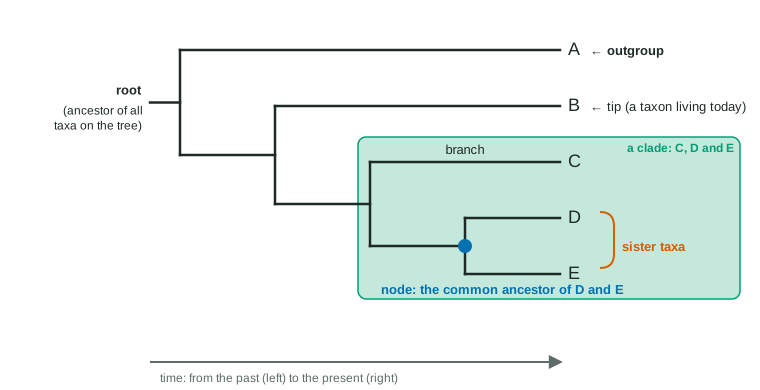
- An ancestral population splits into two lines that no longer share genes.Each line accumulates its own mutations and adaptations, so the two diverge; on a tree, the split is a node with two branches.
- A new heritable trait, such as seeds or hair, arises in one line.Every descendant of that line inherits it (unless it is later lost), so the trait becomes a shared derived character of that group.
- Biologists record which taxa have which derived characters, using an outgroup to tell which states are older.Taxa that share more derived characters are grouped as having a more recent common ancestor, and the groups nest inside each other as clades.
- Different possible trees explain the same data with different numbers of evolutionary changes.By maximum parsimony, biologists prefer the tree with the fewest changes, and they check it against DNA data, where differences build up roughly in proportion to time.
- New fossils or sequences can disagree with an existing tree.The tree is revised: every tree is a hypothesis about evolutionary history, not a final answer.
Part 6 · Key ideas
Key ideas
- A phylogenetic tree shows hypothesized relationships. Each node is a common ancestor; sister taxa share a node no one else shares. The more recent the shared node, the closer the relationship.
- A clade is an ancestor and all its descendants. Shared derived characters mark clades; shared ancestral characters do not. The outgroup shows which states are ancestral.
- Read nodes, not tip order: branches can rotate freely, and every living tip has evolved for equally long. No living organism is the ancestor of another.
- Maximum parsimony prefers the tree with fewest changes. A molecular clock, calibrated with fossils, dates splits. DNA data are often more reliable than body form, and trees are revised with new evidence.
Part 7 · Misconception
A common mistake
The wrong idea: Two tips drawn next to each other are the most closely related, and the tip at the end of the tree is the most evolved.
What actually happens: Relationships come from where lines meet, not from where tips are drawn: rotating branches at a node changes tip order but not the tree. All living tips have been evolving for the same length of time.
Part 8 · Check yourself
Check yourself
Exam-style questions. Anything you miss goes into your review queue.
Data table
A trait matrix for five photosynthetic organisms
Researchers scored four characters in a freshwater green alga and four land plants. Other evidence places the alga outside the group formed by the land plants.
| Organism | Embryo develops inside the parent plant's tissue | Vascular tissue (xylem and phloem) | Seeds | Flowers |
|---|---|---|---|---|
| Green alga | − | − | − | − |
| Moss | + | − | − | − |
| Fern | + | + | − | − |
| Pine | + | + | + | − |
| Oak | + | + | + | + |
1. Which cladogram is best supported by the table?
- Pine and oak are sister taxa, the fern joins them next, and the moss joins that group next
- Moss and fern are sister taxa, and pine and oak are sister taxa, joined to them at one node
- Fern and pine are sister taxa, oak joins them next, and the moss joins that group next
- Oak branches off first among the land plants, then the pine, the fern and finally the moss
Show the answer
Each character marks one clade: embryo (moss, fern, pine, oak), vascular tissue (fern, pine, oak), seeds (pine, oak). Nesting these groups gives moss branching first, then fern, with pine and oak as sister taxa; flowers then mark the oak branch alone.
- Correct: Pine and oak are sister taxa, the fern joins them next, and the moss joins that group next: Correct: the groups marked by the characters nest inside each other in this order.
- Moss and fern are sister taxa, and pine and oak are sister taxa, joined to them at one node: Moss and fern share no character that pine and oak lack, so nothing groups them together.
- Fern and pine are sister taxa, oak joins them next, and the moss joins that group next: Pine shares seeds with oak, not with the fern, so pine and fern are not sister taxa.
- Oak branches off first among the land plants, then the pine, the fern and finally the moss: This reverses the nesting: the oak has every derived character, so it sits inside the most nested group.
2. Which character is a shared derived character that groups the pine with the oak but not with the fern?
- Seeds
- Vascular tissue
- Embryo develops inside the parent plant
- Flowers
Show the answer
Seeds are found in pine and oak and in no other organism in the table, so they mark the ancestor that pine and oak alone share.
- Correct: Seeds: Correct: seeds are shared by pine and oak and lacking in the rest.
- Vascular tissue: The fern has vascular tissue too, so it cannot separate pine and oak from the fern; within that group it is a shared ancestral character.
- Embryo develops inside the parent plant: Every land plant in the table has it, so it does not group pine and oak apart from the fern.
- Flowers: Only the oak has flowers, so they do not unite the oak with the pine.
Model
A tree of seven animals
The tree shows hypothesized relationships among seven living animals, based on many DNA sequences and anatomical characters. Nodes are numbered 1 to 6.
3. Which node represents the most recent common ancestor of the mouse and the turtle?
- Node 1
- Node 2
- Node 3
- Node 5
Show the answer
Trace the mouse and the turtle back toward the root: the first node where their lines meet is node 2.
- Node 1: Node 1 is an ancestor of both, but not the most recent one; it also gave rise to the frog.
- Correct: Node 2: Correct: the lines from the mouse and the turtle first meet at node 2.
- Node 3: Node 3 is an ancestor of the turtle but not of the mouse.
- Node 5: Node 5 is the ancestor of the turtle, crocodile and sparrow only.
4. Which statement is supported by the tree?
- The turtle is equally related to the crocodile and to the sparrow
- The crocodile is more closely related to the lizard than to the sparrow
- The lizard is more closely related to the turtle than the sparrow is
- The frog is the ancestor from which the other six animals evolved
Show the answer
The turtle's most recent common ancestor with the crocodile and with the sparrow is the same node, node 5, so it is equally related to both.
- Correct: The turtle is equally related to the crocodile and to the sparrow: Correct: both pairs meet at node 5.
- The crocodile is more closely related to the lizard than to the sparrow: The crocodile meets the sparrow at node 6 but the lizard only at node 3, so it is closer to the sparrow.
- The lizard is more closely related to the turtle than the sparrow is: The lizard meets the turtle at node 3, while the sparrow meets the turtle at node 5, a more recent ancestor, so the sparrow is the closer relative.
- The frog is the ancestor from which the other six animals evolved: The frog is a living tip; it shares an ancestor (node 1) with the others but is not their ancestor.
5. Select the two groups that are clades on this tree.
- Crocodile and sparrow
- Turtle, crocodile and sparrow
- Lizard, snake, turtle and crocodile
- Mouse, lizard and snake
- Frog and mouse
Show the answer
A clade contains a node and every tip descended from it. Node 6 gives crocodile and sparrow; node 5 gives turtle, crocodile and sparrow.
- Correct: Crocodile and sparrow: Node 6 and all of its descendants.
- Correct: Turtle, crocodile and sparrow: Node 5 and all of its descendants.
- Lizard, snake, turtle and crocodile: Not a clade: their shared ancestor, node 3, also gave rise to the sparrow, which is left out. The traditional group of reptiles is not a clade unless birds are included.
- Mouse, lizard and snake: Not a clade: node 2 also gave rise to the turtle, crocodile and sparrow.
- Frog and mouse: Not a clade: node 1 is their shared ancestor, and it gave rise to every animal on the tree.
Data table
DNA differences among five primates
Researchers sequenced the same 1,000-base stretch of DNA, a region that codes for no protein, in five primates and counted the positions at which each pair differs. Fossils and other evidence date the split between the orangutan line and the line leading to gorillas, chimpanzees and humans to about 15 million years ago.
| Human | Chimpanzee | Gorilla | Orangutan | Macaque | |
|---|---|---|---|---|---|
| Human | — | 12 | 16 | 31 | 62 |
| Chimpanzee | 12 | — | 16 | 31 | 62 |
| Gorilla | 16 | 16 | — | 31 | 62 |
| Orangutan | 31 | 31 | 31 | — | 62 |
| Macaque | 62 | 62 | 62 | 62 | — |
6. Assume differences build up at a constant rate. Using the orangutan split as a calibration, estimate how many million years ago the human and chimpanzee lines split. Give one decimal place.
Type a number in million years.
Show the answer
Rate = 31 differences per 15 million years. Human-chimpanzee: 12 differences × (15 ÷ 31) = 5.8 million years ago. The same calibration gives about 7.7 million years for the gorilla split (16 × 15 ÷ 31).
- Answer: 5.8 million years
7. A tree has the nested grouping ((P, (Q, R)), S), drawn with the tips in the order P, Q, R, S from top to bottom. Which statement is correct?
- R is more closely related to P than to S
- R is more closely related to S, since their tips are drawn side by side
- P is equally closely related to Q and to S
- S is the ancestor of P, Q and R, since it branches off first
Show the answer
R and P meet at the node joining P with (Q, R); R and S meet only at the root. A more recent common ancestor means a closer relationship.
- Correct: R is more closely related to P than to S: Correct: R shares a more recent ancestor with P than with S.
- R is more closely related to S, since their tips are drawn side by side: Tips drawn next to each other are not necessarily close; R and S meet only at the root.
- P is equally closely related to Q and to S: P meets Q at the node above (Q, R) but meets S only at the root, so P is closer to Q.
- S is the ancestor of P, Q and R, since it branches off first: S is a living tip, not an ancestor; it shares the root with the others.
Part 9 · Summary
Summary
A phylogenetic tree is a hypothesis about evolutionary relationships. Tips are living or extinct taxa, branches are lines of descent, and each node is the most recent common ancestor of everything beyond it; the root is the ancestor of the whole tree. Two taxa are more closely related the more recent the node where their lines meet, so trees are read at the nodes, not by the order of the tips, which can be rotated freely. A clade is an ancestor and all of its descendants. Cladograms are built from shared derived characters, traits that arose in a group's ancestor, while shared ancestral characters, inherited from older ancestors, cannot sort a group; an outgroup shows which states are ancestral. Of the trees that fit the data, maximum parsimony prefers the one needing the fewest changes. DNA and protein differences give many more characters than body form and, calibrated with fossils, act as a molecular clock to date splits. Trees are revised when new evidence appears, and classification aims to name groups that are clades.
Part 10 · Up next
What comes next
Part 11 · Connections