Photosynthesis
Photosynthesis stores light energy in sugar.
Part 1 · Hook
Why this matters
A tree that weighs two tonnes grew from a seed lighter than a paperclip. Where did all that mass come from? Not mainly from the soil. Most of it came out of the air, as carbon dioxide, built into sugar using the energy of sunlight. And the oxygen you just breathed in was split out of water molecules inside a leaf. This page follows the energy from sunlight to sugar, one step at a time.
Part 2 · Before you start
What this builds on
Part 3 · Prerequisite check
Quick check before you start
1. Inside a chloroplast, which space surrounds the stacks of thylakoids?
- The stroma
- The thylakoid space
- The cytosol
Show the answer
The stroma is the fluid inside the chloroplast's inner membrane, around the thylakoids. The thylakoid space is inside each thylakoid; the cytosol is outside the chloroplast.
- Correct: The stroma:
- The thylakoid space:
- The cytosol:
2. In a redox reaction, the molecule that gains electrons is
- oxidized
- reduced
- hydrolyzed
Show the answer
Gaining electrons is reduction; losing them is oxidation. Photosynthesis reduces carbon dioxide to sugar and oxidizes water to oxygen.
- oxidized:
- Correct: reduced:
- hydrolyzed:
3. Hydrogen ions are much more concentrated on one side of a membrane than the other. If a channel protein opens, the ions will
- stay where they are, because ions cannot cross membranes
- move toward the side where they are more concentrated
- flow to the side where they are less concentrated, releasing energy that can do work
Show the answer
Ions move down their electrochemical gradient through a channel. A gradient is stored energy; chloroplasts use exactly this to make ATP.
- stay where they are, because ions cannot cross membranes:
- move toward the side where they are more concentrated:
- Correct: flow to the side where they are less concentrated, releasing energy that can do work:
Part 4 · See it
See it first
Part 5 · Step by step
How it works, step by step
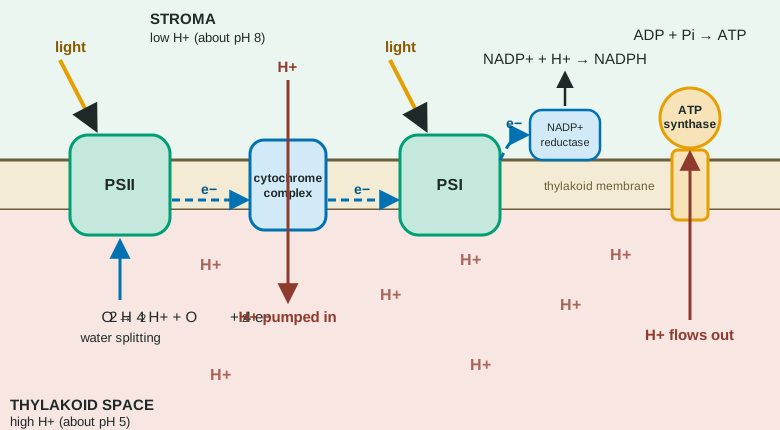
- Pigments in the thylakoid membrane absorb light, mostly blue and red, and pass the energy to the reaction center of photosystem II.An electron in a special chlorophyll a is raised to high energy and handed to an acceptor molecule.
- Photosystem II has lost an electron and pulls strongly on electrons.It takes replacement electrons from water, splitting it: 2 H₂O → 4 H⁺ + 4 e⁻ + O₂. The O₂ is released and the H⁺ stay in the thylakoid space.
- The excited electrons pass along an electron transport chain, releasing energy at each step.The cytochrome complex uses that energy to pump H⁺ from the stroma into the thylakoid space, building a proton gradient.
- At photosystem I, light energizes the electrons again.They are passed to NADP⁺, which is reduced to NADPH in the stroma.
- H⁺ crowded in the thylakoid space can leave only through ATP synthase.Their flow turns ATP synthase, which joins ADP and Pi into ATP in the stroma (chemiosmosis).
- In the stroma, the Calvin cycle attaches CO₂ to an organic molecule (carbon fixation) and spends ATP and NADPH.CO₂ is reduced to sugar, and ADP, Pi and NADP⁺ go back to the light reactions to be recharged.
Part 6 · Key ideas
Key ideas
- Overall: 6 CO₂ + 6 H₂O + light energy → C₆H₁₂O₆ + 6 O₂. The O₂ comes from water; the carbon in sugar comes from CO₂.
- Two stages, two places: the light reactions in the thylakoid membranes make ATP, NADPH and O₂; the Calvin cycle in the stroma uses ATP and NADPH to fix CO₂. Each needs the other's products.
- Pigments absorb some wavelengths: chlorophylls absorb blue and red and reflect green. An action spectrum that is high where accessory pigments absorb shows they pass energy on.
- Photosynthesis that releases O₂ first arose in cyanobacteria. Chloroplasts descend from cyanobacteria taken in by an ancestral eukaryote, and their oxygen built up the atmosphere.
Part 7 · Misconception
A common mistake
The wrong idea: The oxygen a plant releases comes from the carbon dioxide it takes in: the plant removes the carbon and lets the oxygen go.
What actually happens: The O₂ comes from splitting water at photosystem II. Experiments with water labeled with heavy oxygen (¹⁸O) give labeled O₂; labeling the CO₂ instead puts the heavy oxygen into sugar, not into the O₂.
Part 8 · Check yourself
Check yourself
Exam-style questions. Anything you miss goes into your review queue.
Data table
Chloroplasts and a blue dye
DCPIP is a blue dye that becomes colorless when it is reduced (gains electrons). In isolated chloroplasts it can accept electrons from the light reactions in place of NADP⁺. Blue DCPIP absorbs light at 600 nm, so as it is reduced the absorbance at 600 nm falls. DCMU is a weed killer that binds a protein in photosystem II and blocks electrons from leaving photosystem II. Five tubes were set up at 20 °C and the absorbance read every 5 minutes.
| Tube | Contents and conditions | 0 min | 5 min | 10 min | 15 min | 20 min |
|---|---|---|---|---|---|---|
| A | chloroplasts + DCPIP, light | 0.80 | 0.62 | 0.45 | 0.30 | 0.18 |
| B | chloroplasts + DCPIP, dark | 0.80 | 0.80 | 0.79 | 0.80 | 0.79 |
| C | boiled chloroplasts + DCPIP, light | 0.80 | 0.79 | 0.79 | 0.78 | 0.78 |
| D | DCPIP, no chloroplasts, light | 0.80 | 0.80 | 0.80 | 0.80 | 0.80 |
| E | chloroplasts + DCPIP + DCMU, light | 0.80 | 0.79 | 0.78 | 0.78 | 0.77 |
1. What does the fall in absorbance in tube A show?
- Illuminated chloroplasts released electrons, which reduced the DCPIP and turned it colorless.
- Illuminated chloroplasts made sugar, which mixed with the DCPIP and diluted its blue color.
- Light alone bleached the DCPIP, because light energy breaks down blue dyes over time.
- Chloroplasts in the light took in DCPIP through their membranes, removing it from the solution.
Show the answer
DCPIP loses its color when reduced. In the light, chloroplasts pass electrons from water through the light reactions to DCPIP instead of NADP⁺.
- Correct: Illuminated chloroplasts released electrons, which reduced the DCPIP and turned it colorless.: The dye was reduced by electrons flowing out of the light reactions.
- Illuminated chloroplasts made sugar, which mixed with the DCPIP and diluted its blue color.: Isolated chloroplasts in this setup have no CO₂ source mentioned, and sugar does not reduce DCPIP; the color change tracks electron flow.
- Light alone bleached the DCPIP, because light energy breaks down blue dyes over time.: Tube D, DCPIP in the light without chloroplasts, stayed at 0.80, so light alone does not bleach it.
- Chloroplasts in the light took in DCPIP through their membranes, removing it from the solution.: Nothing suggests uptake of dye; boiled chloroplasts (tube C) left the dye in solution, pointing to a working process, not absorption.
2. Which comparison shows that the reaction in tube A requires working chloroplast proteins, not just chloroplast material?
- Tube A with tube C
- Tube A with tube B
- Tube A with tube D
- Tube B with tube D
Show the answer
Tube A and tube C differ only in boiling. Boiling denatures proteins such as the photosystems, and tube C's absorbance barely changed.
- Correct: Tube A with tube C: Only boiling differs, so the comparison tests whether intact, folded proteins are needed.
- Tube A with tube B: Tube A and tube B differ in light, so they show that light is required.
- Tube A with tube D: Tube A and tube D differ in whether chloroplasts are present at all, not in whether their proteins work.
- Tube B with tube D: Neither tube B nor tube D changed, and they differ in two ways (light and chloroplasts), so this comparison tests nothing clearly.
3. In tube E, DCMU blocks electrons from leaving photosystem II. Which prediction about tube E is best supported?
- O₂ release and H⁺ pumping by the cytochrome complex both stop, because electron flow through the chain stops.
- O₂ release continues, because water splitting happens before the block, but no NADPH or ATP is made.
- ATP is still made at the normal rate, because ATP synthase does not depend on electron transport.
- Photosystem I keeps reducing DCPIP at the normal rate, because it receives its electrons directly from water.
Show the answer
With electrons stuck at photosystem II, it cannot accept more from water, so water splitting and O₂ release stop. No electrons reach the cytochrome complex, so H⁺ pumping stops too, and the gradient for ATP fades.
- Correct: O₂ release and H⁺ pumping by the cytochrome complex both stop, because electron flow through the chain stops.: A block anywhere on the chain stops flow along all of it, including water splitting at the start.
- O₂ release continues, because water splitting happens before the block, but no NADPH or ATP is made.: Photosystem II splits water only to replace electrons it has passed on; if it cannot pass them on, splitting stops.
- ATP is still made at the normal rate, because ATP synthase does not depend on electron transport.: ATP synthase needs the H⁺ gradient that electron transport builds.
- Photosystem I keeps reducing DCPIP at the normal rate, because it receives its electrons directly from water.: Photosystem I receives electrons from the chain that starts at photosystem II, not from water; tube E's dye barely changed.
4. In an intact chloroplast, which molecule receives the electrons that DCPIP receives in this experiment?
- NADP⁺
- O₂
- CO₂
- ATP
Show the answer
Electrons from photosystem I normally reduce NADP⁺ to NADPH. DCPIP stands in for NADP⁺ and changes color when reduced.
- Correct: NADP⁺: NADP⁺ is the natural final acceptor of the light reactions' electrons.
- O₂: O₂ is released by water splitting; it does not accept these electrons in photosynthesis.
- CO₂: CO₂ is reduced later, in the Calvin cycle, by NADPH, not directly by the light reactions.
- ATP: ATP is made by ATP synthase using the H⁺ gradient; it does not accept electrons.
5. Select the two products of the light reactions that the Calvin cycle uses directly.
- ATP
- NADPH
- O₂
- CO₂
- Glucose
Show the answer
The light reactions make ATP, NADPH and O₂; the Calvin cycle uses the ATP for energy and the NADPH for electrons.
- Correct: ATP: ATP supplies energy for carbon fixation and for regenerating the cycle's starting molecule.
- Correct: NADPH: NADPH supplies the electrons that reduce CO₂ to sugar.
- O₂: O₂ is released as a by-product; the Calvin cycle does not use it.
- CO₂: CO₂ comes from the air, not from the light reactions.
- Glucose: Glucose is made from the Calvin cycle's products; it is not an input.
6. A plant that has been in bright light is suddenly moved into darkness. Predict the change in each variable over the next few minutes.
| Variable | Change |
|---|---|
| O₂ released by the chloroplasts | — |
| H⁺ concentration in the thylakoid space | — |
| Rate of CO₂ fixation by the Calvin cycle | — |
| Amount of chlorophyll in the leaf | — |
Show the answer
Darkness stops the light reactions at once (no O₂, no new gradient), and the Calvin cycle follows as its ATP and NADPH run out. The pigments themselves stay.
- O₂ released by the chloroplasts: decreases. Without light, photosystem II stops losing electrons, so water is no longer split and no O₂ is released.
- H⁺ concentration in the thylakoid space: decreases. Electron transport stops pumping H⁺ in, while H⁺ keeps flowing out through ATP synthase, so the gradient runs down.
- Rate of CO₂ fixation by the Calvin cycle: decreases. As ATP and NADPH from the light reactions run out, the Calvin cycle slows and stops.
- Amount of chlorophyll in the leaf: no change. Pigments are not used up in a few minutes; the leaf keeps the same chlorophyll whether or not light is shining.
7. In the thylakoid membrane, what does the energy released by electrons moving along the electron transport chain do?
- It pumps H⁺ from the stroma into the thylakoid space, building a gradient that drives ATP synthase.
- It joins ADP and Pi directly, with each electron that passes making one ATP at the cytochrome complex.
- It splits CO₂ into carbon and O₂, which is the source of the oxygen released by plants in the light.
- It is stored as heat in the thylakoid space, which warms the Calvin cycle's enzymes so they work faster.
Show the answer
Electron transport releases energy in small steps; the cytochrome complex uses it to pump H⁺ into the thylakoid space. ATP synthase then uses the H⁺ gradient to make ATP (chemiosmosis).
- Correct: It pumps H⁺ from the stroma into the thylakoid space, building a gradient that drives ATP synthase.: Energy goes into the H⁺ gradient first, then into ATP.
- It joins ADP and Pi directly, with each electron that passes making one ATP at the cytochrome complex.: ATP is made by ATP synthase from the gradient, not directly at the cytochrome complex.
- It splits CO₂ into carbon and O₂, which is the source of the oxygen released by plants in the light.: CO₂ is never split; the O₂ comes from water at photosystem II.
- It is stored as heat in the thylakoid space, which warms the Calvin cycle's enzymes so they work faster.: Heat cannot be used to do the cell's work, and the energy is captured in the gradient instead.
Part 9 · Summary
Summary
Photosynthesis stores light energy in sugar. In the thylakoid membranes, pigments in photosystems II and I absorb light and energize electrons. Photosystem II replaces its electrons by splitting water, releasing O₂. The electrons flow down an electron transport chain that pumps H⁺ into the thylakoid space, then end up in NADPH. The H⁺ gradient drives ATP synthase to make ATP. In the stroma, the Calvin cycle uses that ATP and NADPH to fix CO₂ into sugar. This process began in cyanobacteria, the ancestors of chloroplasts, and filled the atmosphere with oxygen.
Part 10 · Up next
What comes next
Part 11 · Connections