Origin of Life on Earth
Earth formed about 4.6 billion years ago, and the oldest widely accepted fossils, stromatolites and microfossils, are about 3.5 billion years old, so life appeared within roughly the first billion years.
Part 1 · Hook
Why this matters
In 1953 a graduate student, Stanley Miller, sealed water and a few simple gases in glass flasks, ran electric sparks through them for a week, and found amino acids, building blocks of proteins, in the brown water. Miller kept vials from his experiments. Decades later, researchers tested them with modern instruments and found more than 20 different amino acids in samples from one version of the setup. Chemistry alone, given energy, makes the parts of life. How those parts became a living cell is one of the great open questions in biology.
Part 2 · Before you start
What this builds on
Part 3 · Prerequisite check
Quick check before you start
1. Monomers are joined into polymers by
- dehydration synthesis, which releases a water molecule for each bond
- hydrolysis, which adds a water molecule for each bond
- dissolving the monomers in more water
Show the answer
Building a polymer removes water; breaking one (hydrolysis) adds water back.
- Correct: dehydration synthesis, which releases a water molecule for each bond:
- hydrolysis, which adds a water molecule for each bond:
- dissolving the monomers in more water:
2. In water, phospholipids or fatty acids tend to
- assemble into membranes with their hydrophobic tails away from water
- dissolve as single molecules evenly throughout the water
- join into long chains like proteins
Show the answer
Hydrophobic tails cluster away from water, so bilayers and closed vesicles form on their own.
- Correct: assemble into membranes with their hydrophobic tails away from water:
- dissolve as single molecules evenly throughout the water:
- join into long chains like proteins:
3. A catalyst speeds up a chemical reaction by
- lowering the activation energy, without being used up
- adding energy to the reactants, and being used up
- changing which products the reaction makes
Show the answer
Catalysts lower the energy barrier and are released unchanged. In this topic you meet catalysts made of RNA.
- Correct: lowering the activation energy, without being used up:
- adding energy to the reactants, and being used up:
- changing which products the reaction makes:
Part 4 · See it
See it first
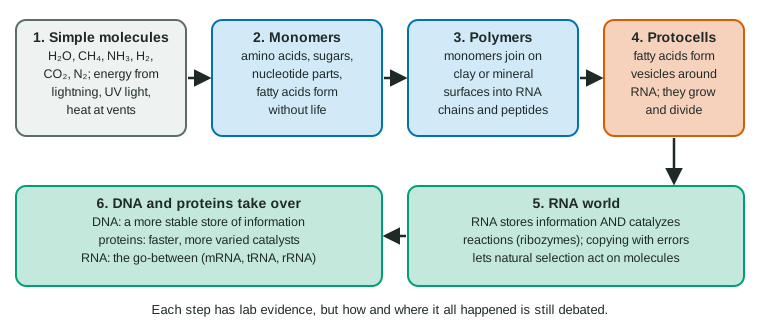
Part 5 · Step by step
How it works, step by step
- Early Earth had water, gases from volcanoes, almost no free oxygen and plenty of energy from lightning, ultraviolet light and hot vents.Simple molecules reacted to form organic monomers such as amino acids and nucleotide parts, as spark experiments show (abiotic synthesis).
- Monomers became concentrated on mineral surfaces such as clay, or in pools that dried and refilled.Dehydration reactions joined them into polymers, including short RNA chains, without enzymes.
- Fatty acids in water assembled on their own into membrane vesicles, which can enclose RNA.Protocells formed: membrane-bound packages that keep their contents together and can grow and divide.
- Some RNA molecules could both carry a copyable sequence and catalyze reactions, including copying RNA, with occasional errors.RNA that copied itself better became more common: natural selection began acting on molecules (the RNA world).
- DNA is more stable than RNA, and proteins are more varied and faster catalysts.DNA took over information storage and proteins took over most catalysis, leaving RNA as the go-between, as in cells today.
Part 6 · Key ideas
Key ideas
- Early Earth: formed about 4.6 billion years ago, with almost no free oxygen. The oldest widely accepted fossils, stromatolites, are about 3.5 billion years old.
- Abiotic synthesis: the Miller-Urey experiment showed that amino acids form from simple gases and energy. Hydrothermal vents are another proposed setting.
- Monomers can join into polymers on clay or mineral surfaces. Fatty acid vesicles can enclose RNA to make protocells.
- RNA world: RNA can store information and catalyze reactions (ribozymes), so it may have come before DNA and proteins.
Part 7 · Misconception
A common mistake
The wrong idea: The Miller-Urey experiment created life in a flask.
What actually happens: It made amino acids, building blocks of proteins, not cells. It shows that one early step, abiotic synthesis of monomers, is possible; making polymers, membranes and self-copying systems are separate steps, each studied with its own experiments.
Part 8 · Check yourself
Check yourself
Exam-style questions. Anything you miss goes into your review queue.
Graph
Amino acids in a spark experiment
Students sealed water, methane (CH4), ammonia (NH3) and hydrogen gas (H2) in sterilized glass flasks. The water was gently boiled so vapor circulated past two electrodes. In three flasks, sparks passed between the electrodes continuously; in three control flasks, the electrodes were present but no sparks were made. Each day a small sample was tested for amino acids. Values are means of three flasks.
Glycine, sparksAlanine, sparksGlycine, no sparks
Data table
| Time (days) | Glycine, sparks | Alanine, sparks | Glycine, no sparks |
|---|---|---|---|
| 0 | 0 | 0 | 0 |
| 1 | 2 | 1.1 | 0 |
| 2 | 3.6 | 2 | 0 |
| 3 | 4.8 | 2.6 | 0 |
| 4 | 5.6 | 3 | 0 |
| 5 | 6.1 | 3.3 | 0 |
| 6 | 6.4 | 3.4 | 0 |
| 7 | 6.5 | 3.5 | 0 |
1. Which statement best describes the results?
- With sparks, both rose fast at first and then slowly, glycine staying higher
- With sparks, alanine built up faster than glycine and passed it after about 3 days
- Amino acids appeared in both kinds of flask, but more slowly without sparks
- With sparks, both amino acids rose at a steady rate for the full 7 days
Show the answer
Glycine rose by 2.0 µmol on day 1 but only 0.1 on day 7; alanine followed the same shape at about half the amount. Without sparks, no glycine formed at all.
- Correct: With sparks, both rose fast at first and then slowly, glycine staying higher: Correct: fast early rise, leveling off, glycine above alanine.
- With sparks, alanine built up faster than glycine and passed it after about 3 days: Alanine stayed below glycine on every day.
- Amino acids appeared in both kinds of flask, but more slowly without sparks: The no-spark flasks had no glycine at any time.
- With sparks, both amino acids rose at a steady rate for the full 7 days: The daily increase shrank from 2.0 to 0.1 µmol, so the rate was not steady.
2. What do the no-spark control flasks allow the students to conclude?
- The sparks' energy made the amino acids; contamination or the gases alone did not
- Amino acids break down when no energy is supplied, so they need to be made continuously
- The gases in the flasks were the same as those in the air of Earth when it first formed
- Living cells are needed to turn the amino acids into proteins inside the flasks
Show the answer
The control flasks match the experimental ones in every way except the sparks, and no amino acids appeared in them. So the sparks' energy, not microbes or the gases left to themselves, produced the amino acids.
- Correct: The sparks' energy made the amino acids; contamination or the gases alone did not: Correct: the only difference is the sparks, and only sparked flasks made amino acids.
- Amino acids break down when no energy is supplied, so they need to be made continuously: No amino acids formed in the controls, so nothing was there to break down.
- The gases in the flasks were the same as those in the air of Earth when it first formed: A control in the lab cannot show what the air of the young Earth was made of.
- Living cells are needed to turn the amino acids into proteins inside the flasks: The experiment tested amino acid formation, not protein synthesis.
3. Many geologists now think the early atmosphere was mostly carbon dioxide and nitrogen, with little methane or ammonia. Which next experiment would best test whether amino acids could still have formed?
- Repeat it with carbon dioxide, nitrogen and water vapor instead of the original gases
- Repeat the experiment with the same gases, but run the sparks for 30 days instead of 7
- Repeat the experiment with the same gases, but add amino acids at the start to see if they last
- Repeat the experiment with the same gases in open flasks, so that air can enter as needed
Show the answer
To test the new hypothesis about the atmosphere, change the gases to match it while keeping everything else the same, and look for amino acids. (Such experiments give lower yields, which rise when the water is buffered against acid.)
- Correct: Repeat it with carbon dioxide, nitrogen and water vapor instead of the original gases: Correct: test the gases that the new hypothesis proposes.
- Repeat the experiment with the same gases, but run the sparks for 30 days instead of 7: A longer run with the old gases does not test the new atmosphere.
- Repeat the experiment with the same gases, but add amino acids at the start to see if they last: Adding amino acids tests their stability, not whether they can form from these gases.
- Repeat the experiment with the same gases in open flasks, so that air can enter as needed: Letting in modern air adds oxygen, which the early atmosphere lacked.
Model
What each kind of molecule can do
The table compares the abilities of three kinds of biological polymer, based on modern cells and on lab experiments.
| Ability | DNA | RNA | Protein |
|---|---|---|---|
| Stores information in a sequence that can be copied by base pairing | Yes | Yes | No |
| Catalyzes chemical reactions in cells | No (some lab-made DNA strands can) | Yes, as ribozymes (for example, the part of the ribosome that joins amino acids) | Yes, as enzymes |
| Chemical stability in water | High | Lower: the 2′ –OH on ribose helps break the backbone | Varies |
| Range of chemical shapes and side groups | Narrow (4 bases) | Narrow (4 bases), but folds into many shapes | Wide (20 amino acids) |
4. In every ribosome, the site that joins amino acids into a chain is made of rRNA, not protein. How does this support the RNA world hypothesis?
- Protein synthesis relies on an RNA catalyst, as expected if RNA catalysts came first
- It shows that rRNA stores the genetic information for each of the proteins the cell makes
- It shows that proteins fold correctly just when rRNA holds them in shape
- It shows that the ribosome evolved after DNA, so DNA came before RNA
Show the answer
If the first catalysts were RNA, the machine that makes proteins should still rely on RNA at its core, a molecular fossil of a time before proteins.
- Correct: Protein synthesis relies on an RNA catalyst, as expected if RNA catalysts came first: Correct: an RNA catalyst at the heart of protein synthesis.
- It shows that rRNA stores the genetic information for each of the proteins the cell makes: Genetic information for proteins is in mRNA copied from DNA, not in rRNA.
- It shows that proteins fold correctly just when rRNA holds them in shape: The ribosome's rRNA joins amino acids; it does not fold finished proteins.
- It shows that the ribosome evolved after DNA, so DNA came before RNA: An RNA core in the ribosome points to RNA coming first, not DNA.
5. In the lab, researchers have made a ribozyme that copies other RNA strands, with some errors. Predict what would happen in a population of such ribozymes copying one another over many rounds, with limited nucleotides.
- Better-copying variants would become more common: natural selection on molecules
- Each copy would match the first ribozyme exactly, because base pairing prevents change
- The ribozymes would turn into DNA, because DNA is the more stable molecule
- The ribozymes would stop copying, because copying with errors destroys the molecules
Show the answer
Copying with errors creates heritable variation; limited nucleotides create competition; variants that copy themselves better leave more copies. That is natural selection, which could have shaped the earliest replicators.
- Correct: Better-copying variants would become more common: natural selection on molecules: Correct: variation plus competition plus inheritance gives selection.
- Each copy would match the first ribozyme exactly, because base pairing prevents change: The stem says copying makes errors, so copies vary.
- The ribozymes would turn into DNA, because DNA is the more stable molecule: Ribozymes copy RNA; nothing in the setup makes DNA.
- The ribozymes would stop copying, because copying with errors destroys the molecules: Most errors leave a working molecule or one slightly worse; selection sorts among them.
6. In water, amino acids and nucleotides tend not to join into long chains. Why might mineral surfaces such as clay, or pools that dry and refill, have helped polymers form?
- They concentrate monomers and remove water, favoring dehydration synthesis
- They add water to the monomers, favoring the hydrolysis reactions that build chains
- They provide oxygen, which the joining reactions use as an energy source
- They hold the monomers far apart so that they do not react with the wrong partner
Show the answer
Joining monomers is dehydration synthesis: it releases water. In open water the reverse, hydrolysis, wins. Surfaces that bind and concentrate monomers, or drying that removes water, tip the balance toward chains.
- Correct: They concentrate monomers and remove water, favoring dehydration synthesis: Correct: concentration and drying favor dehydration synthesis.
- They add water to the monomers, favoring the hydrolysis reactions that build chains: Hydrolysis breaks chains; adding water works against polymer formation.
- They provide oxygen, which the joining reactions use as an energy source: Free oxygen was scarce, and these joining reactions do not use it.
- They hold the monomers far apart so that they do not react with the wrong partner: Monomers must come close together to join.
7. If simple molecules could form life on early Earth, why do new life forms not arise from nonliving chemicals today?
- Oxygen breaks down organic molecules today, and microbes would eat any that formed
- The laws of chemistry have changed since early Earth, so the same reactions no longer happen
- Lightning and volcanoes no longer occur, so there is no energy to build organic molecules
- Living things today release chemicals that turn simple molecules into carbon dioxide on contact
Show the answer
Early Earth had no free oxygen and no life. Today oxygen reacts with and breaks down organic molecules, and microbes everywhere would eat any new ones long before they could assemble into anything.
- Correct: Oxygen breaks down organic molecules today, and microbes would eat any that formed: Correct: oxygen and existing life destroy new organic molecules.
- The laws of chemistry have changed since early Earth, so the same reactions no longer happen: The laws of chemistry are the same; the conditions differ.
- Lightning and volcanoes no longer occur, so there is no energy to build organic molecules: Lightning and volcanoes still occur.
- Living things today release chemicals that turn simple molecules into carbon dioxide on contact: Organisms do not have such chemicals; the issue is oxygen and consumption by existing life.
Part 9 · Summary
Summary
Earth formed about 4.6 billion years ago, and the oldest widely accepted fossils, stromatolites and microfossils, are about 3.5 billion years old, so life appeared within roughly the first billion years. Early Earth had almost no free oxygen and abundant energy from lightning, ultraviolet light and volcanic heat. Experiments such as Miller and Urey's show that organic monomers like amino acids form from simple molecules given energy (abiotic synthesis); hydrothermal vents, with chemical energy and catalytic minerals, are another proposed setting. Monomers can join into polymers on clay or other mineral surfaces, which concentrate them and favor dehydration reactions, and fatty acids assemble into vesicles that can enclose RNA, forming protocells. The RNA world hypothesis proposes that RNA came first because it can both store information and catalyze reactions as ribozymes, as rRNA still does in the ribosome; later, more stable DNA took over storage and proteins took over most catalysis. Each step is supported by experiments, but how and where they happened is still debated.
Part 10 · Up next
What comes next
Part 11 · Connections