Disruptions to Ecosystems
Ecosystems are disrupted by human activity and by natural events.
Part 1 · Hook
Why this matters
Every summer, a patch of the Gulf of Mexico, often about the size of Connecticut, holds too little oxygen for fish. Shrimp boats find nothing there; crabs and worms on the bottom suffocate. The cause starts more than a thousand kilometers away, on farms across the Mississippi River basin, where rain washes fertilizer into streams. Nothing is poisoned. The water simply gets too much of a good thing.
Part 2 · Before you start
What this builds on
Part 3 · Prerequisite check
Quick check before you start
1. When decomposers break down dead matter by aerobic respiration, they
- use oxygen and release carbon dioxide
- release oxygen and use carbon dioxide
- use neither oxygen nor carbon dioxide
Show the answer
Aerobic respiration uses O₂ as the final electron acceptor and releases CO₂.
- Correct: use oxygen and release carbon dioxide:
- release oxygen and use carbon dioxide:
- use neither oxygen nor carbon dioxide:
2. Burning fossil fuels moves carbon
- from long-term storage underground into the atmosphere
- from the atmosphere into the ocean
- from living plants into rock
Show the answer
Coal, oil and gas hold carbon stored for millions of years; burning returns it to the air as CO₂.
- Correct: from long-term storage underground into the atmosphere:
- from the atmosphere into the ocean:
- from living plants into rock:
3. Over its life, a predator eats a mass of prey far larger than its own body mass because
- only about 10% of the energy in its food becomes its own tissue
- it stores all of its food as fat
- prey contain less water than predators
Show the answer
Most food energy is released as heat by respiration, so a predator must eat many times its own mass.
- Correct: only about 10% of the energy in its food becomes its own tissue:
- it stores all of its food as fat:
- prey contain less water than predators:
Part 4 · See it
See it first
Part 5 · Step by step
How it works, step by step
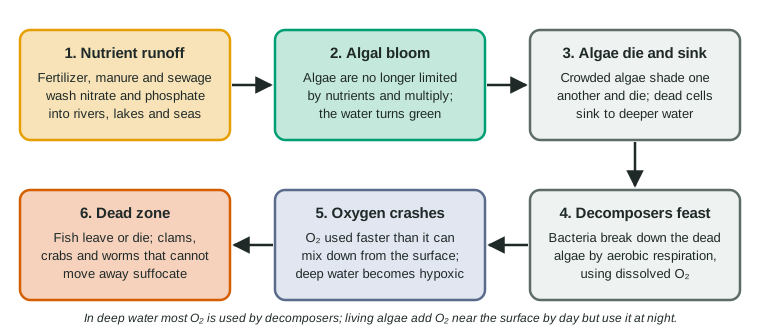
- Rain washes fertilizer, manure and sewage into rivers, carrying nitrate and phosphate to lakes and coasts.Algae, which were limited by those nutrients, grow and multiply fast: an algal bloom.
- The dense bloom shades itself, and the algae die in huge numbers.Dead algae sink into deeper water.
- Decomposers multiply on the dead algae and break them down by aerobic respiration.They use dissolved oxygen faster than it can mix down from the surface.
- Oxygen in the deeper water falls very low (hypoxia).Fish swim away or die, and animals that cannot leave suffocate: a dead zone.
- Fewer species survive, and the food web loses its larger animals.Biodiversity falls until nutrient inputs drop and oxygen returns.
Part 6 · Key ideas
Key ideas
- Human impact lowers biodiversity through habitat loss, invasive species, overharvesting, pollution and climate change.
- Invasive species spread when they escape the predators, parasites and competitors of their home range.
- Eutrophication: extra nitrate and phosphate cause an algal bloom; decomposers of the dead algae use up O₂, creating a dead zone.
- Biomagnification: persistent, fat-soluble toxins (mercury, DDT, PCBs) reach their highest concentrations in top predators.
- Extra CO₂ warms the climate and causes ocean acidification, which makes shells harder to build. Natural disturbances (eruptions, El Niño, fires, storms) also cause sudden change.
Part 7 · Misconception
A common mistake
The wrong idea: Dead zones form because the living algae in a bloom use up the oxygen.
What actually happens: Living algae add oxygen by day. Most of the oxygen in deep water is used by decomposers breaking down the masses of algae that die and sink. That is why dead zones form below the bloom and after it.
Part 8 · Check yourself
Check yourself
Exam-style questions. Anything you miss goes into your review queue.
Graph
Algae and dissolved oxygen along a stream below a fish farm
A fish farm releases water rich in nitrogen and phosphorus (from fish wastes and uneaten food) into a stream at distance 0. On one sunny summer day, a team measured dissolved oxygen at dawn and at 3 p.m., and the concentration of algae (as chlorophyll), at sites from 1 km upstream (−1) to 10 km downstream. Water temperature was 19-20 °C at every site. Many fish are stressed when dissolved oxygen falls below about 4 mg/L.
Dissolved O₂ at 3 p.m. (mg/L)Dissolved O₂ at dawn (mg/L)Algae, as chlorophyll (µg/L)
Data table
| Distance from the outfall (km downstream) | Dissolved O₂ at 3 p.m. (mg/L) | Dissolved O₂ at dawn (mg/L) | Algae, as chlorophyll (µg/L) |
|---|---|---|---|
| -1 | 9 | 8.4 | 2 |
| 0 | 9 | 8.2 | 2.2 |
| 1 | 10.5 | 6.5 | 5.5 |
| 2 | 12.8 | 4.2 | 9.8 |
| 3 | 13.5 | 3.1 | 11 |
| 4 | 12.4 | 3.8 | 9.5 |
| 6 | 10.6 | 5.9 | 6 |
| 8 | 9.6 | 7.4 | 3.8 |
| 10 | 9.2 | 8.1 | 2.8 |
1. Which statement best describes the data downstream of the outfall?
- Algae and both oxygen readings fall below the outfall, reaching their lowest values at 3 km.
- Algae rise to a peak at 3 km, and the gap between afternoon and dawn oxygen is widest there.
- Algae rise to a peak at 3 km, and oxygen rises at dawn and at 3 p.m. by the same amount there.
- Algae stay near upstream levels, while dawn oxygen falls steadily over the whole 10 km.
Show the answer
Chlorophyll rises from 2.2 to 11 µg/L at 3 km; there afternoon oxygen is 13.5 mg/L and dawn oxygen 3.1 mg/L, the widest gap. Farther downstream all three return toward upstream values.
- Algae and both oxygen readings fall below the outfall, reaching their lowest values at 3 km.: Afternoon oxygen and algae rise below the outfall; only dawn oxygen falls.
- Correct: Algae rise to a peak at 3 km, and the gap between afternoon and dawn oxygen is widest there.: Correct: the algae peak matches the largest day-night swing in oxygen.
- Algae rise to a peak at 3 km, and oxygen rises at dawn and at 3 p.m. by the same amount there.: Dawn oxygen falls (to 3.1 mg/L) while afternoon oxygen rises.
- Algae stay near upstream levels, while dawn oxygen falls steadily over the whole 10 km.: Algae rise five-fold, and dawn oxygen recovers after 3 km.
2. Which explanation best accounts for the oxygen readings at 3 km?
- Algae take up O₂ by day for photosynthesis and release it at night, so the stream is richest in O₂ just after dawn.
- The fish farm releases O₂-poor water at night and O₂-rich water by day, so the readings at 3 km follow the farm's daily cycle.
- Water warms during the day, and warm water holds more dissolved O₂, so readings are high in the afternoon and low at dawn.
- By day the dense algae add O₂ by photosynthesis; at night algae and decomposers respire without it, so O₂ falls by dawn.
Show the answer
Photosynthesis adds O₂ only in light; respiration by algae, bacteria and animals uses it all the time. Where algae are dense, the daytime gain and the nighttime loss are both large.
- Algae take up O₂ by day for photosynthesis and release it at night, so the stream is richest in O₂ just after dawn.: Photosynthesis releases O₂; the readings are highest in the afternoon, not at dawn.
- The fish farm releases O₂-poor water at night and O₂-rich water by day, so the readings at 3 km follow the farm's daily cycle.: The swing is largest at 3 km, not at the outfall, and it tracks the algae, not the farm.
- Water warms during the day, and warm water holds more dissolved O₂, so readings are high in the afternoon and low at dawn.: Temperature was 19-20 °C at every site, and warm water actually holds less O₂, not more.
- Correct: By day the dense algae add O₂ by photosynthesis; at night algae and decomposers respire without it, so O₂ falls by dawn.: Correct: photosynthesis by day, respiration around the clock.
Data table
PCB concentrations in a lake food web
PCBs are industrial chemicals that are fat-soluble and break down very slowly. Researchers measured PCBs in the water of a large lake and in organisms from its food web. Gulls eat mainly large fish. Values are means; ppm is parts per million by mass.
| Sample | Trophic level | PCB (ppm) |
|---|---|---|
| Lake water | none | 0.000004 |
| Phytoplankton | producer | 0.02 |
| Zooplankton | primary consumer | 0.1 |
| Small fish (smelt) | secondary consumer | 0.9 |
| Large fish (lake trout) | tertiary consumer | 4.5 |
| Gull eggs | fourth-level consumer | 90 |
3. How many times higher is the PCB concentration in large fish than in the small fish they eat? Give your answer to one decimal place.
Type a number in times.
Show the answer
4.5 ÷ 0.9 = 5.0. At each step up this food chain, PCB concentration rises several-fold.
- Answer: 5.0 times
4. Which explanation best accounts for the pattern in the table?
- PCBs are made inside the bodies of predators from chemicals in their prey, so more PCBs form at each higher level.
- Larger animals drink more lake water than smaller ones, so they take in more of the PCBs dissolved in the water each day.
- PCBs stay in body fat instead of being excreted, and each consumer eats many times its own mass, so they concentrate.
- PCBs break down slowly in small organisms but speed up as they move into larger ones, which makes them more concentrated.
Show the answer
This is biomagnification. Persistent, fat-soluble PCBs stay in the body; since only about 10% of food becomes new tissue, each predator eats far more prey than its own mass and keeps the PCBs from all of it.
- PCBs are made inside the bodies of predators from chemicals in their prey, so more PCBs form at each higher level.: PCBs are industrial chemicals; animals do not make them.
- Larger animals drink more lake water than smaller ones, so they take in more of the PCBs dissolved in the water each day.: The water holds only 0.000004 ppm; drinking cannot explain 4.5 ppm in trout, which take in PCBs mainly in food.
- Correct: PCBs stay in body fat instead of being excreted, and each consumer eats many times its own mass, so they concentrate.: Correct: storage plus the large amount of food eaten.
- PCBs break down slowly in small organisms but speed up as they move into larger ones, which makes them more concentrated.: PCBs break down slowly everywhere; faster breakdown would lower concentrations, not raise them.
5. Zebra mussels from Europe reached North America's Great Lakes in ships' ballast water and spread rapidly, while native mussels declined. Which explanation best accounts for their success?
- Native mussels were already extinct before zebra mussels arrived, leaving the lakes empty of competitors.
- They are larger and stronger than the native mussels, so they win most contests for space on the rocky lake bottom.
- Ballast water made them more fertile, and the effect lasted for several generations after they arrived.
- They left behind the predators and parasites that limit them in Europe, and natives had few ways to resist them.
Show the answer
Invasive species often thrive because they leave their natural enemies behind, while native species have not evolved defenses or competitive responses to them.
- Native mussels were already extinct before zebra mussels arrived, leaving the lakes empty of competitors.: The stem says native mussels declined after the zebra mussels spread, so they were present.
- They are larger and stronger than the native mussels, so they win most contests for space on the rocky lake bottom.: Zebra mussels are small; their success comes from fast reproduction and few enemies, not size.
- Ballast water made them more fertile, and the effect lasted for several generations after they arrived.: A trip in ballast water does not change a species' fertility for generations.
- Correct: They left behind the predators and parasites that limit them in Europe, and natives had few ways to resist them.: Correct: release from natural enemies.
6. The CO₂ concentration of the air above an ocean region keeps rising. Predict the effect on each quantity in the surface seawater over the following decades.
| Variable | Change |
|---|---|
| pH of the seawater | — |
| Carbonate ions (CO₃²⁻) available to shell-building animals | — |
| Rate at which oysters build their shells | — |
| Number of chromosomes in each oyster's cells | — |
Show the answer
Ocean acidification: the oceans absorb CO₂, which lowers pH and reduces the carbonate that corals, oysters and some plankton need.
- pH of the seawater: decreases. More CO₂ dissolves and forms carbonic acid, which releases H⁺, lowering pH.
- Carbonate ions (CO₃²⁻) available to shell-building animals: decreases. Extra H⁺ combines with carbonate to form bicarbonate, leaving less carbonate.
- Rate at which oysters build their shells: decreases. With less carbonate, building calcium carbonate shells takes more energy and is slower.
- Number of chromosomes in each oyster's cells: no change. Seawater chemistry does not change a species' chromosome number.
7. Put the steps of eutrophication in a coastal sea in order.
- Heavy rain washes fertilizer from farm fields into rivers.
- Nitrate and phosphate reach the sea and algae multiply.
- Masses of algae die and sink to deeper water.
- Decomposers break down the dead algae, using dissolved oxygen.
- Fish leave the area and bottom animals suffocate.
Show the answer
Nutrients must arrive before the algae can bloom; the bloom must die before decomposers can use up the oxygen; low oxygen then drives off or kills animals.
- Correct order: 1. Heavy rain washes fertilizer from farm fields into rivers. 2. Nitrate and phosphate reach the sea and algae multiply. 3. Masses of algae die and sink to deeper water. 4. Decomposers break down the dead algae, using dissolved oxygen. 5. Fish leave the area and bottom animals suffocate.
Part 9 · Summary
Summary
Ecosystems are disrupted by human activity and by natural events. Habitat loss and fragmentation leave too little space for many species. Invasive species spread when they escape the predators, parasites and competitors of their home range and can outcompete or eat native species. Overharvesting removes individuals faster than populations replace them. Pollution adds harmful substances: excess nitrate and phosphate cause eutrophication, in which algal blooms die, decomposers use up dissolved oxygen and dead zones form; persistent, fat-soluble toxins such as mercury, DDT and PCBs biomagnify, reaching their highest concentrations in top predators. CO₂ from burning fossil fuels and clearing forests drives climate change, which shifts ranges and the timing of seasonal events, and ocean acidification, which leaves less carbonate for shells and corals. Natural disturbances such as volcanic eruptions, hurricanes, fires and El Niño events also change ecosystems suddenly. Diverse ecosystems tend to resist and recover from these disruptions better.
Part 10 · Up next
What comes next
This is the last topic published so far.
Part 11 · Connections