Community Ecology
A community's structure is which species it contains and how many of each.
Part 1 · Hook
Why this matters
Ecologists once added bass, a fish-eating fish, to a small lake that had none, and watched the water. The bass ate most of the minnows. With few minnows left, the tiny animals the minnows had been eating, zooplankton, multiplied. The zooplankton grazed down the floating algae, and within a summer the green, murky lake had turned clear. One new species changed every level of the food web, and the color of the water.
Part 2 · Before you start
What this builds on
Part 3 · Prerequisite check
Quick check before you start
1. In a food chain, the arrows point
- from the food to the organism that eats it
- from the eater to its food
- from the top predator down to the producers
Show the answer
Arrows show the direction energy and matter move: from what is eaten to what eats it.
- Correct: from the food to the organism that eats it:
- from the eater to its food:
- from the top predator down to the producers:
2. In a mutualism, the two species
- both benefit from living together
- harm each other
- do not affect each other
Show the answer
Mutualism is a symbiosis in which both partners gain, like nitrogen-fixing bacteria in root nodules.
- Correct: both benefit from living together:
- harm each other:
- do not affect each other:
3. A species' niche is
- its way of life: the resources it uses and the conditions it lives in
- the place where it lives, such as a pond
- the number of individuals in its population
Show the answer
The niche is the role and needs of a species; the habitat is just where it lives.
- Correct: its way of life: the resources it uses and the conditions it lives in:
- the place where it lives, such as a pond:
- the number of individuals in its population:
Part 4 · See it
See it first
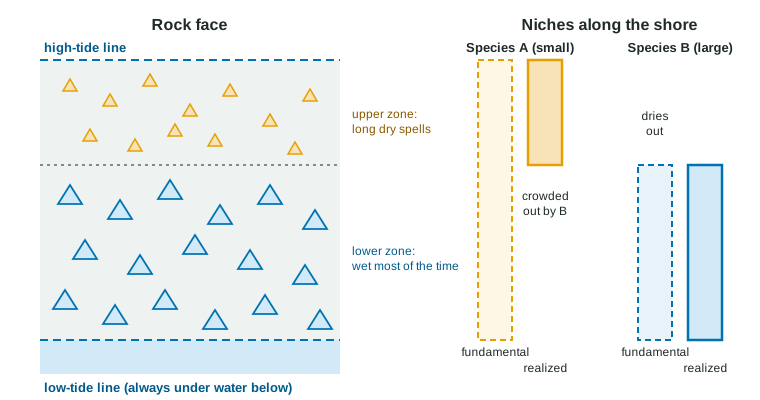
Part 5 · Step by step
How it works, step by step
- Species in a community affect each other's survival and reproduction.Each interaction can be scored for each partner: competition −/−, predation, herbivory and parasitism +/−, mutualism +/+, commensalism +/0.
- Two species use the same limiting resource.The species that uses it more efficiently grows faster, and the other declines: competitive exclusion.
- Competing species use different parts of a resource, such as different foods, heights or times of day.Each lives in a smaller realized niche, competition eases, and both can coexist (resource partitioning).
- Predators catch the prey that are easiest to find or eat.Prey with camouflage, toxins, warning colors or mimicry survive and reproduce more, so prey defenses spread.
- The number of top predators changes.Their prey change in the opposite direction, and the prey's food changes in the opposite direction again: a trophic cascade.
- All these interactions together decide which species live in a community and how many of each.Community structure is described by species richness, relative abundance and an index such as Simpson's diversity index.
Part 6 · Key ideas
Key ideas
- Species richness counts species; relative abundance is each species' share of all individuals. Species diversity combines both, and Simpson's diversity index measures it (0 = one species; near 1 = many, evenly common).
- Interspecific competition (−/−) shrinks a species' fundamental niche to a realized niche. Species with identical needs cannot coexist (competitive exclusion); resource partitioning lets similar species share.
- Predation and herbivory (+/−) shape prey numbers and favor prey defenses: camouflage, toxins, warning coloration, Batesian and Müllerian mimicry.
- Symbioses: mutualism +/+, commensalism +/0, parasitism +/−.
- A trophic cascade passes a change at the top of a food web down through each level (top-down control); nutrients and producers set limits from below (bottom-up control).
Part 7 · Misconception
A common mistake
The wrong idea: Two species can share exactly the same niche forever as long as there is enough food for both at first.
What actually happens: When they need the same limiting resource, the species that uses it a little more efficiently keeps gaining, and the other declines. Coexistence needs some difference in how they use resources.
Part 8 · Check yourself
Check yourself
Exam-style questions. Anything you miss goes into your review queue.
Data table
Ground beetles caught in two woodlands
Students set 20 pitfall traps (cups sunk level with the soil) in each of two woodlands for the same 7 days in June and identified every ground beetle caught. Woodland X is an old mixed forest; woodland Y is a young plantation of one tree species. The last row gives Simpson's diversity index, D, calculated from the counts.
| Beetle species | Woodland X | Woodland Y |
|---|---|---|
| 1 | 40 | 120 |
| 2 | 35 | 10 |
| 3 | 30 | 8 |
| 4 | 25 | 6 |
| 5 | 20 | 5 |
| 6 | 10 | 4 |
| 7 | 0 | 4 |
| 8 | 0 | 3 |
| Total | 160 | 160 |
| Simpson's D | 0.81 | 0.43 |
1. Which statement correctly compares the two woodlands?
- Woodland X has more species, and its beetles are spread more evenly among them.
- Woodland Y has more species, but most of its beetles belong to a single species.
- Both have the same richness, because the same total number of beetles was caught.
- Woodland Y has more species and a more even spread, so it has the larger D.
Show the answer
Woodland Y has 8 species to X's 6, but species 1 makes up 120 of its 160 beetles; X's catch is spread fairly evenly.
- Woodland X has more species, and its beetles are spread more evenly among them.: X has 6 species and Y has 8, so Y is richer.
- Correct: Woodland Y has more species, but most of its beetles belong to a single species.: Correct: higher richness, low evenness.
- Both have the same richness, because the same total number of beetles was caught.: Richness is the number of species (6 and 8), not the number of individuals.
- Woodland Y has more species and a more even spread, so it has the larger D.: Y is richer but far less even, and its D (0.43) is lower than X's (0.81).
2. A student claims woodland Y has the more diverse beetle community because more species were found there. Which response is best supported by the data?
- The claim is supported: richness is the measure of diversity, and Y has two more species than X.
- The claim is supported, because a D of 0.43 shows Y has about half as many rare species as X.
- The claim is impossible to judge, because the two woodlands contain different species of tree.
- The claim is not supported: Y's D (0.43) is lower than X's (0.81), because one species dominates Y.
Show the answer
Diversity combines richness and evenness. In Y, two beetles picked at random are often both species 1, so D is low; X, with fewer species spread more evenly, is more diverse.
- The claim is supported: richness is the measure of diversity, and Y has two more species than X.: Richness is only one part of diversity; evenness matters too.
- The claim is supported, because a D of 0.43 shows Y has about half as many rare species as X.: D is a probability that two random beetles differ in species; it does not count rare species.
- The claim is impossible to judge, because the two woodlands contain different species of tree.: The question asks about the beetle data, which were collected the same way in both woodlands.
- Correct: The claim is not supported: Y's D (0.43) is lower than X's (0.81), because one species dominates Y.: Correct: the index reflects evenness as well as richness.
Graph
Two Paramecium species grown alone and together
Two species of the single-celled Paramecium, A and B, both eat the same bacteria. A student grew each species alone in tubes of culture medium with a daily ration of bacteria, and grew them together in the same kind of tubes with the same ration. Points are means of five tubes.
A aloneB aloneA grown with BB grown with A
Data table
| Time (days) | A alone | B alone | A grown with B | B grown with A |
|---|---|---|---|---|
| 0 | 5 | 5 | 5 | 5 |
| 2 | 25 | 20 | 22 | 18 |
| 4 | 110 | 75 | 92 | 55 |
| 6 | 280 | 170 | 220 | 80 |
| 8 | 380 | 230 | 300 | 70 |
| 10 | 400 | 248 | 335 | 52 |
| 12 | 405 | 252 | 350 | 35 |
| 14 | 398 | 250 | 360 | 22 |
| 16 | 402 | 249 | 368 | 12 |
| 18 | 400 | 251 | 372 | 7 |
| 20 | 399 | 250 | 375 | 4 |
3. Which statement best describes the results?
- Alone, each species levels off at a steady density; together, A levels off a little lower and B rises at first, then declines toward zero.
- Alone, each species levels off at a steady density; together, both species level off at about half their densities when alone.
- Alone, each species keeps growing to day 20; together, B outgrows A after day 8 and A declines to a low but steady density.
- Alone and together, A reaches about 400 cells per mL, while B reaches about 250 cells per mL in each of the tubes.
Show the answer
Alone, A plateaus near 400 and B near 250 cells per mL. Together, A reaches about 375 while B peaks at 80 on day 6 and falls to 4 by day 20.
- Correct: Alone, each species levels off at a steady density; together, A levels off a little lower and B rises at first, then declines toward zero.: Correct: A persists slightly reduced; B is excluded.
- Alone, each species levels off at a steady density; together, both species level off at about half their densities when alone.: A together reaches 375, close to its 400 alone; B falls to 4, not to half of 250.
- Alone, each species keeps growing to day 20; together, B outgrows A after day 8 and A declines to a low but steady density.: Both level off by about day 10 when alone; together it is B that declines.
- Alone and together, A reaches about 400 cells per mL, while B reaches about 250 cells per mL in each of the tubes.: B grown with A falls to 4 cells per mL, far below 250.
4. Which explanation best accounts for the decline of species B when grown with A?
- Species A eats species B, so B is killed faster than it can divide in the shared tubes.
- Both eat the same limited bacteria, and A takes them more efficiently, so B cannot keep pace.
- Species B needs a different food from A, and the tubes contained less of B's food.
- Species B is harmed by the wastes of A alone, since the two species use different resources.
Show the answer
This is competitive exclusion: two species with the same limiting resource cannot coexist for long; the more efficient competitor, A, keeps the bacteria too scarce for B.
- Species A eats species B, so B is killed faster than it can divide in the shared tubes.: Both species eat bacteria; nothing indicates that A eats B.
- Correct: Both eat the same limited bacteria, and A takes them more efficiently, so B cannot keep pace.: Correct: interspecific competition for one limiting resource.
- Species B needs a different food from A, and the tubes contained less of B's food.: The setup says both eat the same bacteria, with the same ration in every tube.
- Species B is harmed by the wastes of A alone, since the two species use different resources.: The setup states they share the same food, which explains the result without any special waste effect.
5. Select each example of commensalism.
- Cattle egrets catch insects that grazing cattle stir up; the cattle are not affected.
- A tapeworm absorbs digested food in a dog's intestine, and the dog loses weight.
- Bees collect nectar from flowers and carry pollen between them.
- Two warbler species feed on insects at different heights in the same tree.
- A lion kills and eats a zebra.
Show the answer
Only the egrets gain while their partner is neither helped nor harmed (+/0).
- Correct: Cattle egrets catch insects that grazing cattle stir up; the cattle are not affected.: Commensalism: egret +, cattle 0.
- A tapeworm absorbs digested food in a dog's intestine, and the dog loses weight.: Parasitism: tapeworm +, dog −.
- Bees collect nectar from flowers and carry pollen between them.: Mutualism: bee + (food), flower + (pollination).
- Two warbler species feed on insects at different heights in the same tree.: Resource partitioning between competitors, not a +/0 symbiosis.
- A lion kills and eats a zebra.: Predation: lion +, zebra −.
6. In a lake, bass eat minnows, minnows eat zooplankton, and zooplankton eat phytoplankton. All the bass are removed. Predict each quantity a year later.
| Variable | Change |
|---|---|
| Number of minnows | — |
| Number of zooplankton | — |
| Amount of phytoplankton | — |
| Phosphate carried into the lake by streams each year | — |
Show the answer
Removing the top predator sets off a trophic cascade: each level below changes in the opposite direction to the level above it. Inputs from outside the food web are unaffected.
- Number of minnows: increases. Their main predator is gone, so more minnows survive and breed.
- Number of zooplankton: decreases. More minnows eat more zooplankton.
- Amount of phytoplankton: increases. Fewer zooplankton graze on the algae, so the algae grow faster than they are eaten.
- Phosphate carried into the lake by streams each year: no change. The streams' phosphate comes from the land around the lake; removing fish does not change it.
7. Two butterfly species that both taste bad to birds have evolved almost the same orange-and-black wing pattern. Why does sharing the pattern benefit both species?
- Birds learn to avoid the pattern after fewer attacks, so fewer butterflies of each species are eaten while birds learn.
- One species can stop making its bad-tasting chemicals, saving energy, because birds avoid the shared pattern.
- The two species can now interbreed, which combines their toxins in hybrid offspring and makes both more toxic.
- Birds confuse the two species, so they eat whichever species tastes less bad and leave the more toxic one alone.
Show the answer
This is Müllerian mimicry. Each bird must sample some butterflies to learn the pattern; when two species share it, that cost is split between them.
- Correct: Birds learn to avoid the pattern after fewer attacks, so fewer butterflies of each species are eaten while birds learn.: Correct: shared learning cost among harmful species.
- One species can stop making its bad-tasting chemicals, saving energy, because birds avoid the shared pattern.: A species that stopped being toxic would be a Batesian mimic; the benefit to both comes from shared learning.
- The two species can now interbreed, which combines their toxins in hybrid offspring and makes both more toxic.: Different species generally do not interbreed, and similar patterns do not require it.
- Birds confuse the two species, so they eat whichever species tastes less bad and leave the more toxic one alone.: Both species taste bad; the shared pattern protects both rather than steering birds to one.
8. On a rocky shore, small barnacles of species A live only high on the rocks and large barnacles of species B live lower down. When B is scraped off the lower rocks, A settles there and survives well. Which conclusion is supported?
- A's realized niche is larger than its fundamental niche.
- A dies when kept under water for long periods.
- B's fundamental niche includes the high rocks.
- Competition with B restricts A's realized niche.
Show the answer
A can live lower down (its fundamental niche includes the lower rocks) but does so only when B is absent, so B's competition shrinks A's realized niche.
- A's realized niche is larger than its fundamental niche.: The realized niche can only be the same as or smaller than the fundamental niche.
- A dies when kept under water for long periods.: A survives well on the lower rocks once B is removed.
- B's fundamental niche includes the high rocks.: The experiment tests A on the lower rocks; it says nothing about B on the high rocks.
- Correct: Competition with B restricts A's realized niche.: Correct: removing the competitor reveals more of A's fundamental niche.
Part 9 · Summary
Summary
A community's structure is which species it contains and how many of each. Species richness counts the species; relative abundance gives each species' share of individuals; species diversity combines the two, and Simpson's diversity index measures it, from 0 for one species toward 1 for many evenly common ones. Interactions shape the structure. Interspecific competition harms both species and shrinks each species' fundamental niche to a smaller realized niche; species with identical needs cannot coexist (competitive exclusion), but resource partitioning lets similar species share. Predation and herbivory benefit one species and harm the other, and they favor prey defenses such as camouflage, warning coloration and mimicry. Symbioses range from mutualism (+/+) through commensalism (+/0) to parasitism (+/−). A change in a top predator can pass down a food web in a trophic cascade, alternately raising and lowering each level below: top-down control, as opposed to bottom-up control by nutrients and producers.
Part 10 · Up next
What comes next
Part 11 · Connections