Artificial Selection
In artificial selection, humans choose which individuals breed according to traits they want, so those traits become more common or more extreme over generations.
Part 1 · Hook
Why this matters
A Chihuahua and a Great Dane can differ in weight about thirty times over, yet both descend from wolves, and both belong to one species. In 1959 a Russian scientist began a test of how such changes start: each generation, he let only the calmest silver foxes breed. Within about ten generations some fox pups wagged their tails and ran to greet people, and later generations began to show floppy ears and patchy coats that nobody had chosen. Humans had taken the place of the environment in deciding who reproduces.
Part 2 · Before you start
What this builds on
Part 3 · Prerequisite check
Quick check before you start
1. For natural selection to change a trait over generations, the variation in that trait must be
- at least partly heritable
- caused by the environment alone
- present in only one individual
Show the answer
If offspring do not inherit the parents' version of the trait, selection on the parents does not change the next generation.
- Correct: at least partly heritable:
- caused by the environment alone:
- present in only one individual:
2. Bacteria can gain a gene from another bacterium through
- conjugation, transformation or transduction
- meiosis and fertilization
- mitosis
Show the answer
These forms of horizontal gene transfer move DNA, often on plasmids, between bacterial cells.
- Correct: conjugation, transformation or transduction:
- meiosis and fertilization:
- mitosis:
3. Directional selection on a trait with many values
- shifts the mean toward one extreme
- favors the middle and narrows variation
- splits the population into two peaks
Show the answer
Directional selection favors one end of the range, so the average moves that way over generations.
- Correct: shifts the mean toward one extreme:
- favors the middle and narrows variation:
- splits the population into two peaks:
Part 4 · See it
See it first
Part 5 · Step by step
How it works, step by step
- A population varies in a heritable trait, such as tameness in foxes or oil content in corn kernels.Breeders can tell individuals apart and pick out those with the most of the trait they want.
- Breeders let only the chosen individuals reproduce.Only the chosen individuals' alleles reach the next generation, so the trait is more common, or more extreme, in their offspring.
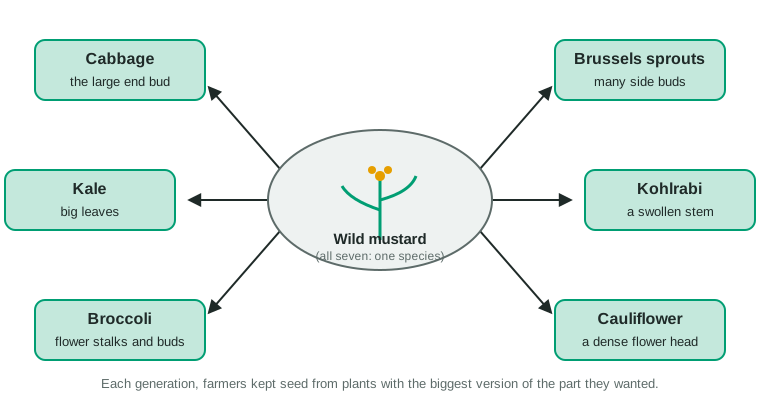
- The same choice is repeated generation after generation.Large changes build up, as in dog breeds, corn and the cabbage family, until little heritable variation in the trait remains.
- People also change the environment without meaning to select, for example by using antibiotics or by removing the largest fish.Individuals that happen to carry alleles for surviving the change, such as resistant bacteria, leave more offspring: unintended selection.
- An antibiotic kills susceptible bacteria and leaves resistant cells to multiply.The infection becomes mostly resistant, and the drug stops working against it.
Part 6 · Key ideas
Key ideas
- In artificial selection (selective breeding), humans decide which individuals reproduce; in natural selection, the environment does. Both act on heritable variation and change populations over generations.
- Domestication through artificial selection gave dogs from wolves, corn from teosinte and six crops from one wild mustard. It can only use the variation that exists, and traits can change together when the same genes affect them.
- Antibiotic resistance is unintended selection: random mutations or transferred genes make a few cells resistant, the drug kills the rest, and the survivors multiply. MRSA is an example.
- Other unintended selection: fishing that removes large fish favors fish that mature small and young; poaching for ivory favors elephants born without tusks.
Part 7 · Misconception
A common mistake
The wrong idea: Antibiotics make bacteria mutate into resistant forms.
What actually happens: Resistance alleles arise at random, by mutation or by gene transfer, often before the drug is ever used. The antibiotic does not create them; it kills the susceptible cells, so the few resistant cells survive and multiply.
Part 8 · Check yourself
Check yourself
Exam-style questions. Anything you miss goes into your review queue.
Graph
Selecting corn for high and low oil content
In a long-running breeding experiment, researchers started two lines from the same variety of corn, whose kernels averaged 4.7% oil. Every generation they measured the oil content of the kernels on many ears. In the high line they planted only kernels from the 12 ears with the most oil; in the low line, only kernels from the 12 ears with the least. All plants were grown in the same fields. The graph shows the mean oil content of each line every 10 generations (values rounded).
High-oil lineLow-oil line
Data table
| Generation | High-oil line | Low-oil line |
|---|---|---|
| 0 | 4.7 | 4.7 |
| 10 | 7 | 2.9 |
| 20 | 9 | 2.2 |
| 30 | 10.6 | 1.8 |
| 40 | 12 | 1.5 |
| 50 | 13.4 | 1.3 |
| 60 | 14.6 | 1.1 |
| 70 | 16 | 1 |
| 80 | 17.2 | 0.9 |
| 90 | 18.6 | 0.8 |
| 100 | 19.8 | 0.8 |
1. Which statement best describes the results?
- The high line rose steadily, by about 15 percentage points; the low line fell fast, then leveled off.
- Both lines changed at a steady rate, so the low line will reach 0% oil within a few more generations.
- Both lines changed quickly at first and then stopped changing after about 30 generations.
- The high line leveled off after 50 generations, while the low line kept falling at an even rate to the end.
Show the answer
High: 4.7% to 19.8% with nearly equal steps each 10 generations. Low: 4.7% to 1.8% in the first 30 generations, then only to 0.8% over the next 70.
- Correct: The high line rose steadily, by about 15 percentage points; the low line fell fast, then leveled off.: Correct: a steady rise in one line, a fast fall that flattens in the other.
- Both lines changed at a steady rate, so the low line will reach 0% oil within a few more generations.: The low line slowed sharply after 30 generations, so it is not falling at a steady rate toward 0%.
- Both lines changed quickly at first and then stopped changing after about 30 generations.: The high line kept rising by more than 1 percentage point every 10 generations through generation 100.
- The high line leveled off after 50 generations, while the low line kept falling at an even rate to the end.: This reverses the two lines: the high line kept rising, and the low line leveled off.
2. Which explanation best accounts for the high line still responding after 100 generations?
- Oil content depends on many genes, so heritable variation remained for each round of selection.
- Each generation the plants made more oil because they were grown in fields that suited high-oil corn.
- The plants in the high line learned to store more oil, and passed what they learned to their kernels.
- Choosing the 12 best ears each generation caused fresh mutations for high oil content in their kernels.
Show the answer
A polygenic trait has many alleles that each add a little. Each round of selection makes some of them more common, but plenty of heritable variation is left (and mutation adds a little), so the next round can still move the mean.
- Correct: Oil content depends on many genes, so heritable variation remained for each round of selection.: Correct: continued response needs continued heritable variation.
- Each generation the plants made more oil because they were grown in fields that suited high-oil corn.: Both lines grew in the same fields, so the fields cannot explain why only one line rose.
- The plants in the high line learned to store more oil, and passed what they learned to their kernels.: Plants do not learn, and changes in an individual are not inherited; the line changed because of which plants bred.
- Choosing the 12 best ears each generation caused fresh mutations for high oil content in their kernels.: Choosing parents does not cause mutations; it changes which existing alleles are passed on.
3. Which explanation best accounts for the leveling off of the low-oil line?
- Kernels need some oil to grow, and most low-line plants already carried low-oil alleles, leaving little variation.
- The breeders lost interest in the low line and stopped choosing the ears with the least oil after generation 30.
- Corn has no alleles for less oil than the starting variety held, so the low line could not drop below 4.7%.
- The low line was too small a population for selection to work, while the high line was a large one.
Show the answer
Kernels with almost no oil grow poorly, which limits how far the line can go, and once nearly every plant carries the low-oil alleles, there is little heritable variation for further selection to act on.
- Correct: Kernels need some oil to grow, and most low-line plants already carried low-oil alleles, leaving little variation.: Correct: a physical limit plus used-up variation slows the response.
- The breeders lost interest in the low line and stopped choosing the ears with the least oil after generation 30.: The method was the same for both lines every generation, as the stimulus states.
- Corn has no alleles for less oil than the starting variety held, so the low line could not drop below 4.7%.: The low line did fall far below 4.7%, to 0.8%, so the starting variety did hold alleles for less oil.
- The low line was too small a population for selection to work, while the high line was a large one.: Both lines were run the same way with the same number of selected ears.
Experimental setup
Bacteria grown with a rising antibiotic dose
Researchers started six flasks from a single culture of E. coli that had never met antibiotics. Three flasks (treated) received a low dose of an antibiotic, and the dose was doubled every three days. Three flasks (untreated) received none. Every day, 1% of each culture was moved into a fresh flask of the same medium. Every six days the researchers measured the MIC, the lowest antibiotic concentration that stops a sample of the culture from growing.
| Day | Treated flask 1 | Treated flask 2 | Treated flask 3 | Untreated flasks (all three) |
|---|---|---|---|---|
| 0 | 2 | 2 | 2 | 2 |
| 6 | 8 | 4 | 8 | 2 |
| 12 | 32 | 16 | 32 | 2 |
| 18 | 64 | 128 | 128 | 2 |
| 24 | 256 | 512 | 128 | 2 |
4. Which explanation best accounts for the step-by-step rise in MIC in the treated flasks?
- Cells whose random mutations raised resistance survived each higher dose and multiplied, again and again.
- The antibiotic damaged DNA in a way that changed the drug's target, so the cells that it reached became resistant to it.
- Each cell gradually got used to the antibiotic, and its tolerance was passed on when it divided.
- The rising dose broke the antibiotic down faster, so later doses had less effect on the cells.
Show the answer
Resistance mutations arise at random in a huge population. Each dose kills the less resistant cells, so the more resistant ones take over; later random mutations in those survivors can raise resistance again, giving a rise in steps.
- Correct: Cells whose random mutations raised resistance survived each higher dose and multiplied, again and again.: Correct: random variation plus repeated selection by the drug.
- The antibiotic damaged DNA in a way that changed the drug's target, so the cells that it reached became resistant to it.: Mutations are not directed at the drug's target by the drug; resistant variants are random, and the drug removes the others.
- Each cell gradually got used to the antibiotic, and its tolerance was passed on when it divided.: Tolerance gained by one cell during its life is not what changes the MIC; resistant mutants replace susceptible cells.
- The rising dose broke the antibiotic down faster, so later doses had less effect on the cells.: The MIC is measured on fresh samples with a set concentration, so it reflects the cells, not breakdown of the dose.
5. The three treated flasks were handled identically, yet on day 24 their MICs were 256, 512 and 128 µg/mL. Which explanation best fits this?
- Resistance mutations arise at random, so each flask gained different mutations at different times.
- The flasks probably received different doses, since identical handling should give identical results.
- Flask 2 started with more resistant cells, because it was taken from the top of the starting culture.
- Bacteria in flask 3 were less able to sense the antibiotic, so fewer of them changed.
Show the answer
Which resistance mutations appear, and when, is a matter of chance. Flasks started alike can follow different paths, which is evidence that the mutations were not directed by the drug.
- Correct: Resistance mutations arise at random, so each flask gained different mutations at different times.: Correct: random mutation makes replicate populations differ.
- The flasks probably received different doses, since identical handling should give identical results.: The doses were the same; differences between replicates are expected when mutations arise by chance.
- Flask 2 started with more resistant cells, because it was taken from the top of the starting culture.: All flasks had the same MIC on day 0, so there is no evidence that flask 2 started different.
- Bacteria in flask 3 were less able to sense the antibiotic, so fewer of them changed.: Bacteria do not change in response to sensing a drug; random mutants are selected.
6. What is the main difference between artificial selection and natural selection?
- In artificial selection people decide which individuals breed; in natural selection the environment does.
- Artificial selection acts on heritable variation; natural selection acts on traits gained during life.
- Artificial selection creates alleles; natural selection acts on alleles that already exist.
- Artificial selection changes individuals directly; natural selection changes populations over generations.
Show the answer
Both change populations over generations by acting on heritable variation. The difference is the agent: human choice or the environment.
- Correct: In artificial selection people decide which individuals breed; in natural selection the environment does.: Correct: the difference is who or what does the choosing.
- Artificial selection acts on heritable variation; natural selection acts on traits gained during life.: Both act on heritable variation; traits gained during life are not inherited in either.
- Artificial selection creates alleles; natural selection acts on alleles that already exist.: Neither creates alleles; mutation does. Both select among existing variants.
- Artificial selection changes individuals directly; natural selection changes populations over generations.: Both change populations, not individuals.
7. A patient says, "The antibiotic made the bacteria in my infection mutate so they could resist it." Which response is most accurate?
- Resistant cells were likely present by chance before treatment; the drug killed the rest, so they multiplied.
- That is right: bacteria change their DNA in response to a drug, which is why resistance appears so quickly.
- That is right for bacteria but not for animals, because bacteria can change their genes when they need to.
- Resistance comes from the patient's immune system getting used to the antibiotic, not from the bacteria.
Show the answer
Resistance alleles arise by random mutation or gene transfer. The antibiotic is the selective pressure: it removes susceptible cells, so the resistant ones take over.
- Correct: Resistant cells were likely present by chance before treatment; the drug killed the rest, so they multiplied.: Correct: the drug selects; it does not create resistance.
- That is right: bacteria change their DNA in response to a drug, which is why resistance appears so quickly.: Bacteria do not mutate on demand; mutations arise at random.
- That is right for bacteria but not for animals, because bacteria can change their genes when they need to.: No organism changes its alleles because it needs to; bacteria evolve fast because of their numbers and short generations.
- Resistance comes from the patient's immune system getting used to the antibiotic, not from the bacteria.: Resistance is a property of the bacteria, measured by their survival at a given drug concentration.
8. An infection contains 4 × 10⁸ bacteria, of which 1 cell in 10⁶ is resistant to a drug. One day of treatment kills 99.9% of susceptible cells and no resistant cells. What percentage of the surviving cells is resistant? Give your answer to one decimal place.
Type a number in %.
Show the answer
Resistant: 4 × 10⁸ ÷ 10⁶ = 400 cells. Susceptible survivors: 0.1% of about 4 × 10⁸ = 4 × 10⁵ = 400,000 cells. Resistant share = 400 ÷ (400 + 400,000) × 100 = 0.0999% ≈ 0.1%, up from 0.0001% before treatment: a thousand-fold enrichment in one day.
- Answer: 0.1 %
Part 9 · Summary
Summary
In artificial selection, humans choose which individuals breed according to traits they want, so those traits become more common or more extreme over generations. It needs heritable variation, just as natural selection does, and has produced domesticated animals and crops: dogs from wolves, corn from teosinte, and cabbage, kale, broccoli and other crops from one wild mustard. Selection on one trait can change others controlled by the same genes, and progress slows as heritable variation is used up. Human activity also causes unintended selection. Antibiotics kill susceptible bacteria and leave cells that carry resistance alleles, from random mutation or gene transfer, to multiply, so infections become resistant. Heavy fishing of large fish and poaching for ivory have selected for fish that mature small and elephants without tusks.
Part 10 · Up next
What comes next
Part 11 · Connections