The thoracic cage
1Why this matters
Mrs. Lee, 68, collapses at a bus stop and is not breathing. A bystander kneels, puts the heel of one hand on the lower half of her breastbone, and pushes hard and fast. With each push, the front of her chest sinks about 5 cm and then springs back. Her rib cage can do that because its front ends are cartilage, not bone. Knowing its parts tells you where to push and what can break.
2What this builds on
3Quick check before you start
1. What kind of cartilage is flexible and smooth, and covers the ends of bones?
- Hyaline cartilage
- Fibrocartilage
- Elastic cartilage
Show the answer
Hyaline cartilage is smooth and bends slightly, and it covers bone ends. The costal cartilages of the ribs are made of it too. Fibrocartilage forms the intervertebral discs, and elastic cartilage shapes the outer ear.
- Correct: Hyaline cartilage:
- Fibrocartilage:
- Elastic cartilage:
2. How many thoracic vertebrae does an adult have?
- 7
- 12
- 5
Show the answer
There are 12 thoracic vertebrae, T1 to T12, one for each pair of ribs. There are 7 cervical and 5 lumbar vertebrae.
- 7:
- Correct: 12:
- 5:
3. Which vertebrae carry costal facets?
- Cervical
- Thoracic
- Lumbar
Show the answer
Thoracic vertebrae have costal facets, the smooth pits where the ribs meet them. Cervical vertebrae have transverse foramina instead, and lumbar vertebrae have neither.
- Cervical:
- Correct: Thoracic:
- Lumbar:
4Anatomy
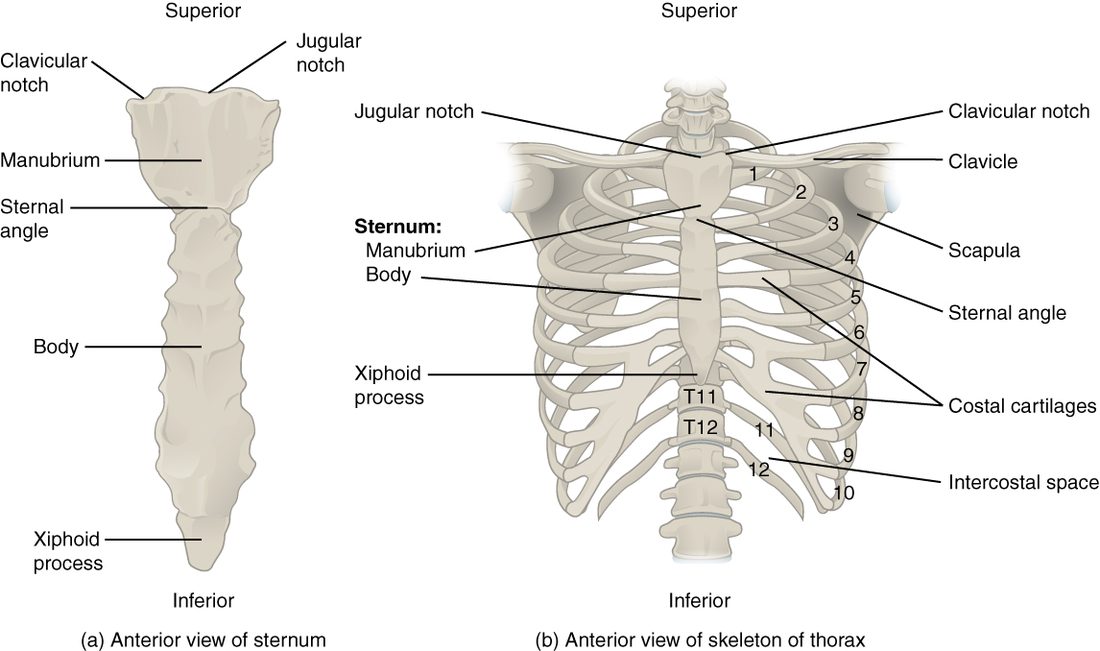
With labels hidden, select a box to reveal its label.
5How it works, step by step
- Each rib's head, and in most ribs its tubercle, meets the thoracic vertebrae at the back.The rib can swing up and down, hinged at its back end.
- At the front, each rib continues as a costal cartilage of hyaline cartilage, joined to the sternum directly or through the cartilage above.The front of the cage can bend and twist instead of being held rigid.
- When muscles lift the ribs, their curved bodies swing outward and the sternum moves forward.The cage widens from side to side and from front to back.
- When the force stops, the bent costal cartilages spring back to their resting shape.The cage returns to its resting size, which is also what lets the chest recoil after each CPR compression.
6Core concepts
7A common mistake
The wrong idea: Floating ribs are loose ribs that are not attached to anything.
What actually happens: Floating ribs (11 and 12) are attached at the back, where their heads meet the vertebrae, just like every other rib. What they lack is a front attachment: their short cartilages end in the muscles of the abdominal wall instead of reaching the sternum. "Floating" describes only the front end.
8Check yourself
Anything you miss goes into your review queue.
1. Name the pinned part of the sternum.
- Body of the sternum
- Manubrium
- Xiphoid process
- Costal cartilage
Show the answer
The manubrium is the wide top piece of the sternum. The first ribs and the collarbones attach to it.
- Body of the sternum: The body is the long middle piece below the manubrium.
- Correct: Manubrium: Correct. The wide top piece is the manubrium.
- Xiphoid process: The xiphoid process is the small tip at the bottom.
- Costal cartilage: Costal cartilages are the bars of cartilage at the front ends of the ribs, not part of the sternum.
2. Name the pinned landmark on the sternum.
- Jugular notch
- Costal margin
- Sternal angle
- Clavicular notch
Show the answer
The sternal angle is the ridge where the manubrium meets the body. The second rib's cartilage attaches at this level.
- Jugular notch: The jugular notch is the dip in the top edge of the manubrium.
- Costal margin: The costal margin is the lower edge of the cage, formed by the joined cartilages of the lower ribs.
- Correct: Sternal angle: Correct. The ridge between manubrium and body is the sternal angle.
- Clavicular notch: The clavicular notches are at the upper corners of the manubrium, where the collarbones meet it.
3. Which ribs are the true ribs?
- Ribs 1 to 5
- Ribs 1 to 7
- Ribs 1 to 10
- Ribs 8 to 12
Show the answer
Ribs 1 to 7 are true ribs: each one's own costal cartilage reaches the sternum directly.
- Ribs 1 to 5: Ribs 6 and 7 also reach the sternum by their own cartilage, so the true ribs run to 7.
- Correct: Ribs 1 to 7: Correct. The true ribs are ribs 1 to 7.
- Ribs 1 to 10: Ribs 8 to 10 reach the sternum only through the cartilage of the rib above, so they are false ribs.
- Ribs 8 to 12: Ribs 8 to 12 are the false ribs.
4. What makes ribs 11 and 12 floating ribs?
- They have no attachment to the vertebrae
- They have no costal cartilage at all
- They have no attachment at the front
- They attach to the xiphoid process
Show the answer
The floating ribs, 11 and 12, meet the vertebrae at the back but have no front attachment. Their short cartilages end in the muscles of the abdominal wall.
- They have no attachment to the vertebrae: Every rib, floating ribs included, meets the vertebrae at the back.
- They have no costal cartilage at all: They do have short cartilage tips; what they lack is a front attachment.
- Correct: They have no attachment at the front: Correct. Floating ribs have no front attachment.
- They attach to the xiphoid process: No ribs attach to the xiphoid process.
5. A nurse needs to find a patient's third rib. She cannot feel the first rib under the collarbone. Where should she start counting?
- At the jugular notch
- At the sternal angle
- At the xiphoid process
- At the costal margin
Show the answer
The sternal angle, the ridge where the manubrium meets the body, is level with the cartilage of the second rib. From there she slides sideways onto rib 2 and counts down one rib to rib 3.
- At the jugular notch: The jugular notch is the dip at the top of the manubrium, above the level of the first rib, and no rib attaches there.
- Correct: At the sternal angle: Correct. The sternal angle marks the second rib.
- At the xiphoid process: The xiphoid process has no rib attached, and the seventh rib's cartilage beside it is hard to pick out, so counting from there is unreliable.
- At the costal margin: The costal margin is formed by the joined cartilages of ribs 7 to 10, so it does not mark a single rib to count from.
6. Fluid must be drained from a patient's pleural cavity with a needle passed between two ribs. Why is the needle placed just above the upper edge of the lower rib?
- Costal cartilage is thinnest at the upper edge of each rib
- A nerve, artery and vein run along the lower edge of each rib
- The tubercle of each rib points upward into the space
- The upper edge of each rib has the most sensory nerve endings
Show the answer
Each rib has a costal groove along the lower edge of its inner surface, where a nerve, an artery and a vein run. Passing the needle just over the top of the lower rib keeps it away from the groove of the rib above.
- Costal cartilage is thinnest at the upper edge of each rib: Costal cartilage is at the front ends of the ribs, not along their edges, and its thickness is not what decides the site.
- Correct: A nerve, artery and vein run along the lower edge of each rib: Correct. The costal groove shelters a nerve and vessels under each rib.
- The tubercle of each rib points upward into the space: The tubercle is at the back, near the vertebra, not in the space between ribs at the side of the chest.
- The upper edge of each rib has the most sensory nerve endings: Sensory endings are not concentrated at the upper edge; the danger is the nerve and vessels running along the lower edge.
7. Order the parts of a typical rib from its back end to its front end.
- Head
- Neck
- Tubercle
- Angle
- Body
- Costal cartilage
Show the answer
From back to front: the head meets two vertebral bodies, the neck is the narrow part beyond it, the tubercle meets the transverse process, the angle is the sharp bend, the body curves forward, and the costal cartilage continues it to the front.
- Correct order: 1. Head 2. Neck 3. Tubercle 4. Angle 5. Body 6. Costal cartilage
9Summary
The thoracic cage is the 12 thoracic vertebrae, 12 pairs of ribs with their costal cartilages, and the sternum. The sternum has a manubrium, a body and a xiphoid process; the jugular notch is at its top, and the sternal angle marks the second rib, which is how ribs are counted. A typical rib has a head that meets two vertebral bodies, a neck, a tubercle that meets a transverse process, an angle, a body and a costal groove that shelters a nerve and vessels. Ribs 1 to 7 are true ribs, 8 to 12 are false ribs, and 11 and 12 are floating ribs with no front attachment. The costal cartilages make the cage flexible.