Hair, nails and skin glands
1Why this matters
Grace, 29, calls her doctor in a panic. Three months after giving birth, her hair is coming out in handfuls in the shower. Her scalp looks healthy and she has no bald patches. Her doctor tells her the hair will grow back, and it does. To see why the loss came months after the birth, and why it was temporary, you need to know how a hair follicle grows, rests and sheds.
2What this builds on
3Quick check before you start
1. In which layer of the epidermis do cells divide to make new keratinocytes?
- Stratum corneum
- Stratum basale
- Stratum granulosum
Show the answer
Basal cells in the stratum basale divide throughout life. Hair and nails grow from matrix cells that work the same way.
- Stratum corneum:
- Correct: Stratum basale:
- Stratum granulosum:
2. In which mode of secretion does the whole cell burst and become the product?
- Merocrine
- Apocrine
- Holocrine
Show the answer
In holocrine secretion a cell fills with product and breaks apart, so the gland needs new cells from dividing stem cells. The skin's oil glands work this way.
- Merocrine:
- Apocrine:
- Correct: Holocrine:
3. Which type of muscle tissue is involuntary and has no striations?
- Smooth muscle
- Skeletal muscle
- Cardiac muscle
Show the answer
Smooth muscle has no striations and contracts without conscious control. The tiny muscle that raises each hair is smooth muscle.
- Correct: Smooth muscle:
- Skeletal muscle:
- Cardiac muscle:
4Anatomy
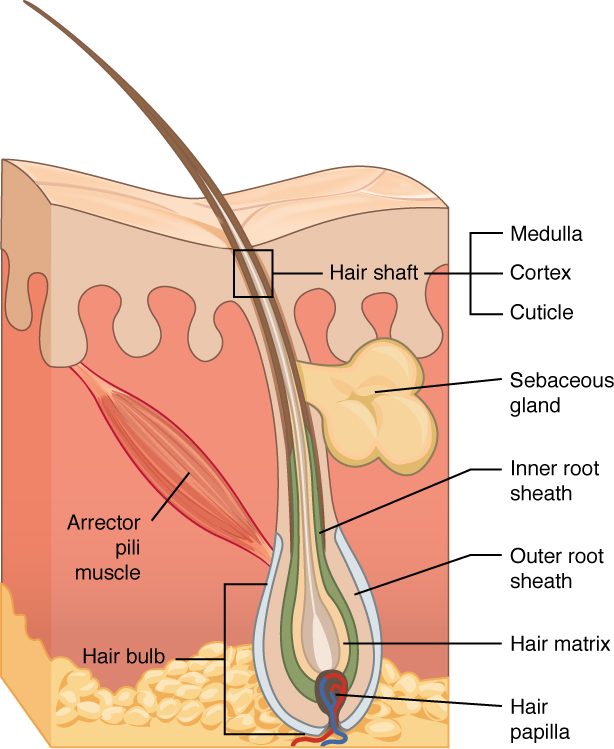
With labels hidden, select a box to reveal its label.
5How it works, step by step
- During pregnancy, high hormone levels keep many scalp follicles in anagen longer than usual; after the birth those levels fall abruptly.The held-over follicles switch into catagen at the same time.
- In catagen, the matrix stops dividing and the lower follicle shrinks.Each hair stops growing, and its base hardens into a club that stays anchored in the follicle.
- The follicles enter telogen together and rest for about three months.The club hairs stay in place, so no extra shedding is seen yet.
- The follicles start a new anagen together, and new hairs grow up beneath the club hairs.The club hairs are pushed out in large numbers about three months after the shock, and the new hairs replace them.
6Core concepts
7A common mistake
The wrong idea: Shaving makes hair grow back thicker, darker and faster.
What actually happens: Shaving cuts only the dead hair shaft at the skin surface. The living matrix sits deep in the hair bulb and is untouched, so the width, color and growth rate of the hair do not change. Regrowing hair feels coarse because its cut end is blunt instead of tapered, and short new hair has not yet been lightened by sun.
8Check yourself
Anything you miss goes into your review queue.
1. Name the pinned layer of dividing cells in the hair bulb.
- Hair papilla
- Hair matrix
- Inner root sheath
- Hair cortex
Show the answer
The hair matrix is the layer of rapidly dividing cells in the bulb, just above the papilla. Its new cells are pushed upward, fill with hard keratin and die, forming the hair.
- Hair papilla: The hair papilla is the knob of connective tissue with capillaries beneath the matrix. It supplies the matrix but does not make the hair.
- Correct: Hair matrix: Correct. The dividing cells that make the hair form the hair matrix.
- Inner root sheath: The inner root sheath lines the follicle around the hair; it is not the growing layer at the base.
- Hair cortex: The cortex is the middle layer of the hair itself, made of dead cells, not a layer of dividing cells in the bulb.
2. Grace, 29, notices large amounts of hair coming out when she brushes, about three months after giving birth. Her scalp looks normal. What best explains the timing?
- Childbirth destroyed many hair matrix cells, which cannot be replaced
- Her sebaceous glands stopped making sebum at delivery
- Her arrector pili muscles are pulling hairs out
- Follicles that rested together after the birth now shed together
Show the answer
During pregnancy, high hormone levels keep extra scalp follicles in anagen. After the birth those levels fall abruptly, and the held-over follicles enter catagen and telogen at the same time. Telogen lasts about 3 months; when those follicles start a new anagen, the new hairs push the old club hairs out together. The follicles are intact, so the hair regrows.
- Childbirth destroyed many hair matrix cells, which cannot be replaced: The matrix cells are not destroyed; the follicles are resting. The hair grows back once they re-enter anagen.
- Her sebaceous glands stopped making sebum at delivery: Sebum oils the hair but does not hold it in the follicle, and loss of sebum would not cause shedding three months later.
- Her arrector pili muscles are pulling hairs out: The arrector pili raises a hair by tilting it; it cannot pull hairs out.
- Correct: Follicles that rested together after the birth now shed together: Correct. Follicles pushed into the resting phase together shed together about three months later.
3. Which features describe apocrine sweat glands? Select all that apply.
- Their ducts empty into hair follicles
- They start working at puberty
- They are densest on the palms and soles
- Their secretion contains proteins and lipids
- They are the main glands that release heat through sweat
Show the answer
Apocrine sweat glands, in the armpits, groin and around the nipples, empty into hair follicles, start working at puberty, and make a thicker secretion with proteins and lipids that bacteria turn into body odor. Eccrine glands are the densest on palms and soles and the ones that release heat.
- Correct: Their ducts empty into hair follicles: Yes. Apocrine ducts open into hair follicles above the sebaceous glands.
- Correct: They start working at puberty: Yes. They become active at puberty.
- They are densest on the palms and soles: No. The palms and soles have no hair follicles and are packed with eccrine glands instead.
- Correct: Their secretion contains proteins and lipids: Yes. Proteins and lipids make apocrine secretion thicker than eccrine sweat.
- They are the main glands that release heat through sweat: No. Heat loss through sweat is the job of eccrine glands; apocrine glands respond mainly to emotional stress.
4. During a long race on a hot day, a runner's sweat rate is very high, and dried white salt streaks form on her shirt. On an easy walk her sweat leaves no streaks. Why is her fast sweat saltier?
- Fast-flowing sweat leaves the duct less time to take back sodium and chloride
- Her apocrine glands take over at high sweat rates
- Her sebaceous glands add salt to the sweat during hard work
- The secreting coil adds extra salt when it works hard
Show the answer
The secreting coil makes a watery fluid like protein-free plasma. As it flows up the duct, duct cells take back sodium and chloride. The faster the flow, the less time for that, so more salt stays in the sweat that reaches the skin.
- Correct: Fast-flowing sweat leaves the duct less time to take back sodium and chloride: Correct. Less time in the duct means less salt taken back, so fast sweat is saltier.
- Her apocrine glands take over at high sweat rates: Apocrine glands respond to emotion, not heat, and they are few; heavy sweating in a race comes from eccrine glands.
- Her sebaceous glands add salt to the sweat during hard work: Sebaceous glands make an oily lipid product, not salt.
- The secreting coil adds extra salt when it works hard: The coil's fluid starts at about the same salt level whatever the rate. What changes with flow is how much the duct takes back.
5. A teenager worries that shaving his legs will make the hair grow back thicker and darker. Which statement is correct?
- Shaving stimulates the hair matrix to make wider hairs
- Shaving removes the cuticle, so regrown hair looks darker
- Shaving cuts only dead shaft; blunt tips feel coarser
- Shaving moves follicles from telogen into anagen
Show the answer
Shaving cuts the hair shaft at the surface. The shaft is dead and the matrix sits deep in the bulb, untouched, so the hair's width, color and growth rate do not change. The cut end is blunt instead of tapered, which feels stubbly, and short new hair has not yet been lightened by sun.
- Shaving stimulates the hair matrix to make wider hairs: The matrix is deep in the follicle and receives no signal from a cut at the surface.
- Shaving removes the cuticle, so regrown hair looks darker: The cuticle is part of each hair and is made fresh by the matrix; shaving the shaft does not change the new hair's layers or pigment.
- Correct: Shaving cuts only dead shaft; blunt tips feel coarser: Correct. Only dead shaft is removed, so the new hair is the same; it only feels coarser.
- Shaving moves follicles from telogen into anagen: The growth cycle is set inside the follicle, not by cutting the shaft above the skin.
6. Two patients crush a fingertip. In one, the injury tears the nail bed under the middle of the nail. In the other, it crushes the tissue under the proximal nail fold. Which patient is more likely to have a permanently ridged or split nail, and why?
- The nail bed patient, because the nail bed makes the nail
- Neither, because nails are dead and regrow from the free edge
- Both equally, because the lunula covers the whole nail bed
- The proximal fold patient, because the nail matrix lies there
Show the answer
The nail matrix, under the nail root beneath the proximal nail fold, makes the nail. Scarring there changes the plate the matrix produces, leaving it ridged or split for good. The nail bed only supports the plate as it slides forward, so injury there usually heals without a lasting deformity.
- The nail bed patient, because the nail bed makes the nail: The nail bed supports the plate; the matrix, not the bed, makes it.
- Neither, because nails are dead and regrow from the free edge: Nails grow from the matrix at their base, not from the free edge.
- Both equally, because the lunula covers the whole nail bed: The lunula is only the visible front of the matrix at the base of the nail; it does not cover the nail bed.
- Correct: The proximal fold patient, because the nail matrix lies there: Correct. Damage to the matrix changes the nail it makes.
7. Eyebrow hairs grow somewhat more slowly than scalp hairs, but not nearly slowly enough to explain why they stay so short. What best explains this?
- Eyebrow hairs are worn down by friction against the skin of the brow
- Eyebrow follicles have no hair matrix
- Eyebrow hairs lack a cortex, so they break off
- Eyebrow follicles stay in anagen for only a few months
Show the answer
A hair's maximum length is its growth rate times the length of anagen. Eyebrow hairs grow only about half as fast as scalp hairs, but scalp follicles stay in anagen for years and eyebrow follicles for only a few months, so the hair enters catagen and telogen, and is shed, while still short.
- Eyebrow hairs are worn down by friction against the skin of the brow: Uncut eyebrows reach the same short length whether or not they are rubbed; the limit is set in the follicle.
- Eyebrow follicles have no hair matrix: Every growing hair needs a matrix; without one, eyebrows would not grow at all.
- Eyebrow hairs lack a cortex, so they break off: Eyebrow hairs are terminal hairs with a normal cortex.
- Correct: Eyebrow follicles stay in anagen for only a few months: Correct. A short anagen phase limits how long the hair gets.
9Summary
Hair, nails and skin glands all grow from the epidermis. A hair is dead cells filled with hard keratin, made by the matrix in the hair bulb over the hair papilla; its shaft projects above the skin and its root lies in the follicle, and it has a medulla, cortex and cuticle. Follicles cycle through anagen (growth), catagen (regression) and telogen (rest); the length of anagen sets how long a hair gets. The arrector pili, a smooth muscle, raises the hair in cold or fear. Sebaceous glands, the holocrine oil glands, empty sebum into follicles. Eccrine sweat glands open at surface pores and make watery sweat whose salt the duct partly takes back; apocrine sweat glands open into follicles from puberty and make a thicker secretion that bacteria turn into odor. A nail is a hard keratin plate made by the nail matrix, sliding over the nail bed, sealed by the eponychium and hyponychium.