From gene to protein
1Why this matters
Mr. Novak, 42, is short of breath, and his liver tests are abnormal. His blood level of alpha-1 antitrypsin, a protein his liver cells make and secrete to shield his lungs from protein-digesting enzymes, is very low. Both of his copies of the gene carry the same one-base change. His liver cells still build the protein, but it misfolds and gets stuck in the ER, so little reaches his blood, and the trapped protein harms the liver cells.
2What this builds on
3Quick check before you start
1. In DNA, which base pairs with adenine?
- Guanine
- Cytosine
- Thymine
- Adenine
Show the answer
Adenine pairs with thymine, forming two hydrogen bonds. Guanine pairs with cytosine.
- Guanine:
- Cytosine:
- Correct: Thymine:
- Adenine:
2. Which organelle is studded with ribosomes and receives proteins as they are made?
- Smooth ER
- Rough ER
- Mitochondrion
- Lysosome
Show the answer
Rough ER carries ribosomes on its outer surface, and the proteins they make pass into it.
- Smooth ER:
- Correct: Rough ER:
- Mitochondrion:
- Lysosome:
3. A vesicle fuses with the plasma membrane and releases its contents outside the cell. What is this process called?
- Exocytosis
- Endocytosis
- Osmosis
- Facilitated diffusion
Show the answer
Exocytosis releases the contents of a vesicle to the outside of the cell. Endocytosis is the reverse: taking material in.
- Correct: Exocytosis:
- Endocytosis:
- Osmosis:
- Facilitated diffusion:
4Anatomy
With labels hidden, select a box to reveal its label.
5How it works, step by step
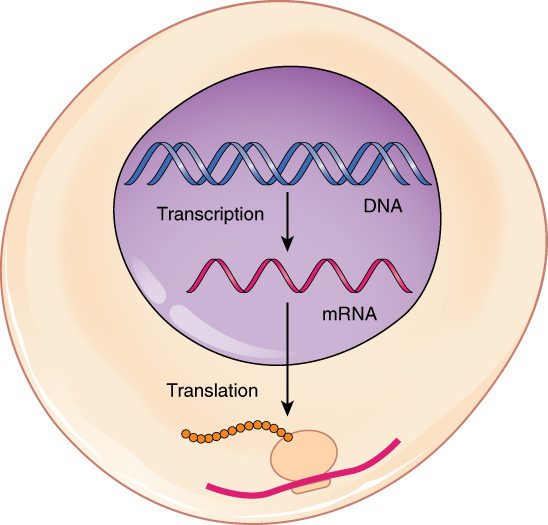
- Transcription factors bind DNA near a gene's promoter.RNA polymerase binds the promoter and transcribes the gene into RNA.
- The first RNA copy contains introns between its exons.The spliceosome removes the introns and joins the exons; a cap and tail are added, making finished mRNA.
- The finished mRNA passes through a nuclear pore into the cytoplasm.A ribosome binds it and starts at the AUG start codon.
- tRNAs whose anticodons match each codon bring their amino acids.The ribosome joins them by peptide bonds into a polypeptide, until a stop codon releases it.
- A signal sequence at the front of the chain docks the ribosome on the rough ER.The protein enters the ER, folds and gains sugars, then moves in vesicles to the Golgi apparatus.
- The Golgi apparatus sorts the protein into secretory vesicles.The vesicles fuse with the plasma membrane and release the protein by exocytosis.
6Core concepts
7A common mistake
The wrong idea: Each cell type has its own genes: liver cells have liver genes and skin cells have skin genes.
What actually happens: Almost every cell in your body carries the same genome. Cells differ in gene expression: each cell type carries its own mix of transcription factors, which switch on a different subset of genes. A skin cell still carries the genes for pancreas enzymes; it just never transcribes them.
8Check yourself
Anything you miss goes into your review queue.
1. The template strand of a gene reads 3′-TACGGC-5′. What mRNA does RNA polymerase make from it?
- 5′-ATGCCG-3′
- 5′-AUGCCG-3′
- 5′-UACGGC-3′
- 5′-TACGGC-3′
Show the answer
RNA polymerase pairs RNA nucleotides with the template: T→A, A→U, C→G, G→C. The mRNA is 5′-AUGCCG-3′, which begins with the start codon AUG.
- 5′-ATGCCG-3′: The pairing is right, but this uses T. RNA has no thymine; it places U opposite A.
- Correct: 5′-AUGCCG-3′: Correct. Complementary bases, with U opposite A and the ends running opposite to the template.
- 5′-UACGGC-3′: This copies the template's own bases, swapping T for U. The mRNA must be complementary to the template, not the same.
- 5′-TACGGC-3′: This repeats the template itself. An mRNA is built from complementary RNA bases.
2. An mRNA reads 5′-AUG UUU GGC UAA-3′. Using AUG = methionine (start), UUU = phenylalanine, GGC = glycine and UAA = stop, what does a ribosome make?
- Methionine–phenylalanine–glycine–stop
- Phenylalanine–glycine
- Methionine–phenylalanine–glycine
- Methionine alone
Show the answer
The ribosome starts at AUG, which adds methionine, then reads UUU (phenylalanine) and GGC (glycine). At UAA no tRNA fits, a release protein frees the chain, and no amino acid is added.
- Methionine–phenylalanine–glycine–stop: A stop codon is not an amino acid. It ends translation without adding anything.
- Phenylalanine–glycine: The start codon AUG also codes for methionine, so the chain begins with methionine.
- Correct: Methionine–phenylalanine–glycine: Correct. Three amino acids, then the chain is released at the stop codon.
- Methionine alone: AUG both starts translation and codes for methionine. The ribosome keeps reading until it reaches a stop codon.
3. Two mutations hit the same gene near its start. One deletes a single base. The other deletes three neighboring bases that make up one codon. Which comparison is most accurate?
- The single-base deletion shifts every later codon; the three-base deletion removes one amino acid
- Both shift every later codon, so both proteins are equally scrambled
- The three-base deletion shifts every later codon; the single-base deletion removes one amino acid
- Neither changes the protein: the code is redundant
Show the answer
The code is read in groups of three from the start codon. Losing one base shifts the reading frame, so every codon after it is misread. Losing a whole codon keeps the frame: the protein lacks one amino acid and the rest reads normally.
- Correct: The single-base deletion shifts every later codon; the three-base deletion removes one amino acid: Correct. One base lost is a frameshift; three bases lost is an in-frame deletion.
- Both shift every later codon, so both proteins are equally scrambled: Deleting a multiple of three bases leaves the reading frame intact, so only the three-base deletion keeps the rest of the protein normal.
- The three-base deletion shifts every later codon; the single-base deletion removes one amino acid: This reverses the two. It is the loss of one base, not three, that throws off the triplet reading.
- Neither changes the protein: the code is redundant: Redundancy lets some base substitutions go unnoticed. It cannot hide a lost base or a lost codon.
4. A 42-year-old man has lung damage and liver injury. Both copies of his alpha-1 antitrypsin gene carry the same missense mutation. Liver cells normally make this protein and secrete it into the blood. His liver cells transcribe and translate the gene at a normal rate. Where does most of his alpha-1 antitrypsin end up?
- Secreted into his blood at a normal level
- Trapped in the ER of his liver cells
- In the nucleus, stuck behind the nuclear pores
- Nowhere: the gene is no longer transcribed
Show the answer
The swapped amino acid makes the protein misfold in the ER. Misfolded protein is held back in the ER, where much of it clumps, so little moves on through the Golgi apparatus to be secreted. That explains both problems: low blood levels leave the lungs unprotected, and the trapped protein injures the liver cells.
- Secreted into his blood at a normal level: If it were secreted at a normal level, his lungs would be protected and his liver cells would not be injured. Very little reaches the blood.
- Correct: Trapped in the ER of his liver cells: Correct. The misfolded protein is held in the ER instead of continuing along the secretory pathway.
- In the nucleus, stuck behind the nuclear pores: The protein is made on ribosomes docked on the rough ER and enters the ER; it never goes into the nucleus. The mutation affects folding, not the pores.
- Nowhere: the gene is no longer transcribed: The stem says transcription and translation run normally. The problem arises after translation, when the protein folds.
5. Pancreas cells make large amounts of a digestive enzyme, while skin cells from the same person make none. What best explains the difference?
- The skin cells lost that gene long ago
- The skin cells carry a mutation in that gene
- Each cell type carries its own mix of transcription factors
- The pancreas cells carry many extra copies of the gene
Show the answer
Both cell types carry the same genome. Pancreas cells hold transcription factors that switch the enzyme's gene on, and skin cells do not, so only pancreas cells transcribe it.
- The skin cells lost that gene long ago: Your body cells keep the whole genome. The gene is present in skin cells but switched off.
- The skin cells carry a mutation in that gene: A mutation would affect the gene's sequence, not a whole cell type's pattern of use. The gene is normal in both.
- Correct: Each cell type carries its own mix of transcription factors: Correct. Different transcription factors switch on different sets of genes.
- The pancreas cells carry many extra copies of the gene: Both cell types carry the same number of copies. The difference is in how much the gene is transcribed.
6. Researchers remove the signal sequence from the gene of an enzyme that a cell normally secretes. Where does the enzyme now end up?
- Outside the cell, released as before
- In the cytosol
- In the plasma membrane
- In lysosomes
Show the answer
The signal sequence docks the ribosome on the rough ER. Without it, the ribosome stays free and releases the finished enzyme into the cytosol, so it never enters the secretory pathway.
- Outside the cell, released as before: Secretion requires entry into the ER, which depends on the signal sequence. Without it, the enzyme cannot reach exocytosis.
- Correct: In the cytosol: Correct. No signal sequence, no ER entry: the enzyme stays in the cytosol.
- In the plasma membrane: Membrane proteins also enter through the ER, which needs the signal sequence.
- In lysosomes: Lysosome proteins also pass through the ER and Golgi apparatus first, which needs the signal sequence.
7. Select every step that takes place inside the nucleus.
- Transcription
- Splicing out introns
- Translation
- Adding sugar chains in the Golgi apparatus
- Adding the cap and tail to the mRNA
Show the answer
Transcription, splicing and the addition of the cap and tail all happen in the nucleus. Only the finished mRNA leaves. Translation and the secretory pathway happen in the cytoplasm.
- Correct: Transcription: In the nucleus. The DNA template stays there.
- Correct: Splicing out introns: In the nucleus. The spliceosome works on the RNA before it leaves.
- Translation: Not in the nucleus. Ribosomes translate mRNA in the cytoplasm.
- Adding sugar chains in the Golgi apparatus: Not in the nucleus. The Golgi apparatus is in the cytoplasm.
- Correct: Adding the cap and tail to the mRNA: In the nucleus. The cap and tail are added before the mRNA exits through a pore.
9Summary
A gene is used in two steps. Transcription, in the nucleus, copies the gene into RNA: RNA polymerase binds the promoter, and the spliceosome then removes introns and joins exons to make mRNA. Translation, on ribosomes in the cytoplasm, reads the mRNA three bases at a time: each codon names one amino acid or a stop, and each amino-acid codon is matched by a tRNA anticodon. Proteins with a signal sequence enter the rough ER and follow the secretory pathway through the Golgi apparatus to exocytosis. Transcription factors decide which genes each cell expresses, so cells with the same genome make different proteomes. A mutation changes the DNA sequence; its effect depends on what it does to the codons.