Muscle energy and fatigue
1Why this matters
Jada, 17, runs the 400 meters. She flies through the first 200, but in the final stretch her legs burn and tighten, her stride shortens and two runners pass her. Her coach says she "ran out of gas". Her muscles still hold plenty of ATP. What changed is which systems were remaking it, and what those systems left behind in her fibers.
2What this builds on
3Quick check before you start
1. How many ATP does one glucose yield when it is split to lactate without oxygen?
- 2
- About 30–32
- 36–38
Show the answer
Glycolysis alone nets 2 ATP per glucose; turning pyruvate into lactate makes none but regenerates NAD+. Complete aerobic breakdown gives about 30–32.
- Correct: 2:
- About 30–32:
- 36–38:
2. In the cross-bridge cycle, what does a fresh ATP do when it binds a myosin head attached to actin?
- Makes the head release actin
- Releases calcium from the SR
- Pulls tropomyosin over actin
Show the answer
ATP binding lets the myosin head detach from actin; splitting it then re-cocks the head. Without ATP, heads stay attached, as in rigor mortis.
- Correct: Makes the head release actin:
- Releases calcium from the SR:
- Pulls tropomyosin over actin:
4Anatomy
With labels hidden, select a box to reveal its label.
5How it works, step by step
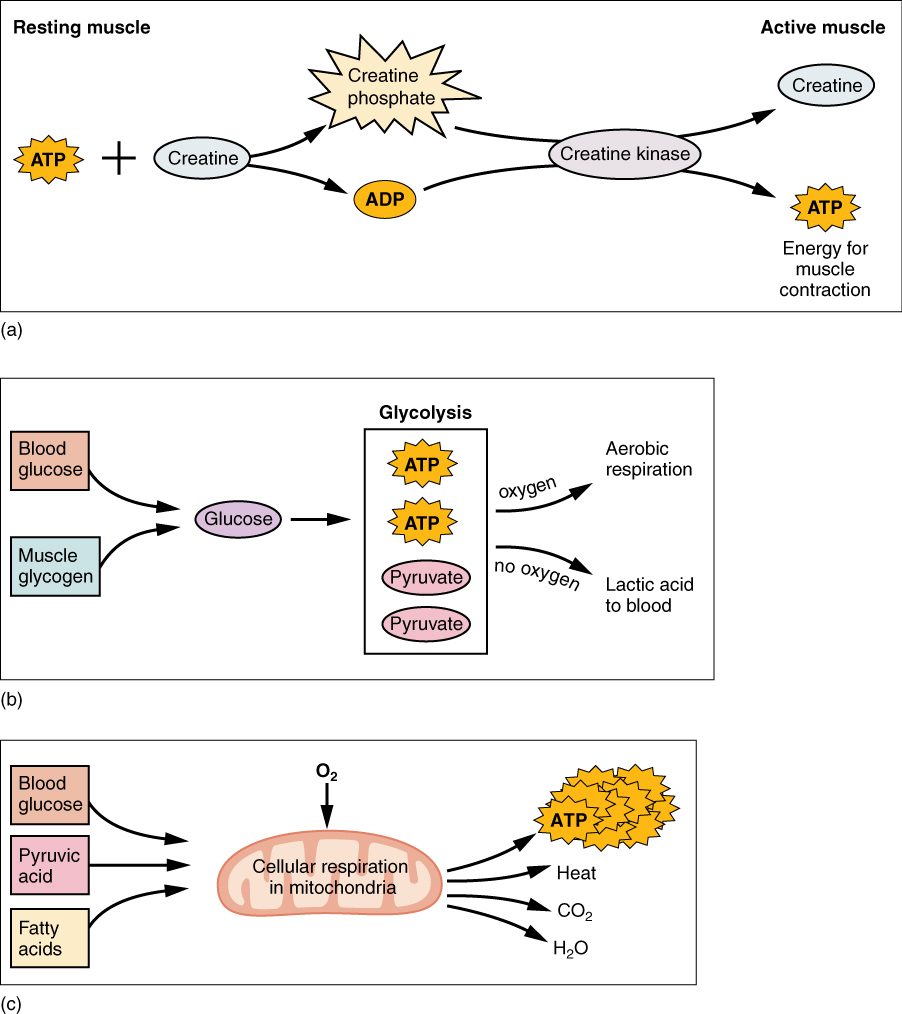
- A hard run starts, and cross-bridges and calcium pumps split ATP many times faster than at rest.ADP builds up, and creatine kinase moves phosphate from creatine phosphate onto it, keeping ATP nearly constant for the first seconds.
- Creatine phosphate falls, and ADP and phosphate rise.Glycolysis speeds up, breaking down muscle glycogen and making ATP fast, but only 2 per glucose.
- Glycolysis now makes pyruvate faster than the mitochondria can take it in.Pyruvate is turned into lactate, regenerating NAD+ so glycolysis keeps running; lactate leaves the fiber as fuel for other tissues.
- Phosphate from spent creatine phosphate and ATP accumulates in the fiber.Each cross-bridge pulls less hard and the SR releases less calcium, so force falls: muscle fatigue, while ATP stays near three quarters of its resting level.
- The run ends, but creatine phosphate, myoglobin oxygen and lactate are all away from their resting values.Oxygen use stays high for minutes (EPOC) while aerobic respiration rebuilds the stores and clears lactate.
6Core concepts
7A common mistake
The wrong idea: Lactic acid is a waste product that poisons tired muscles and causes the soreness you feel the next day.
What actually happens: Lactate is a fuel: heart muscle and other fibers burn it, and the liver makes glucose from it. It is cleared within about an hour. Fatigue during hard work comes largely from phosphate buildup and reduced calcium release, though researchers still debate the details, and next-day soreness from small injuries in the fibers, especially after eccentric work.
8Check yourself
Anything you miss goes into your review queue.
1. A sprinter explodes out of the blocks. During the first 5 seconds, where does most of the ATP his leg muscles spend come from?
- Aerobic respiration of fatty acids
- Anaerobic glycolysis of glucose from the blood
- Stored ATP and creatine phosphate
- Lactate taken up from the blood
Show the answer
Stored ATP and creatine phosphate are right beside the myosin heads, and creatine kinase remakes ATP in one step, so they supply most of the ATP in the first seconds of an all-out effort.
- Aerobic respiration of fatty acids: Aerobic respiration is the slowest system to deliver ATP; in the first seconds of a sprint it supplies only a small share.
- Anaerobic glycolysis of glucose from the blood: Glycolysis speeds up within seconds, but in the first 5 seconds creatine phosphate supplies more. And muscle glycolysis runs mainly on stored glycogen, not glucose from the blood.
- Correct: Stored ATP and creatine phosphate: Correct. Creatine phosphate dominates the first seconds.
- Lactate taken up from the blood: Lactate is a fuel for steadier work later. At the start of a sprint, muscle is making lactate, not using it.
2. A kilogram of muscle holds 5 mmol of ATP and 20 mmol of creatine phosphate, and during an all-out effort it spends 2.5 mmol of ATP per second. Ignoring glycolysis and aerobic respiration, how long could stored ATP plus creatine phosphate supply it?
- 2 seconds
- 8 seconds
- 10 seconds
- 62.5 seconds
Show the answer
Each creatine phosphate remakes one ATP, so the total available is 5 + 20 = 25 mmol. Time = 25 mmol ÷ 2.5 mmol per second = 10 seconds.
- 2 seconds: 2 seconds is how long the stored ATP alone would last (5 ÷ 2.5). Creatine phosphate adds much more.
- 8 seconds: 8 seconds counts only the creatine phosphate (20 ÷ 2.5) and leaves out the stored ATP.
- Correct: 10 seconds: Correct. (5 + 20) ÷ 2.5 = 10 seconds.
- 62.5 seconds: 62.5 comes from multiplying 25 by 2.5. Time is the amount divided by the rate.
3. A student runs 400 meters as fast as she can, which takes about a minute. Predict the change in each variable in her leg muscles at the end of the run, compared with rest.
| Variable | Change |
|---|---|
| Rate of glycolysis | — |
| Lactate production | — |
| Creatine phosphate | — |
| Muscle glycogen | — |
| ATP concentration in the fibers | — |
Show the answer
A one-minute all-out run spends creatine phosphate early and relies heavily on fast glycolysis, which burns glycogen and produces lactate. Aerobic respiration is climbing too. Through it all, ATP itself falls only modestly, because it is remade almost as fast as it is used.
- Rate of glycolysis: up. Rising ADP and phosphate and falling creatine phosphate speed up the glycolytic enzymes, which supply ATP fast.
- Lactate production: up. Glycolysis makes pyruvate faster than the mitochondria can take it in, so pyruvate is turned into lactate, regenerating NAD+.
- Creatine phosphate: down. Creatine phosphate is spent in the first seconds to remake ATP and is not rebuilt until she rests.
- Muscle glycogen: down. Glycolysis runs mainly on glycogen stored in the fibers, and it uses glucose wastefully, 2 ATP each.
- ATP concentration in the fibers: down. It falls only modestly, to roughly three quarters of its resting level, far less than creatine phosphate, because the energy systems remake ATP almost as fast as it is spent.
4. Thirty seconds into an all-out cycling sprint, which statement best describes the rider's leg muscles?
- Glycolysis has replaced creatine phosphate, which has switched off
- Aerobic respiration has taken over now that the start is over
- Creatine phosphate is still supplying nearly all the ATP
- All three run; glycolysis supplies the most
Show the answer
The energy systems overlap. At 30 seconds, creatine phosphate is largely spent, glycolysis supplies the largest share and aerobic respiration a growing one. No system switches off; only their shares change.
- Glycolysis has replaced creatine phosphate, which has switched off: Creatine kinase keeps working as long as some creatine phosphate remains, and aerobic respiration runs from the start too.
- Aerobic respiration has taken over now that the start is over: Aerobic respiration is rising, but at 30 seconds of an all-out effort it supplies well under half of the ATP.
- Creatine phosphate is still supplying nearly all the ATP: Stored ATP and creatine phosphate last only about 10 seconds of all-out work.
- Correct: All three run; glycolysis supplies the most: Correct. All three run; their shares shift over time.
5. Myoglobin binds oxygen more tightly than the oxygen carrier in red blood cells does. What is the effect of this in a muscle fiber?
- It pulls oxygen from the blood and keeps it until oxygen in the fiber falls very low
- It stops the mitochondria from ever running short of oxygen
- It makes the fiber less able to take up oxygen from the blood
- It lets the fiber make ATP without mitochondria
Show the answer
Because myoglobin binds oxygen more tightly, oxygen moves from the blood onto myoglobin, and myoglobin gives it up only when oxygen in the fiber drops low, as at the start of exercise or during a strong contraction. It is a small reserve and a shuttle toward the mitochondria.
- Correct: It pulls oxygen from the blood and keeps it until oxygen in the fiber falls very low: Correct. Tighter binding makes it a reserve released at low oxygen.
- It stops the mitochondria from ever running short of oxygen: The store is small, enough for seconds of hard work. Mitochondria can still run short of oxygen in sustained hard exercise.
- It makes the fiber less able to take up oxygen from the blood: Tighter binding does the opposite: it helps draw oxygen from the blood into the fiber.
- It lets the fiber make ATP without mitochondria: Myoglobin only holds oxygen. ATP made with oxygen is made in the mitochondria.
6. Two days after his first long downhill hike, Mr. Park's thigh muscles are sore and tender. A friend says it is lactic acid left in his muscles. What is the better explanation?
- Lactate has crystallized in the muscle fibers
- His muscles have run out of creatine phosphate
- Small fiber injuries from eccentric work
- Myoglobin has leaked out of his damaged muscle fibers
Show the answer
Blood lactate returns to resting levels within about an hour, so it cannot explain soreness two days later. Downhill walking is mostly eccentric work for the thigh muscles, which causes small injuries inside the fibers; the soreness comes from that damage and the repair that follows.
- Lactate has crystallized in the muscle fibers: Lactate dissolves and is cleared or burned within about an hour; it does not crystallize in muscle.
- His muscles have run out of creatine phosphate: Creatine phosphate is rebuilt within minutes of rest.
- Correct: Small fiber injuries from eccentric work: Correct. Delayed soreness comes from small muscle injuries, especially after eccentric work.
- Myoglobin has leaked out of his damaged muscle fibers: A small leak of muscle proteins can accompany the injury, but the soreness itself comes from the injury and repair, not from myoglobin.
7. During a series of hard, repeated contractions, which change inside the fibers is best supported as a major cause of the falling force?
- Lactate poisoning the myosin heads
- ATP falling to zero
- Inorganic phosphate building up
- Myoglobin running out of iron
Show the answer
Breaking down creatine phosphate and ATP releases inorganic phosphate. It weakens each cross-bridge's pull and reduces calcium release from the SR, and it is one of the best-supported causes of fatigue in hard, repeated contractions.
- Lactate poisoning the myosin heads: Lactate is a fuel, and adding it to rested muscle does not weaken it.
- ATP falling to zero: ATP stays near three quarters of its resting level even in severe fatigue.
- Correct: Inorganic phosphate building up: Correct. Phosphate buildup is a leading cause of peripheral fatigue.
- Myoglobin running out of iron: Myoglobin keeps its iron; it may give up its oxygen, but that does not destroy it.
9Summary
Muscle keeps ATP from falling far by remaking it almost as fast as it is spent. Creatine phosphate, through creatine kinase, remakes ATP in one step and covers about the first 10 seconds of all-out work. Anaerobic glycolysis, mainly from muscle glycogen, is fast but yields only 2 ATP per glucose and makes lactate when it outpaces the mitochondria; lactate is a fuel, not a waste. Aerobic respiration yields about 30–32 ATP per glucose, burns fatty acids and lactate too, and supplies nearly all ATP in activity longer than a few minutes. The systems overlap. Myoglobin stores and shuttles oxygen inside fibers. Muscle fatigue comes from reduced drive, phosphate buildup, less calcium release and, in long events, glycogen depletion, not from ATP running out. EPOC is the extra oxygen used after exercise to restore stores and pay the costs of recovery.