The pelvic girdle and lower limb
1Why this matters
Mrs. Alvarez, 82, trips on a rug and lands on her left side. She cannot stand, and her left foot is turned outward, the leg a little shorter than the right. Her family says she has "broken her hip", but the X-ray shows her pelvis is intact. The break is in the narrow neck of her thigh bone, the weakest point on the path her body weight takes to the ground.
2What this builds on
3Quick check before you start
1. What is a trochanter?
- A large, blunt bump found only on the femur
- A small hole for a nerve
- A smooth hollow that holds another bone
Show the answer
A trochanter is a very large, blunt bump; the femur is the only bone that has them. A small hole is a foramen, and a smooth hollow is a fossa.
- Correct: A large, blunt bump found only on the femur:
- A small hole for a nerve:
- A smooth hollow that holds another bone:
2. Which bone forms the back of the bony pelvis between the two hip bones?
- The fifth lumbar vertebra
- The sacrum
- The coccyx alone
Show the answer
The sacrum, five fused vertebrae, is wedged between the two hip bones at the back. The coccyx hangs below it, and L5 sits above it.
- The fifth lumbar vertebra:
- Correct: The sacrum:
- The coccyx alone:
3. How many phalanges are in one hand?
- 10
- 14
- 15
Show the answer
The thumb has 2 phalanges and each finger has 3, for 14. The foot follows the same pattern.
- 10:
- Correct: 14:
- 15:
4Anatomy
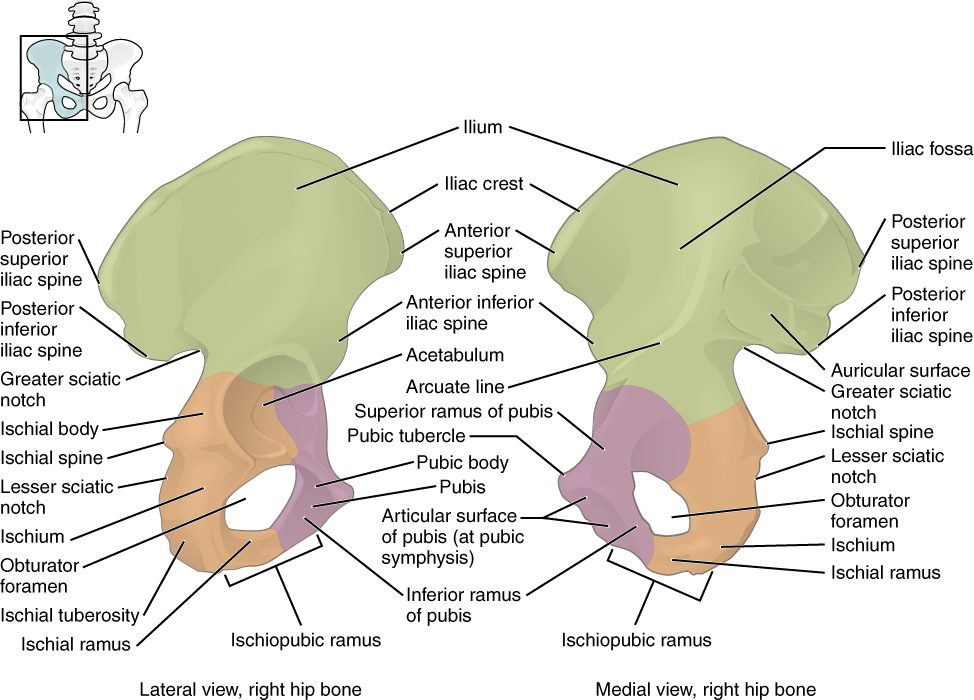
With labels hidden, select a box to reveal its label.
5How it works, step by step
- The weight of the trunk presses down on the wedge-shaped sacrum.The sacrum is driven down between the two hip bones, and the strong ligaments behind it tighten and lock it in place.
- The hip bones take the load from the sacrum.Thick bone of each ilium carries it around to the acetabulum.
- The acetabulum presses down on the head of the femur.The load travels through the angled femoral neck into the shaft, bending the neck, which is the femur's weak point.
- The femoral condyles rest on the condyles of the tibia.The tibia carries almost all of the load down the leg to the talus.
- The talus passes the load to the calcaneus behind and along the arches in front.Body weight is spread between the heel and the ball of the foot.
6Core concepts
7A common mistake
The wrong idea: A "broken hip" is a break in the hip bone of the pelvis.
What actually happens: In older adults, a "broken hip" almost always means a break at the top of the femur: through the femoral neck or between the greater and lesser trochanters. The hip bone itself can break too, but that injury is usually called a pelvic fracture. The femoral neck breaks so often because it is narrow, it carries body weight at an angle, and in osteoporosis its spongy bone thins.
8Check yourself
Anything you miss goes into your review queue.
1. Name the pinned socket on the hip bone.
- Obturator foramen
- Iliac fossa
- Greater sciatic notch
- Acetabulum
Show the answer
The acetabulum is the deep cup-shaped socket on the outer side of the hip bone, where the ilium, ischium and pubis meet. The head of the femur fits into it.
- Obturator foramen: The obturator foramen is the large hole below the socket, not the socket itself.
- Iliac fossa: The iliac fossa is the broad shallow hollow on the inner surface of the ilium.
- Greater sciatic notch: The greater sciatic notch is a deep notch on the back edge of the hip bone.
- Correct: Acetabulum: Correct. The deep socket is the acetabulum.
2. Name the pinned bump on the femur.
- Lesser trochanter
- Head of the femur
- Greater trochanter
- Lateral epicondyle
Show the answer
The greater trochanter is the large bump on the lateral side where the neck of the femur meets the shaft. It is the bony point you feel on the side of your hip.
- Lesser trochanter: The lesser trochanter is the smaller bump lower down on the back and inner side.
- Head of the femur: The head is the smooth ball that fits into the acetabulum.
- Correct: Greater trochanter: Correct. The large lateral bump at the top of the shaft is the greater trochanter.
- Lateral epicondyle: The lateral epicondyle is at the knee end of the femur.
3. Name the pinned bone of the foot.
- Talus
- Cuboid
- Navicular
- Calcaneus
Show the answer
The calcaneus is the heel bone, the largest tarsal, lying below the talus. The thick tendon of the calf muscles anchors to its back.
- Talus: The talus sits on top of the calcaneus and meets the tibia.
- Cuboid: The cuboid is in front of the calcaneus, on the outer side of the foot.
- Navicular: The navicular is in front of the talus, on the inner side of the foot.
- Correct: Calcaneus: Correct. The heel bone is the calcaneus.
4. A forensic team examines an adult pelvis. It is light, the lesser pelvis is shallow, the pelvic inlet is wide and round, and the subpubic angle is about 95 degrees. What is the most likely sex?
- Male
- Female
- It cannot be judged from the pelvis
Show the answer
A light build, a shallow lesser pelvis, a round inlet and a subpubic angle near 90 degrees or more are all features of the average female pelvis. The male pelvis is heavier and deeper, with a heart-shaped inlet and a subpubic angle of about 50 to 60 degrees.
- Male: A male pelvis is usually heavier and deeper, with a heart-shaped inlet and a narrow subpubic angle of about 50 to 60 degrees.
- Correct: Female: Correct. These features together point to a female pelvis.
- It cannot be judged from the pelvis: Individual pelves overlap, but the pelvis is one of the most reliable parts of the skeleton for judging sex, especially when several features agree, as they do here.
5. An 84-year-old man slips and lands on the side of his hip. He cannot stand, and his injured leg looks shorter and turned outward. An X-ray shows a break between the head of the femur and the greater trochanter. What part of the femur is broken?
- The linea aspera
- The femoral neck
- The lateral condyle
- The lesser trochanter alone
Show the answer
The femoral neck joins the head to the shaft at an angle, and it is the femur's weak point. In older adults a fall on the side of the hip often breaks it; this is what most people call a broken hip.
- The linea aspera: The linea aspera runs down the back of the shaft, below the trochanters.
- Correct: The femoral neck: Correct. The break is through the femoral neck.
- The lateral condyle: The lateral condyle is at the knee end of the femur.
- The lesser trochanter alone: The lesser trochanter is below the neck, and a break of it alone would not fit a break between the head and the greater trochanter.
6. Order the structures that carry the weight of the trunk down to the foot when you stand on one leg.
- Sacrum
- Ilium
- Acetabulum
- Head of the femur
- Tibia
- Talus
Show the answer
The trunk's weight passes from the sacrum into the ilium, around to the acetabulum, into the head of the femur, down the femur to the tibia, and from the tibia to the talus, which spreads it to the rest of the foot.
- Correct order: 1. Sacrum 2. Ilium 3. Acetabulum 4. Head of the femur 5. Tibia 6. Talus
7. A student described the tarsal bones. One statement is wrong. Which one?
- The talus is the tarsal that meets the tibia
- The calcaneus is the heel bone
- The cuboid lies on the inner side of the foot
- The cuneiforms lie in front of the navicular
Show the answer
The cuboid lies on the outer (lateral) side of the foot, in front of the calcaneus. The navicular is the tarsal on the inner side, in front of the talus.
- The talus is the tarsal that meets the tibia: This statement is right. The tibia rests only on the talus.
- The calcaneus is the heel bone: This statement is right. The calcaneus is the heel bone.
- Correct: The cuboid lies on the inner side of the foot: This is the error. The cuboid is on the outer side of the foot.
- The cuneiforms lie in front of the navicular: This statement is right. The three cuneiforms sit in a row in front of the navicular.
9Summary
The pelvic girdle is two hip bones, each made of the ilium, ischium and pubis fused at the acetabulum. With the sacrum and coccyx they form the bony pelvis; the pelvic brim divides the greater pelvis from the lesser pelvis, and the average female pelvis is wider and shallower, with a round inlet and a wide subpubic angle. The femur has a head, neck, two trochanters, the linea aspera and two condyles; the patella is a sesamoid bone at the knee. The tibia is medial and bears the weight, and the fibula is lateral and thin; their malleoli grip the talus. The foot has 7 tarsals, 5 metatarsals and 14 phalanges arranged in arches held in part by the plantar aponeurosis.