Fertilization
1Why this matters
Priya and her husband have been trying to conceive for two years. His semen analysis shows plenty of sperm that swim well, but under the microscope their heads are round and smooth: they have no acrosome. At their fertility clinic, sperm placed around her oocytes never get in. When an embryologist injects a single sperm straight into each oocyte, three of them start dividing. To see why the injection worked when swimming could not, you need the steps a sperm has to pass through to fertilize an oocyte.
2What this builds on
3Quick check before you start
1. A human oocyte has 23 chromosomes and a sperm has 23. What are the two gametes called, and what will the cell they form be?
- Both haploid; the new cell will be diploid
- Both diploid; the new cell will be haploid
- Both diploid; the new cell will have 92 chromosomes
Show the answer
Gametes are haploid: one set of 23 chromosomes. Two haploid gametes together restore the diploid number, 46.
- Correct: Both haploid; the new cell will be diploid:
- Both diploid; the new cell will be haploid:
- Both diploid; the new cell will have 92 chromosomes:
2. What is the acrosome of a sperm?
- The mitochondria-packed midpiece that powers the tail
- A cap-like sac of digestive enzymes over the front of the nucleus
- The protein coat that holds the sperm's DNA tightly
Show the answer
The acrosome is a sac of digestive enzymes, made from the Golgi apparatus, that sits over the front of the sperm's head.
- The mitochondria-packed midpiece that powers the tail:
- Correct: A cap-like sac of digestive enzymes over the front of the nucleus:
- The protein coat that holds the sperm's DNA tightly:
3. At what stage is the oocyte paused when it is released at ovulation?
- Prophase I, as a primary oocyte
- Metaphase II, as a secondary oocyte
- Finished meiosis, as a mature ovum
Show the answer
Just before ovulation the primary oocyte finishes meiosis I. The secondary oocyte then starts meiosis II and pauses at metaphase II; it finishes only if a sperm enters.
- Prophase I, as a primary oocyte:
- Correct: Metaphase II, as a secondary oocyte:
- Finished meiosis, as a mature ovum:
4Anatomy
With labels hidden, select a box to reveal its label.
5How it works, step by step
- Sperm spend several hours in the fluids of the uterus and uterine tube, which strip cholesterol from their membranes and let calcium and bicarbonate in.The sperm capacitate: their tails switch to hyperactivated beating and their acrosomes become ready to release enzymes.
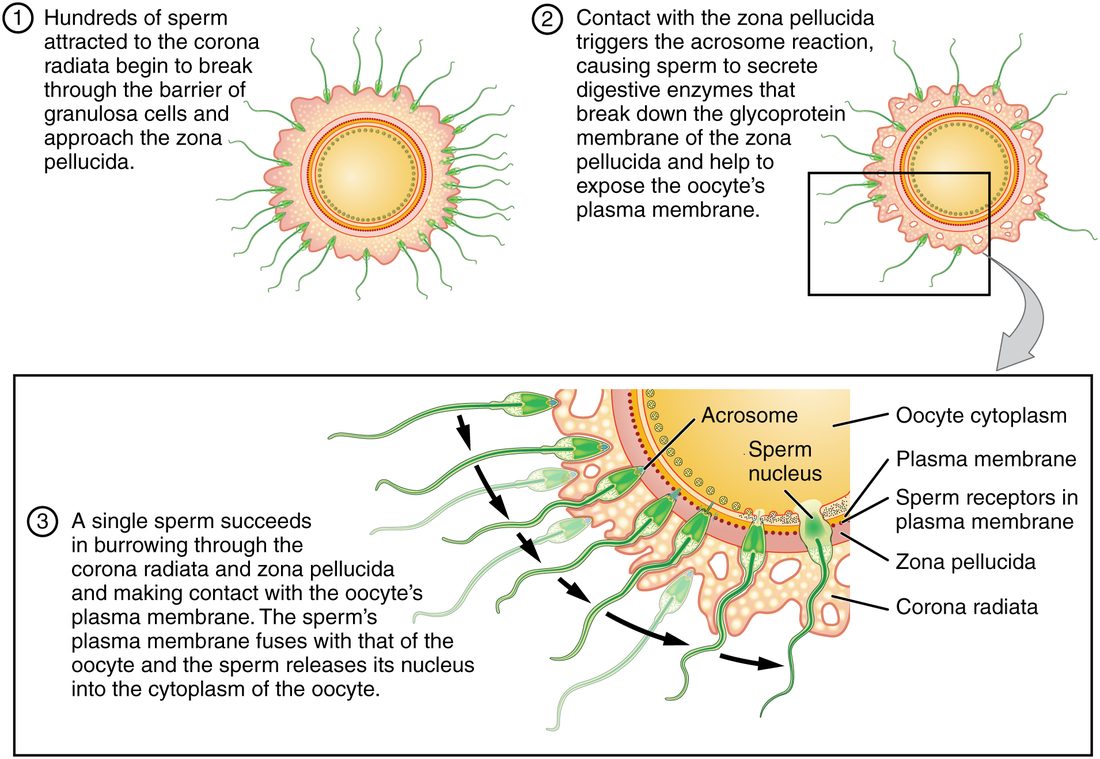
- Capacitated sperm reach the oocyte in the ampulla and push through the corona radiata, helped by hyaluronidase on their heads.Calcium rises in the sperm head and the acrosomal reaction releases acrosin and other enzymes.
- The released enzymes and the sperm's forceful beating cut a tunnel through the zona pellucida.One sperm reaches the oocyte's plasma membrane, binds it and fuses with it, and its nucleus enters.
- An enzyme carried in by the sperm sets off waves of calcium release inside the oocyte.Cortical granules release their contents, which alter the zona pellucida so no other sperm can bind: the block to polyspermy.
- The same calcium waves release the oocyte from its pause at metaphase II.Meiosis II finishes with a second polar body, two haploid pronuclei form and copy their DNA, and their chromosomes combine into the diploid zygote.
6Core concepts
7A common mistake
The wrong idea: The first sperm to reach the oocyte is the one that fertilizes it.
What actually happens: The first sperm to arrive, some within minutes of intercourse, have not yet capacitated, and an uncapacitated sperm cannot fertilize. Fertilization needs a sperm that has spent hours in the female tract and is ready at the moment it meets the oocyte. The fertilizing sperm is more likely one that was held in the tube's reservoir and released later. Speed matters far less than timing.
8Check yourself
Anything you miss goes into your review queue.
1. A lab technician mixes freshly collected sperm with an oocyte in plain salt solution. The sperm swim vigorously for hours, but none gets through the zona pellucida. The same sperm succeed after a few hours in a medium containing albumin, bicarbonate and calcium. What did the second medium allow?
- Capacitation
- The cortical reaction
- Completion of meiosis II in the sperm
- Formation of the acrosome
Show the answer
Albumin pulls cholesterol from the sperm membrane, and bicarbonate and calcium enter the sperm. These are the changes of capacitation, which makes the sperm able to undergo the acrosomal reaction and fertilize. Swimming alone is not enough.
- Correct: Capacitation: Correct. The medium copies the female tract fluids that capacitate sperm.
- The cortical reaction: The cortical reaction happens in the oocyte after one sperm has fused with it. It blocks further sperm; it does not help any sperm get in.
- Completion of meiosis II in the sperm: Sperm finish both meiotic divisions in the testis, long before ejaculation. It is the oocyte that finishes meiosis II at fertilization.
- Formation of the acrosome: The acrosome forms during spermiogenesis in the testis. These sperm already had one; what they lacked was the ability to use it.
2. Put the steps of fertilization in order, starting when sperm reach the uterine tube.
- Sperm capacitate over several hours
- Capacitated sperm push through the corona radiata
- The acrosomal reaction releases enzymes that digest a path through the zona pellucida
- One sperm fuses with the oocyte's plasma membrane
- Calcium waves trigger the cortical reaction
- The oocyte completes meiosis II, and the chromosomes of the two pronuclei combine into the zygote
Show the answer
Sperm must capacitate before they can fertilize. They then cross the outer layer, the corona radiata, and release their acrosomal enzymes to cross the inner layer, the zona pellucida. Fusion of one sperm starts calcium waves in the oocyte, which trigger the cortical reaction and restart meiosis II. Finally the two haploid pronuclei combine their chromosomes into the diploid zygote.
- Correct order: 1. Sperm capacitate over several hours 2. Capacitated sperm push through the corona radiata 3. The acrosomal reaction releases enzymes that digest a path through the zona pellucida 4. One sperm fuses with the oocyte's plasma membrane 5. Calcium waves trigger the cortical reaction 6. The oocyte completes meiosis II, and the chromosomes of the two pronuclei combine into the zygote
3. In a lab experiment, a drug stops cortical granules from fusing with the oocyte's plasma membrane but has no other effect. A sperm fuses with the oocyte. Predict each variable compared with an untreated oocyte.
| Variable | Change |
|---|---|
| Calcium waves in the oocyte after fusion | — |
| Cutting of ZP2 in the zona pellucida | — |
| Number of sperm able to bind the zona after the first sperm enters | — |
| Chance of polyspermy | — |
| Completion of meiosis II | — |
Show the answer
Calcium waves drive two separate outcomes: cortical granule exocytosis and the restart of meiosis II. Blocking only the granules removes the zona block to polyspermy, so more sperm can bind and polyspermy becomes more likely, while meiosis II still finishes.
- Calcium waves in the oocyte after fusion: no change. The calcium waves are set off by the enzyme the sperm delivers. The drug acts on granule fusion, which comes after the calcium rise.
- Cutting of ZP2 in the zona pellucida: down. The enzyme that cuts ZP2 is released from the cortical granules. If they cannot fuse, it stays inside them.
- Number of sperm able to bind the zona after the first sperm enters: up. With ZP2 uncut, the zona still offers binding sites, so more sperm keep attaching.
- Chance of polyspermy: up. The zona block is lost, and only the slower membrane block remains, so a second sperm is more likely to get in.
- Completion of meiosis II: no change. Meiosis II is restarted by the calcium waves, not by the cortical granules, so it still finishes.
4. A couple has intercourse once, on day 11 of a 28-day cycle, and the woman ovulates on day 14. She becomes pregnant. Which statement best explains how?
- The oocyte waited in the uterine tube from day 11 until the sperm reached it there
- Some sperm survived in her tract for three days and fertilized the oocyte after ovulation
- Fertilization happened on day 11, and the zygote then paused in the tube until day 14
- Sperm entered the ovary and fertilized the oocyte inside its follicle
Show the answer
Sperm stored in the cervical crypts and the tube's isthmus can survive up to about five days and are released a few at a time. Some were still available when the oocyte arrived after ovulation on day 14.
- The oocyte waited in the uterine tube from day 11 until the sperm reached it there: There was no oocyte on day 11; ovulation happened on day 14. Once released, an oocyte lives only 12 to 24 hours.
- Correct: Some sperm survived in her tract for three days and fertilized the oocyte after ovulation: Correct. Sperm survival of up to about five days is what makes the fertile window about six days long.
- Fertilization happened on day 11, and the zygote then paused in the tube until day 14: Fertilization needs an ovulated secondary oocyte. None existed until day 14.
- Sperm entered the ovary and fertilized the oocyte inside its follicle: Sperm do not enter the ovary. Fertilization happens in the ampulla of the uterine tube after the oocyte is released.
5. A student wrote out the events that follow sperm entry. One step is wrong. Which one?
- The sperm delivers an enzyme that starts calcium waves in the oocyte
- Cortical granules release their contents under the zona pellucida
- The oocyte, released from its pause, completes meiosis I
- A second polar body is pinched off
- Two haploid pronuclei form and copy their DNA
Show the answer
The ovulated oocyte already finished meiosis I just before ovulation and is paused at metaphase II. Sperm entry releases that pause, so it completes meiosis II.
- The sperm delivers an enzyme that starts calcium waves in the oocyte: This step is right. The sperm's enzyme triggers repeated calcium release from the oocyte's endoplasmic reticulum.
- Cortical granules release their contents under the zona pellucida: This step is right. That is the cortical reaction, the zona block to polyspermy.
- Correct: The oocyte, released from its pause, completes meiosis I: This is the error. Meiosis I finished before ovulation; the oocyte completes meiosis II after sperm entry.
- A second polar body is pinched off: This step is right. Meiosis II is lopsided, and the discarded set of chromosomes leaves in the second polar body.
- Two haploid pronuclei form and copy their DNA: This step is right. Each pronucleus holds one set of chromosomes and copies its DNA before the first mitotic division.
6. A man's semen has normal numbers of sperm that swim well, but every sperm has a round head with no acrosome. In the lab, his sperm reach the zona pellucida of donor oocytes but never get through. Which approach can bypass the problem?
- Giving him testosterone to make more sperm
- Placing many more of his sperm around each oocyte
- Injecting one sperm directly into each oocyte
- Adding extra albumin and calcium to capacitate his sperm
Show the answer
Without an acrosome, a sperm has no enzymes to digest a path through the zona pellucida, however many try or however well they are capacitated. Injecting a sperm into the cytoplasm skips the zona entirely. Round-headed sperm often carry too little of the enzyme that activates the oocyte, so clinics may also add a treatment that raises calcium in the oocyte after the injection.
- Giving him testosterone to make more sperm: Sperm numbers are already normal. More sperm without acrosomes would fail in the same way.
- Placing many more of his sperm around each oocyte: Every one of his sperm lacks an acrosome, so more of them adds no enzymes. Numbers are not the problem.
- Correct: Injecting one sperm directly into each oocyte: Correct. Intracytoplasmic injection skips the zona, the step these sperm cannot pass.
- Adding extra albumin and calcium to capacitate his sperm: Capacitation readies a sperm to release its acrosome's enzymes. A sperm with no acrosome has nothing to release.
7. An early pregnancy loss is examined, and its cells contain 69 chromosomes: two paternal sets and one maternal set. Which failure best explains this?
- Nondisjunction of one chromosome pair during the father's meiosis
- The oocyte skipped meiosis I
- The zygote copied all of its DNA twice before it first divided
- Two sperm entered the oocyte: the block to polyspermy failed
Show the answer
Two whole paternal sets plus one maternal set means two sperm delivered their nuclei into one oocyte. That is polyspermy, which the cortical reaction and the membrane block normally prevent.
- Nondisjunction of one chromosome pair during the father's meiosis: Nondisjunction of one pair adds or removes a single chromosome, giving 45 or 47, not a whole extra set of 23.
- The oocyte skipped meiosis I: If the oocyte skipped meiosis I, the extra set would be maternal, not paternal.
- The zygote copied all of its DNA twice before it first divided: Copying DNA twice would double every set equally, maternal and paternal alike, giving 92 chromosomes.
- Correct: Two sperm entered the oocyte: the block to polyspermy failed: Correct. Two sperm, each with 23 chromosomes, plus the oocyte's 23 gives 69.
9Summary
Fertilization normally happens in the ampulla of the uterine tube. The oocyte lives 12 to 24 hours after ovulation and sperm up to about five days, so the fertile window is about six days. Sperm must capacitate for several hours in the female tract, losing membrane cholesterol, taking in calcium and switching to hyperactivated motility. They pass the corona radiata, and the acrosomal reaction releases enzymes that cut through the zona pellucida. One sperm fuses with the oocyte and triggers calcium waves. These cause the cortical reaction, which changes the zona so no other sperm can bind (the block to polyspermy), and they restart meiosis II, which ends with a second polar body. The two pronuclei combine their chromosomes to form the diploid zygote, whose genetic sex is set by the sperm's X or Y.